
“It’s Doctrinal Ambiguity, Not Firmness, That Drives Young People Away”

From Warsaw, the archbishop’s homily offers a message for the whole Church: doctrinal ambiguity, lack of appeal, and inconsistency drive young people away.
It helps explain why faith remains so vibrant in Poland.
We were alerted to an address by the Archbishop of Warsaw, Archbishop Adrian Galbas, to catechists ahead of the new school and catechetical year.
It is a message worth hearing for anyone who cares about the future of the Church.
Stay up to date by subscribing to our new channels:


Young People and Doctrinal Ambiguity
On August 29, priests, religious and lay catechists gathered at the Temple of Divine Providence in Warsaw ahead of the new school year. Mass followed a meeting on the planning of the catechetical program.
During the homily, Archbishop Galbas, appointed by Pope Francis in 2024 to lead the Archdiocese of Warsaw, began by reflecting on St. John the Baptist, whose martyrdom was commemorated in the liturgy that day.
The archbishop presented him as a man who was not afraid to say openly to Herod what others merely whispered: “It is not lawful for you.”
He then applied this example to catechists: “If today young people are drifting away from the Church,” the Polish prelate said, “it is also because her teaching is presented by some in a way that is so unclear that it becomes like soapy water, like mixed-up jelly, and does not differ at all from what is offered at the other stalls of the world.”
This sentence contains a truth for which millions of Catholics are deeply thirsty, disappointed and embittered by pastors because they see in them little more than efforts to water down moral doctrine in order to appear more attractive.
What emerges so often from Sunday homilies, seminars and catechetical programs is therefore a watered-down teaching, contradictory and unable to show any meaningful difference from the social and civic values already offered by the rest of the world.
Leo XIV showed that he is fully aware of this when, just a few months ago, he reminded Catholics that “it is certainly not by watering down the content and softening the demands that Christianity can be made attractive.”

Joy, Credibility and Consistency: The Only Ways to Pass on the Faith
(28/05/2026)
“What Good Is a Church Like This?”
The Archbishop of Warsaw also shows that he understands the pastoral approach of “anything goes.”
This is what leads some people to say, “At last the Church has understood, at last it has adapted, at last it is likable.”
Archbishop Galbas responds with a question: “We would then have a likable Church, likable people, a likable 21st century. There is just one question: what good is a Church like this?”
Instead, he continued, “The Church—as John did—must point to Christ, not only with words, but also through fidelity to principles. Fidelity to the Gospel. Therefore, it must clearly say that not everything is permissible.”
He then cited concrete examples of issues on which the world is heading in the opposite direction: the protection of human life, respect for marriage and natural parenthood, sexual morality and identity, education, and the understanding of freedom.
Less Talk, More Witness
The most significant part, however, came when Archbishop Adrian Galbas added a fundamental clarification.
Doctrine itself is not enough, nor is it enough to repeat words that are clear and consistent. What is needed above all is personal witness.
The prelate recalled Pope Francis’ answer when asked what a bishop should do to be a good bishop: “Your only instrument is witness.”
Archbishop Galbas observed that the most effective witness is given through one’s daily life, appropriately balancing justice and mercy.
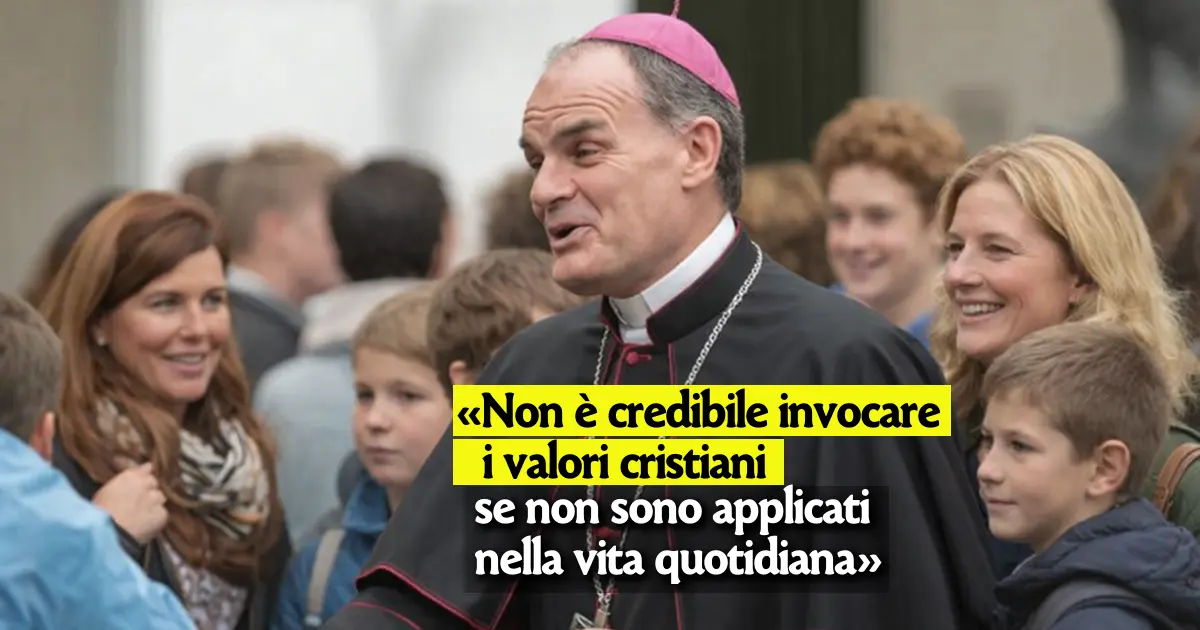
Bishop Ivo Muser Warns Against “Occasional Christianity”
(22/04/2026)
Without Consistency, Everything Falls Apart
The final part of the homily focused on moral consistency.
“Every evil committed by people within the Church makes her authority weaker and less effective,” the archbishop said.
Doctrinal firmness and authentic witness rooted in the life of the community—living among the people, with the “smell of the sheep”—are important. But if example and consistency are missing, everything falls apart.
In one sentence, Archbishop Galbas summed up the most damaging objection to credibility: “You cannot tell us what we must not do if you yourselves often do worse things than those you tell us we should not do.”
A Message for Everyone
A homily in Poland has therefore offered guidance useful to the entire Church, from religious to ordinary lay faithful.
There is little point in complaining: if young people are drifting away—especially after Confirmation—it is also because the truth is either abandoned or no longer lived consistently.
The result is that the Church stops having something decisive to communicate to them, and they will prefer to learn those same things from the various stalls of the world.
Author








0 commenti a “It’s Doctrinal Ambiguity, Not Firmness, That Drives Young People Away”