
Ratzinger’s Resignation: Vatican Inquiry Is Merely a Routine Procedure
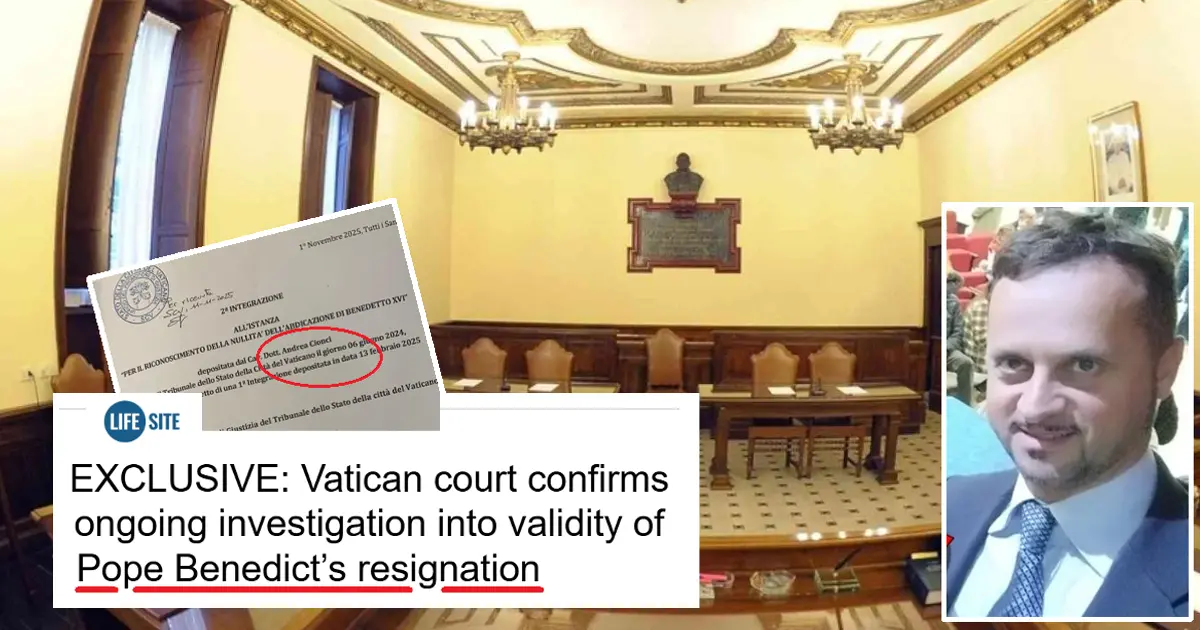
The Promoter of Justice confirms a case file on Andrea Cionci’s petition regarding the resignation of Benedict XVI. A routine step is being framed as a turning point.
The Vatican tribunal confirms the existence of a file concerning the validity of the resignation of Benedict XVI.
The news, circulated by an American outlet, has been welcomed by some as an epochal turning point. In reality, it is something far more ordinary, predictable, and routine.
Cionci and the petition in the Vatican
It all began with a petition submitted on June 6, 2024, by the Italian tenor and art critic Andrea Cionci to the Vatican Tribunal.
The document—drafted with the support of attorney Roberto Tieghi—was accompanied by numerous signatures and requested verification of the validity of Benedict XVI’s resignation.
The origin of the complaint lies in the bizarre theory that the author of the petition has been promoting continuously for about seven years, namely that Pope Francis is an illegitimate antipope because Benedict XVI allegedly only pretended to renounce the papacy.
Perhaps inspired by the famous fairy tale “Tom Thumb”, Pope Ratzinger allegedly scattered throughout his speeches and documents a kind of enigmatic “secret code” to communicate this message to anyone clever enough to decipher it. That is, no one—except Cionci himself.
The result is a fanciful religious psycho-thriller built on attributing intentions to Benedict XVI, in which every statement is surgically dissected and twisted into a clue, every syllable magically becomes evidence, and every denial turns into further confirmation.
An unassailable system: if something does not add up, it is because the “code” is even deeper.
The Vatican, the file, and the spin
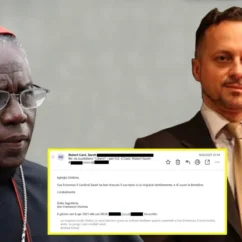
John-Henry Westen, director of “LifeSiteNews” and ghostwriter for the excommunicated former nuncio Carlo Maria Viganò, reported yesterday that the Office of the Promoter of Justice of the Vatican has formally confirmed the existence of a file regarding Cionci’s petition.
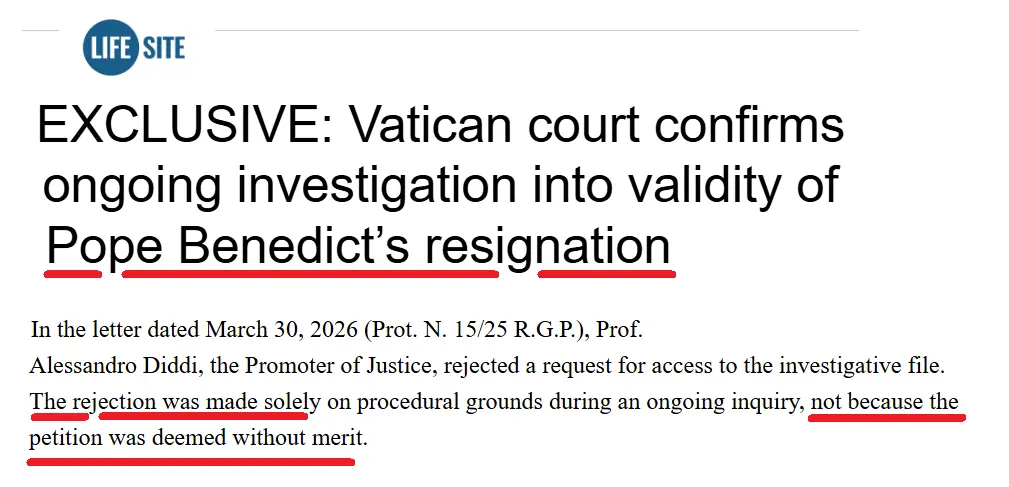
In a letter dated March 30, 2026, the Promoter of Justice Alessandro Diddi rejected attorney Tieghi’s request (dated March 26) for access to the documents, stating that «the Office is conducting investigations and it is not, at present, possible to foresee when they will be concluded».
Westen commented that «the rejection was made solely for procedural reasons within the framework of an ongoing investigation, not because the petition was considered unfounded».
A routine act: judicial practice
Westen’s words reveal a misleading attempt to portray the mere opening of a file as recognition by the Vatican of the strength and validity of Cionci’s petition.
Yet even the most basic principles of criminal procedure show that denying access to documents is not a favorable act for the applicant’s claims, but rather what normally occurs in any preliminary investigation: as long as the file is in the investigative phase, access is restricted.
The fact that the Promoter of Justice states that he is “conducting investigations” does not in any way imply that the hypothesis is well-founded or worthy of substantive examination.
It simply means that the complaint has been formally received as a mandatory step, and that it is being assessed to determine whether there are minimal grounds to proceed further.
The competent authority is required to register and open a file when a formal complaint is submitted, especially if supported by a significant number of signatures. This is standard procedure, even in the Vatican.
The document is handled by the Promoter of Justice—the equivalent of a public prosecutor—whose task is to evaluate its content, carry out inquiries through questioning (as happened with Cionci himself), and determine whether sufficient elements exist to proceed.
In the vast majority of cases, especially when complaints are based on imaginative interpretations or theses already discredited in theological and canonical scholarship, the outcome is dismissal due to manifest lack of foundation.
This is standard practice and it is what will happen with the investigation in question.
Stay updated by subscribing to our new channels:


No doubts about Ratzinger’s resignation
Moreover, no recognized scholar of canon law doubts that “Declaratio” of Benedict XVI meets the legal requirements, particularly the freedom of the act and its proper manifestation.
Even the public statements of the Pope Emeritus himself, up until his death in 2022, confirmed his intention to renounce the Petrine ministry and to recognize his successor as valid.
This tedious controversy over the alleged invalidity of his resignation emerged belatedly as an attack on the pontificate of Pope Francis, exploiting Ratzinger’s unprecedented gesture as a tool to delegitimize Bergoglio.
To canon lawyers who, by professional duty, examined its contents, it appeared less a serious investigation than a poorly told joke, earning it hardly academic judgments (to put it mildly).
-
Geraldina Boni, full professor of ecclesiastical and canon law at the University of Bologna, dismissed it as «canonical improvisation» supported by «entirely far-fetched considerations» and by the «visibly inconsistent level of credibility of the claims put forward».
-
Fr. Silvio Barbaglia, theologian and lecturer at the Higher Institute of Religious Sciences in Novara, demonstrated that the assumptions underlying the thesis are «all groundless and consequently the sensationalist thesis collapses on its own fragile foundations».
-
Rosario Priore, founder of “Vox Canonica” and PhD candidate in Canon Law, observed on UCCR that it is a thesis «absolutely fantastical and meaningless», «the product of distorted ideas» and lacking even the «slightest theological and/or legal foundation».
-
Finally, Ratzinger’s beloved personal secretary, Msgr. Georg Ganswein, described it as a «personal speculation in the style of Dan Brown»1G. Ganswein, “Nothing but the Truth. My Life Beside Benedict XVI”, Piemme 2023, p. 218.
Conspiracism and modus operandi
Of course, there is freedom of inquiry on any issue, from chemtrails to flat-earth theories—even to a grand conspiracy allegedly orchestrated by Pope Benedict XVI.
What remains is that the opening of a file following a formal complaint only demonstrates that justice in the Vatican operates no differently from other legal systems.
Interpreting this technical step as proof that the Vatican has validated the merits of the petition, as “LifeSiteNews” does, is a deliberate confusion between the procedural and substantive levels.
After all, the tendency to twist every event to one’s own advantage is the typical modus operandi of conspiracism, a narrative framework to which—at least according to canon lawyers—the petition submitted to the Vatican belongs.
Author












1 commenti a Ratzinger’s Resignation: Vatican Inquiry Is Merely a Routine Procedure
[…] is no longer any room for trials of intention, “Ratzinger codes” and appeals in the Vatican to verify the […]