
Rhode Island Diocese Abuse Report: Seven Years for Nothing
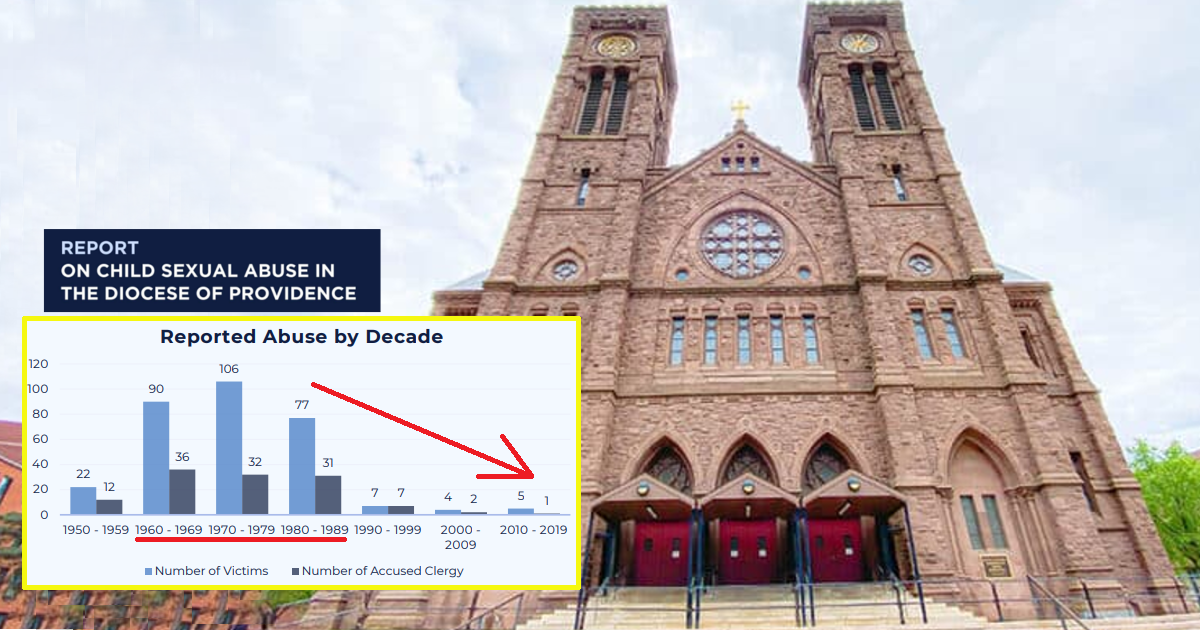
Despite the media hype, the Report on abuse in the Diocese of Providence (Rhode Island) uncovered only old allegations and no priests currently under investigation.
A full 284 pages and 7 years of investigations, yet nobody is talking about it.
The Attorney General of Rhode Island (United States) cannot be very pleased after drawing the conclusions of a report that the Boston Globe had previously described as explosive.
The Rhode Island report
Attorney General Peter Neronha had hoped to replicate the media success achieved in 2018 by his Pennsylvania counterpart, Josh Shapiro, with his sensational “grand jury report” that attracted international attention.
At the time, UCCR also covered it, while also pointing out what the media had ignored: the abuses dated back more than 20 years, many of the accused priests were homosexual, and most of the victims were young seminarians (not children).
Some of these issues also emerged in the report of 284 pages recently produced by the Rhode Island Attorney General, in which he claims to document abuses committed by priests in the state.
Describing Neronha’s report as “disappointing” compared to expectations would be an understatement.
However, a single abuse is already far too many, and we do not intend in any way to downplay its seriousness. Our criticism is directed at media sensationalism, false narratives, and the use of these crimes to broadly attack the Church in a generalized way.
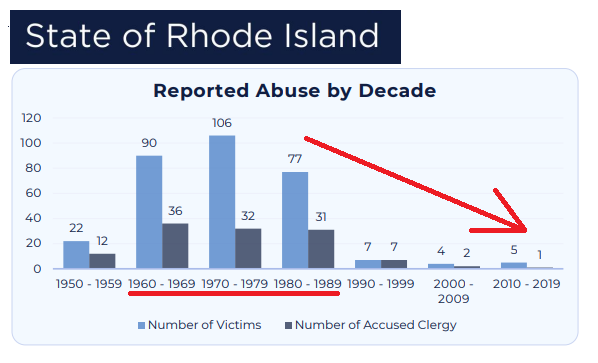
97% of the abuse dates back to the 1970s
The main finding in the Rhode Island report mirrors what was highlighted in Pennsylvania: the alleged abuses, as admitted by Attorney General Neronha himself, date back to “three-quarters of a century ago”.
He also stated that he “found no evidence of recent sexual abuse of minors by clergy” and that “sexual abuse in Rhode Island appears to have peaked in the 1960s and 1970s and then declined”.
And further: “No priest credibly accused of abuse is currently in active ministry in the Diocese of Providence”.
In particular, nearly 97% of the 300 alleged abuses occurred between 1950 and 1997, and 42% before 1972. These are described as alleged facts because the accusations have not been verified.
Why does this peak of abusers appear precisely in that period?
We addressed this in our commentary on the Georgetown University report: the “moral collapse” of the 1968 era, when leading intellectuals signed appeals for the “sexual liberation of children,” unfortunately also affected many men of the Church.
Another finding presented by the Rhode Island Attorney General is that of the 75 priests accused in the report, 64 (i.e. 85%) are deceased and therefore unable to defend themselves.
The prosecutor’s accusations
Despite this, Neronha still accused the Diocese of Providence of failing to investigate allegations against priests who had long been deceased, and of “destroying confidential files after the priests’ deaths, unless there were ongoing legal proceedings involving them”.
Both accusations are false, first of all because the investigation was made possible precisely thanks to the handover of files to the authorities by the Diocese of Providence.
And it is not true that the diocese failed to investigate the allegations.
This is demonstrated by a case emphasized by the Boston Globe, involving the priest Francis Santilli, highlighting the presence of “credible accusations.”
The decision to focus on a single case among 75 already suggests they did not find much else. In any case, regarding Santilli, the Diocese of Providence conducted an investigation and deemed the accusations not credible, even under the broadly permissive standards adopted by the diocese itself.
Stay updated by subscribing to our new channels:


The bishop: “The Report finds no evidence”
All this led the Bishop of Providence, Bruce Lewandowski, to respond to the report presented by Attorney General Neronha.
After noting that the investigation was made possible precisely because the diocese provided Neronha with all personnel files, including “material dating back more than seventy-five years”, he acknowledged “serious errors” in the “initial recognition and handling of this terrible period”, while emphasizing efforts made to improve transparency and prevention.
The bishop then noted that “any suggestion that there is an ongoing crisis within this diocese requiring urgent intervention is contradicted by the fact that the Report took nearly seven years to be published”.
Bishop Lewandowski further observed that “the Report itself reveals no evidence of recent sexual abuse of minors by clergy, no credible allegations against those currently in ministry, and no failure by the diocese to meet its legal reporting obligations”.
Yet these 75 years are presented “in such a way as to lead the reader to conclude that these issues are still unresolved or represent new revelations. This is not the case”.
Applying today’s sensibilities to the past
Finally, the Bishop of Providence also criticized the Report for its stigmatization of the diocese’s initial response to the allegations, applying “contemporary standards, practices, and awareness to conduct that occurred almost half a century ago, when the world was very different”.
This is a key point, often poorly understood.
The Attorney General, in fact, repeatedly notes that abusive priests were at the time sent to medical treatment centers, implying this was an insufficient or hypocritical response.
But at the time, today’s awareness did not exist, and the belief that pedophiles suffered from psychological conditions treatable medically was widespread in society.
In the same period, Lewandowski also recalled, “judges and prosecutors in Rhode Island themselves approved and ordered similar treatments for those under criminal proceedings”, citing several well-known cases.
Author








0 commenti a Rhode Island Diocese Abuse Report: Seven Years for Nothing