
The Pachamama and the Pope? «I was there: no pagan ritual»
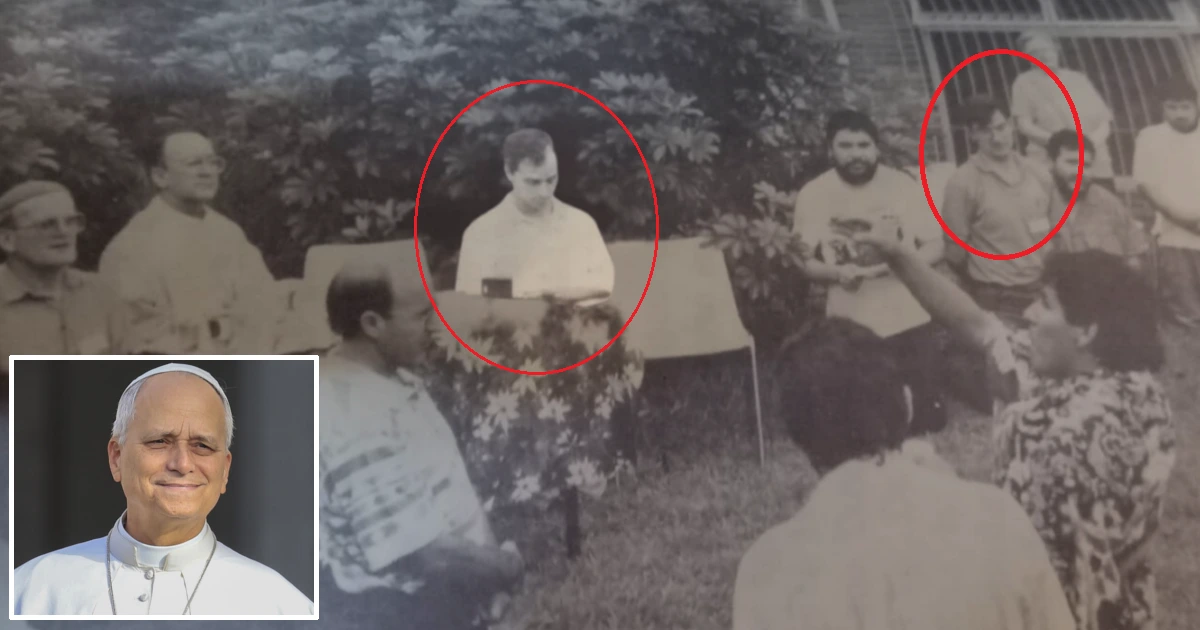
Exclusive to UCCR: a participant in the 1995 Symposium together with the young Prevost, now Pope. The Pachamama was not a pagan ritual but a Christian gesture of inculturation.
Last month we addressed the issue of certain photographs.
The article we published, both in Italian and in English, quickly spread around the world.
The Pope Images and the Pachamama
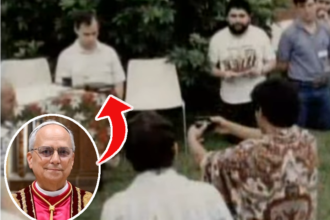
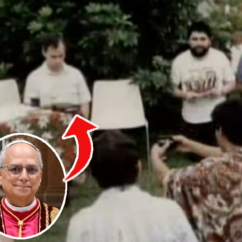
We had analyzed the images circulated by “anti-papal” circles concerning the participation in 1995 of the young Robert Francis Prevost in an academic symposium organized by the Organization of Augustinians of Latin America (OALA), during which a ritual associated with the Pachamama allegedly took place.
While “LifeSiteNews” (the journalistic outlet linked to the excommunicated Carlo Maria Viganò) openly described it as a pagan ritual — emphasizing that Prevost’s current heresy would therefore predate his pontificate — the official photographs referred instead to an “agricultural ritual” carried out informally within an event that also included liturgical celebrations.
We nevertheless admitted our discomfort with the image portraying participants kneeling or genuflecting during the ritual, although we noted that Father Prevost was the only person in the photo not assuming that posture.
UCCR and the Symposium Participant
Our investigation led us to contact several Augustinians who participated in that Symposium in São Paulo, particularly Juan Alberto Perez.
Juan Alberto was a delegate of the Secretariat for Justice and Peace in the Integrity of Creation of the Apostolic Vicariate of Iquitos and the one who proposed that ritual, as he later did a second time in an Amazonian context.
He still belongs to the Order of Saint Augustine but, for personal reasons, no longer lives in community. Nevertheless, he tells UCCR: “I continue to live in poverty and chastity extra domus within the Church as a deacon responsible for the pastoral care of the Roma people in the Archdiocese of Barcelona”, and he also serves as a hospitalero on the Camino de Santiago.
Answering our questions, the Augustinian confirms that “when Pope Leo was still a simple Augustinian friar, he participated in that Ecotheology symposium together with other Augustinian religious”.
Within those conferences, the Eucharist, the Liturgy of the Word, and the Liturgy of the Hours were celebrated, but also what he defines as “meaningful gestures which today have attracted the attention of ill-intentioned people, who decontextualize the events from their true meaning”.
Stay updated by subscribing to our new channels:


“Photos Taken Out of Context: No Pagan Ritual”
The “meaningful gesture” in that case was precisely the Pachamama ritual. Why does he speak of decontextualization?
Juan Alberto answers without hesitation: “That gesture was intended to illustrate the theories and practices of Ecotheology, namely when local Churches incarnated within Andean and Amazonian cultures express and communicate themselves through indigenous languages and through symbols and signs proper to those cultures”.
Among them there is precisely “care for and respect toward Creation, integrated into the values of peace and justice toward what has been created and into the worship of the Creator”.
Thus, during that gesture, “reference was made to fidelity to the inculturated Gospel, to ecclesial documents and the Social Doctrine of the Church, as well as to the directives of the Second Vatican Council concerning ecumenical and interreligious relations and the integrity of Creation”.
The Augustinian is very precise in clarifying that respect for creation was “expressed through veneration and not idolatrous worship”, that is, teaching wonder “for what is God’s creation”.
In doing so, “catechetical language and sacramental and symbolic signs such as water, earth, and plants were used within ritual contexts that are deeply meaningful in the ancestral cultures of Amazonian and Andean peoples”.
In such contexts, Juan Alberto Perez explains to us, the Pachamama “means respect and care for the Common Home as a place of relationship among created beings together with humanity”, and “it is absolutely not an idolatrous or deviant cult”.
As it is experienced there, therefore, “the celebration of the Pachamama ritual is a gesture filled with profound symbolism, such as recognizing the value of the Creator manifested in His creatures, in His creation, and in the relationships among creatures themselves”.
There is nothing pagan or idolatrous about it.
The Augustinian repeats this to us several times, also recalling the decontextualizations and forced interpretations “used to attack Pope Francis in the context of the encyclical ‘Laudato si’, or even Pope Saint John Paul II”.
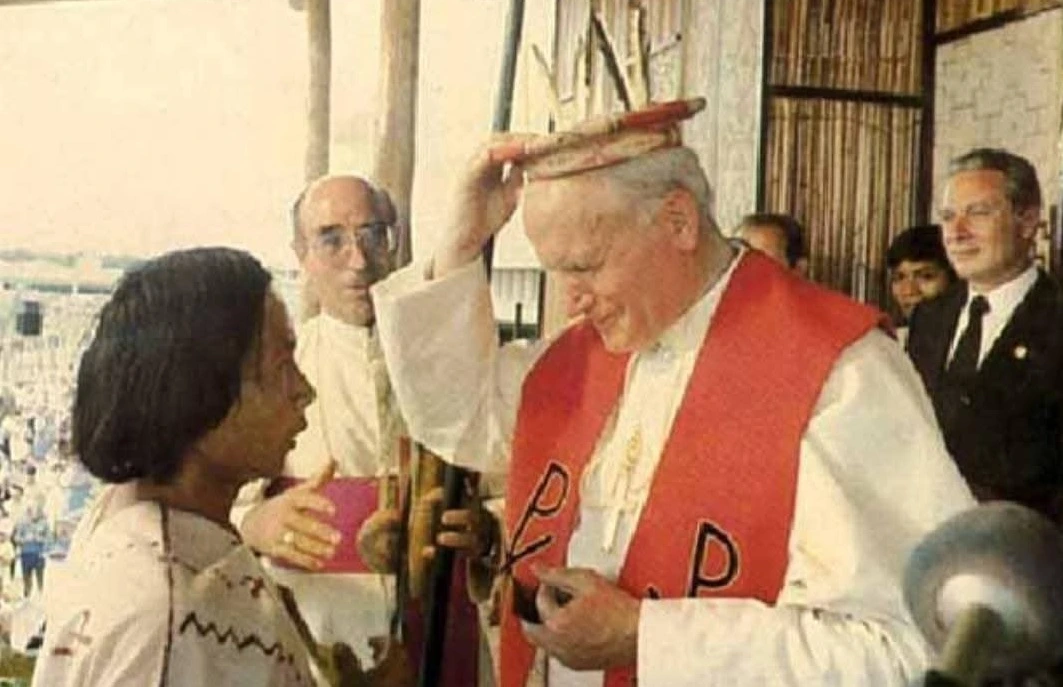
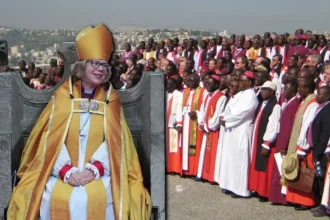
Regarding Pope Wojtyła, he sent us this photograph as a small example of inculturation: while wearing a Tikuna crown and a Shipibo stole, both typical of Amazonian tribes.
What Pachamama Means
The term “Pachamama“, the missionary explains, originated “within cultural ritual contexts, especially in oral, agricultural, and pastoral societies such as the Andean one, and corresponds to a Quechua cosmology divided into spaces and times: the janajpacha or higher reality, the ujkupacha or lower reality, and the kaypacha or intermediate reality”.
The missionary Church “has progressively become inculturated, incarnating the Gospel within cultures in order to better reach the understanding of peoples and nations”.
It is from this that Black, Indigenous, and Roma theology emerged, namely “a liturgy adapted in its forms — more than in its contents — to the concrete reality of the place”.
Thus, the Augustinian concludes, “Pachamama is not a divinity or a fertility goddess, but a cosmology and a holistic representation of creation”.
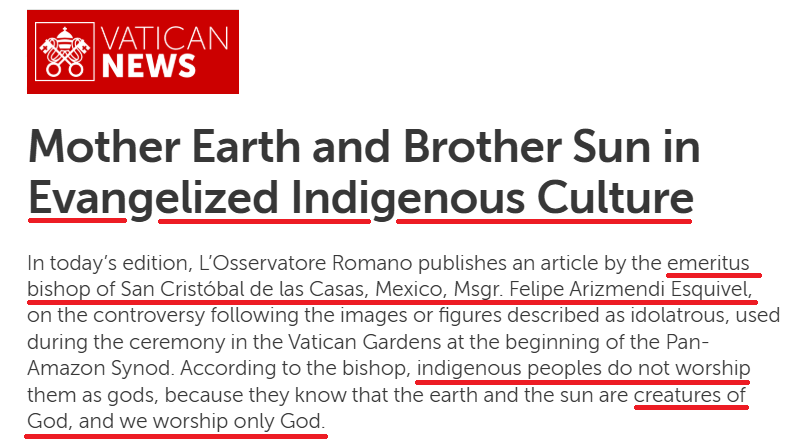
Words fully confirmed by the explanation provided in “L’Osservatore Romano” by the emeritus bishop of San Cristóbal de las Casas, Mexico, Bishop Felipe Arizmendi Esquivel.
Why Kneel or Genuflect?
However, the issue of kneeling and genuflection, as seen in the photographs, remains.
Juan Alberto responds to UCCR with the same frankness: “Gestures such as bodily postures, genuflection, or kneeling do not belong exclusively to the Latin liturgy: other traditions and cultures also kneel as a sign of respect and veneration toward the earth that sustains and nourishes us”.
Likewise, he says, “Saint Francis of Assisi spoke the words ‘sister mother Earth’”.
One must understand, he explains, that “within the indigenous and rural Andean peasant context, just as in a Christian temple, kneeling is not a sign of worship or idolatry of the soil or sacralized earth, but rather of respect for the place inhabited by life and of worship toward its divine Craftsman and Creator”.
Indeed, the missionary continues, “kneeling is not reserved solely for Eucharistic adoration, but is also a gesture of forgiveness, humble respect, and charity, as in the gesture and sign of the washing of the feet”.
For this reason, within the same 1995 Symposium, “it was proposed to carry out a ‘paraliturgy’, incarnating the Word within an Andean cultural context, accompanied by certain gestures such as kneeling”.
But attention, he emphasizes once again: “not as an expression of profane or pagan worship, but as a wonder-filled and merciful respect for everything that breathes and contains life, created by the Creator of all things”.
Prevost Participated Only That One Time
The instrumentalization of the images in a pagan key “is clearly the result of malice, interested in seeking out and inventing other meanings, taking them out of context and distancing them from reality”.
Those photographs simply portray what occurred in other OALA symposiums connected to Ecotheology, namely “small prayers and some meaningful gestures” typical of inculturation, “accompanied by the brief act of kneeling while reading this text: ‘We ask forgiveness for our transgressions against the created work and for not being co-creators with the Creator, but destroyers and transgressors of Creation’”.
Regarding the participation of the then-Robert Prevost, our sources and Juan Alberto himself clarify that “he participated for the first time in this type of prayer” in 1995 and never participated again.
Certainly not from 1999 onward, at least according to the testimony we received from an important member of the OALA leadership, Father Víctor Lozano Roldán, who was present from that year forward.
Missionaries and Inculturation
Those who spread the photographs from the São Paulo Symposium while providing a desacralizing interpretation against the current Leo XIV should have had this long conversation with Juan Alberto Perez.
It is normal for us Westerners to feel unfamiliar and unsettled by the concepts of inculturation; it is not so for the courageous missionaries who — often at the cost of their lives — made the face and words of Christ familiar to entire indigenous populations, far removed from the concepts and meanings of Christian theology.
To do so, they necessarily had to learn how to express themselves through local symbolism, adapting the “forms” but not the “contents,” as the Augustinian carefully explained to us.
Our interlocutor’s full ability to distinguish between an act of veneration and one of worship, between pagan ideology and Christian forms of inculturation, as well as his clear knowledge of the Andean meaning of Pachamama, confirms what we had already suggested while analyzing the images.
What the young Prevost participated in was not an idolatrous ritual.
Author

0 commenti a The Pachamama and the Pope? «I was there: no pagan ritual»