
Canada, 63% No Longer Believe in Mass Graves in Schools
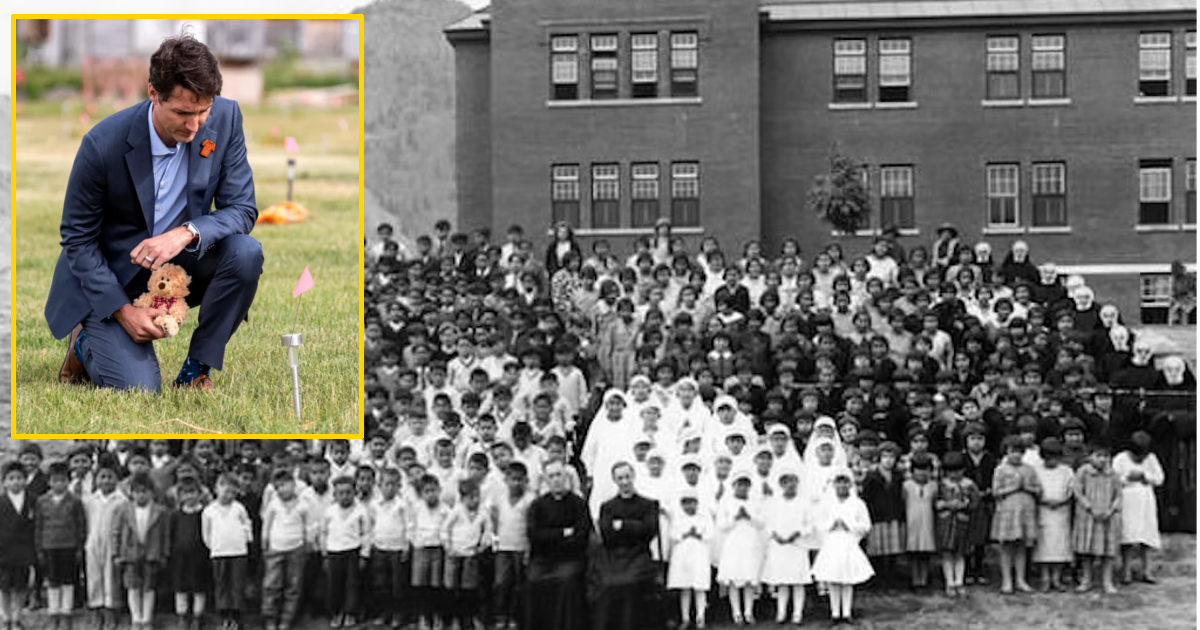
The Canadian people and the Natives have realized that the story of the mass graves in residential schools in Canada is a hoax and are asking for evidence. Here’s what historian Jacques Rouillard tells us.
It was May 2021 when Canada was hit by an apocalyptic announcement.
215 Indigenous children (215, exact!) were buried in a mass grave on the grounds of the former Catholic residential school of Kamloops. Thus began the story of the mass graves in Canada and more appeared everywhere.
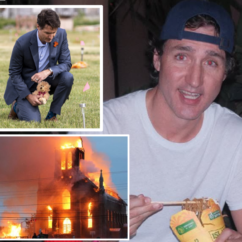
Shouted headlines, politicians on their knees, flags at half-mast for months, vigils, accusations of genocide, and dozens of churches set on fire in retaliation.
Today we know it was a hoax and most Canadians (and even Indigenous people themselves), according to a recent survey, are no longer willing to believe this story without proof.
The fake news of mass graves in Canada
We have spoken many times about the residential schools in Canada, immediately explaining the falsehood and highlighting the lack of even a single photograph of these so-called “mass graves.”
Then, quietly, last June the Canadian government halted the searches: after 8 million spent, nothing was found, not even a bone.
At best, they were ground anomalies creatively interpreted (likely under the influence of anti-Catholic bias and the sacralization of minorities following the woke culture). Thus Canadian media began to call it the greatest hate hoax of all time.
But the narrative of the “residential school mass graves” spread so widely that most still believe the horror story told. The last to fall for it was even an experienced journalist, Milena Gabanelli.
Canadians tired of believing without proof
But today something is shifting.
In May 2024 Canadian columnist Terry Glavin wrote in the National Post that “Canada is slowly acknowledging there never was a ‘mass grave.’”
Indeed, according to a survey published on August 14 by the Angus Reid Institute, 63% of Canadians and even 56% of Indigenous Canadians themselves are no longer willing to take the mass graves story at face value.
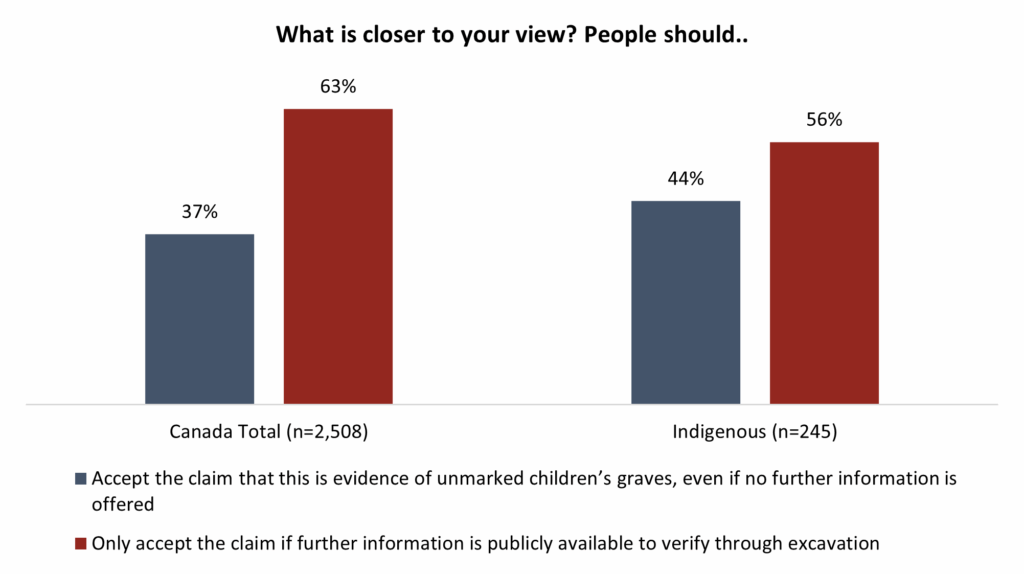
“To date”, it reads, “no human remains have been confirmed or exhumed and the suspected anomalies remain unverified.” The majority want serious evidence, exhumations, forensic data. In other words: if there really are graves—at Kamloops or elsewhere—prove it.
It is a significant figure considering that in Canada it had become for years a top national issue, so much so that those who dared to raise doubts or ask for verification were accused of denialism and often fired. Some even proposed laws to criminally punish those who dared to doubt.
The recent survey also covered this, and once again, fortunately, 62% of Canadians have no intention of turning opinion into a crime. Fewer than three in ten today would force resignations of professors, high school teachers, or lawyers who raise doubts about genocide.
And among the Indigenous interviewed, 45% said they were opposed to criminalizing denial (versus 42%).
The scholar’s satisfaction
UCCR submitted the survey to Jacques Rouillard, professor of History at the University of Montreal and one of the top specialists on residential schools.
With satisfaction, he pointed out that finally “there is a clear gap in Canadian public opinion regarding the narrative pushed by Indigenous leaders in recent decades.”
In fact, Rouillard confirms, “it had reached the point where there was a demand for the government to criminalize those who downplay the historical impact of residential schools, but the survey shows that the majority of Canadians are against it. I strongly doubt, therefore, that such a law could be passed in the current context.”
Finally, the historian concludes, people have understood that “evidence is needed before making criminal accusations against the Kamloops school administration, something the media forgot.” Canadians, he adds, have until now lived “in shame for the alleged treatment inflicted on Indigenous people.”
We had already interviewed Rouillard in 2022 and he explained to us the details of the “genocide operation,” namely the million-dollar compensation sought by the Conseil de bande (the local representatives of Indigenous people).
The Canadian historian also points out that even Rosanne Casimir, leader of the Canadian Indigenous, revised the version of events in 2024, no longer referring to the “confirmation of the remains of 215 children” and only evoking the presence of “unmarked graves,” completely forgetting the notion of a mass grave.
The investigation that disproves cultural genocide
The controversial issue remains that of “cultural genocide.”
As many as two-thirds (68%) of Canadians in the recent survey still claim that a form of cultural genocide occurred, 23% disagree or strongly disagree. 54% say the damage persists today while 46% ask to focus less on the issue.
Clearly, media narrative and the influence of former Prime Minister Justin Trudeau are still strong, as seen in the fact that the majority in Canada vastly overestimate the percentage of children who attended residential schools, putting it at 60% or more.
This refers to the transformation of Indigenous values, the teaching of English instead of their language, and the tools “instilled” in them to integrate into Western society.
The Canadian bishops persuaded Pope Francis to undertake a “reconciliation” trip to Canada to show repentance for the “ideological colonization” carried out in schools to “re-educate” Indigenous people according to Western standards.
But from the research conducted by Jacques Rouillard, as he tells us, it emerges that 3 Indigenous people were teaching at the Kamloops residential school in the 1960s, and as many as 23 in 1963 according to government reports (by 1970 they would likely reach thirty, then management passed entirely to the State).
Should we then conclude that the so-called “cultural genocide” would have been perpetrated by Indigenous teachers themselves or with their consent?
The historian also tells us that the residential schools, created starting in 1883, arose “following the request of the Indigenous communities themselves, in 11 treaties signed between 1871 and 1911.”
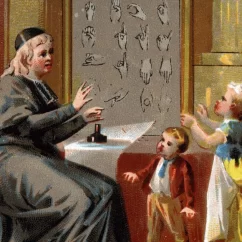
Indigenous people themselves indeed aspired to adapt “to the new agricultural and industrial economy developing around them, to learn to read, to write in English or French, and to count. The Indigenous languages were spoken, but neither written nor read.”
Moreover, by consulting the memoranda sent to the federal government in 1948 and 1969, he discovered that Indigenous associations have always had “a positive image of Western education and residential schools”, and likewise “the ‘Assemblée des Premières Nations’ in its memorandum to the Royal Commission on Aboriginal Peoples in 1993”, when the media demonization of residential schools began.
Residential schools, from suggestion to evidence
We agree with Prof. Rouillard who will send us his work as soon as he finishes the study he is drafting.
The positive fact remains that today, Indigenous people themselves and the majority of Canadians are no longer willing to kneel before a hoax and prefer the truth, marking the shift from emotional suggestion to the demand for real evidence.
Perhaps, more than “reconciliation,” Canada feels the need for a healthy dose of reality after being blinded by the thirst for blame and the ideological rewriting of its own history.
title (title case):
Author




1 commenti a Canada, 63% No Longer Believe in Mass Graves in Schools
[…] Last August, 63% of Canadians had realized they had fallen for a massive fake news story. We hope that percentage has increased today. […]