
Support for Galileo within the religious orders of the 17th century
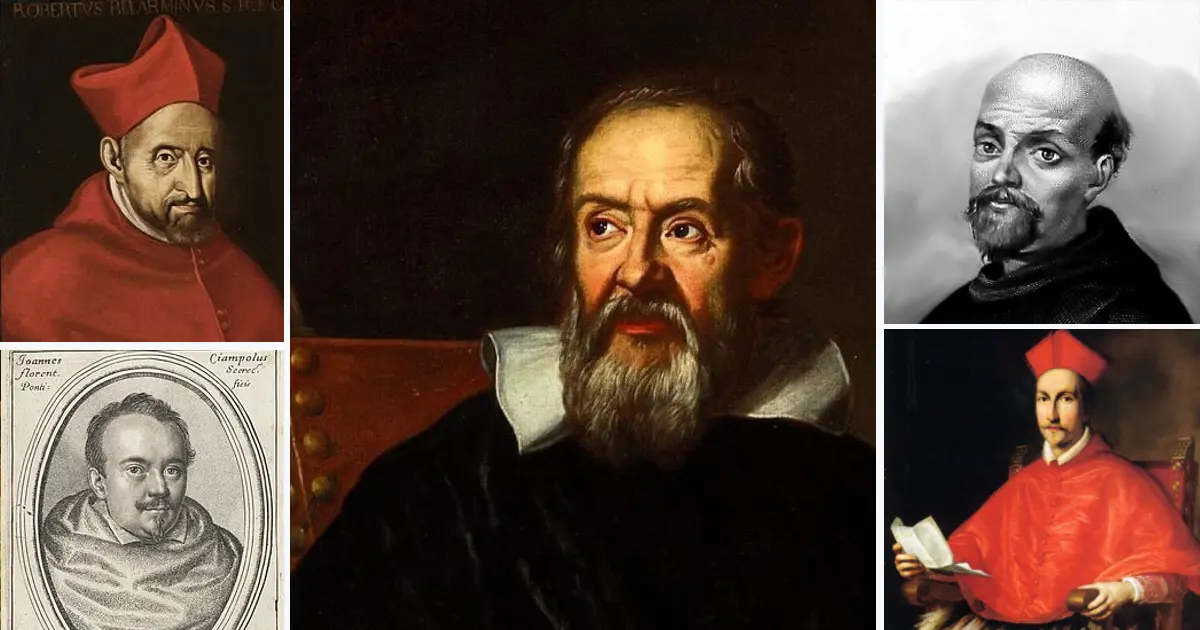
The Church and the religious orders that supported Galileo Galilei and the pro-Copernican theses in disputes with Aristotelian philosophers. Historian Massimo Bucciantini weighs in.
In 2022, the publishing house Morcelliana launched the series “Library of Religious Scientists”, dedicated to the writings of Piarist, Benedictine, and Jesuit scholars produced between the 17th and 18th centuries.
A rich testimony to the philosophical and scientific ferment within religious orders.
Interest in science in monasteries
This was highlighted by historian Massimo Bucciantini, professor of the History of Science at the University of Siena, noting with appreciation that “it shows us how wide-ranging and extensive the interest in science was within religious orders during the first great scientific revolution.”
The series begins with the writings of the Jesuit from Brescia, Francesco Lana Terzi (1631–1687), founder of aeronautical science. Then comes Benedetto Castelli (1577/78–1643), a renowned Benedictine mathematician, loyal disciple of Galileo, and author of the first modern treatise on hydrodynamics.
The third author is Carlo Barletti (1735–1800), a member of the Piarists, best known as the predecessor of Alessandro Volta in the chair at the University of Pavia, overlooking—as Bucciantini writes—“how significant his contributions were to the field of study of the ‘electric fire’ at work in nature, namely electricity.”
The final figure to open the series is the Piarist monk Father Giovanni Battista Beccaria, who corresponded regularly with Benjamin Franklin and was one of the leading “electricians” of the era.
Support for Galileo within the religious orders
Alongside the already mentioned Castelli, the Jesuit Bonaventura Cavalieri, and the Carmelite Paolo Foscarini, many of these “natural philosophers” were outspoken supporters of Galileo Galilei in his disputes with Aristotelian philosophers.
The Pope’s astronomers—in particular, the Jesuits of the Roman College led by the celebrated Christophorus Clavius (1537–1612)—received Galileo’s discoveries with objectivity.
No one within the ecclesiastical world or the Church openly challenged Galileo over his pro-Copernican theories (even though the Copernican system had not yet been proven at the time), not even Pope Paul V, who in fact received Galileo with great honour.
Galileo’s “Dialogue Concerning the Two Chief World Systems” was published thanks to the Dominican Niccolò Riccardi, Master of the Sacred Palace and papal theologian, “who looked favourably on Galileo”1C. Black, Storia dell’Inquisizione in Italia, Carrocci Editore 2013, p. 430, notes Christopher Black, emeritus professor of Italian History at the University of Glasgow.
The Dominican Raffaello Visconti, consulted by Riccardi, also gave a favourable opinion. Further approval came from priest Giovanni Ciampoli, secretary for papal correspondence and member of the Accademia dei Lincei, who “boasted a long friendship with both Galileo and the Barberini family”2C. Black, Storia dell’Inquisizione in Italia, Carrocci Editore 2013, pp. 430, 431.
“Galileo,” Black further observed, “enjoyed for several decades the help and support (not always acknowledged) of the leading Jesuit mathematicians”3C. Black, Storia dell’Inquisizione in Italia, Carrocci Editore 2013, p. 448, and also found backing from “highly prominent cardinals such as Bellarmine and Maffeo Barberini (until he felt personally offended in 1631–32, when he had become Pope Urban VIII)”4C. Black, Storia dell’Inquisizione in Italia, Carrocci Editore 2013, p. 459.
Among others, the English historian concluded, “even the Pope’s nephew, Cardinal Francesco Barberini, sympathised with Galileo”5C. Black, Storia dell’Inquisizione in Italia, Carrocci Editore 2013, p. 468.
The Church and the Galileo affair: a political issue
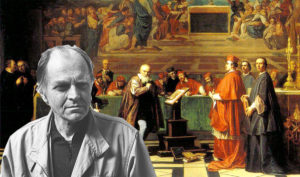
Then, between Galileo and Urban VIII, relations soured and events took the course we all know.
But how is this possible if the Pisan scientist was so widely supported by many scientists belonging to religious orders, very close to the Pope?
Though it provoked the ire of Il Foglio, we discussed this some time ago, citing the work of Ada Palmer, professor of Modern European History at the University of Chicago, who stated that “if you read the actual trial documents of Galileo, science is hardly mentioned—it was marginal.”
This is echoed by Ronald Naylor, philosopher of science at the University of Greenwich, and Russell Stannard, emeritus professor of Physics at the Open University:
“It was a matter of politics and wounded personal feelings, not a fundamental rift between science and religion. The Galileo affair could easily have been avoided had the situation been handled differently on both sides.”6R. Stannard, La scienza e i miracoli, TEA 1998, p. 18.
Author




0 commenti a Support for Galileo within the religious orders of the 17th century