
Catherine of Siena, the Saint Who Brought the Pope Back to Rome
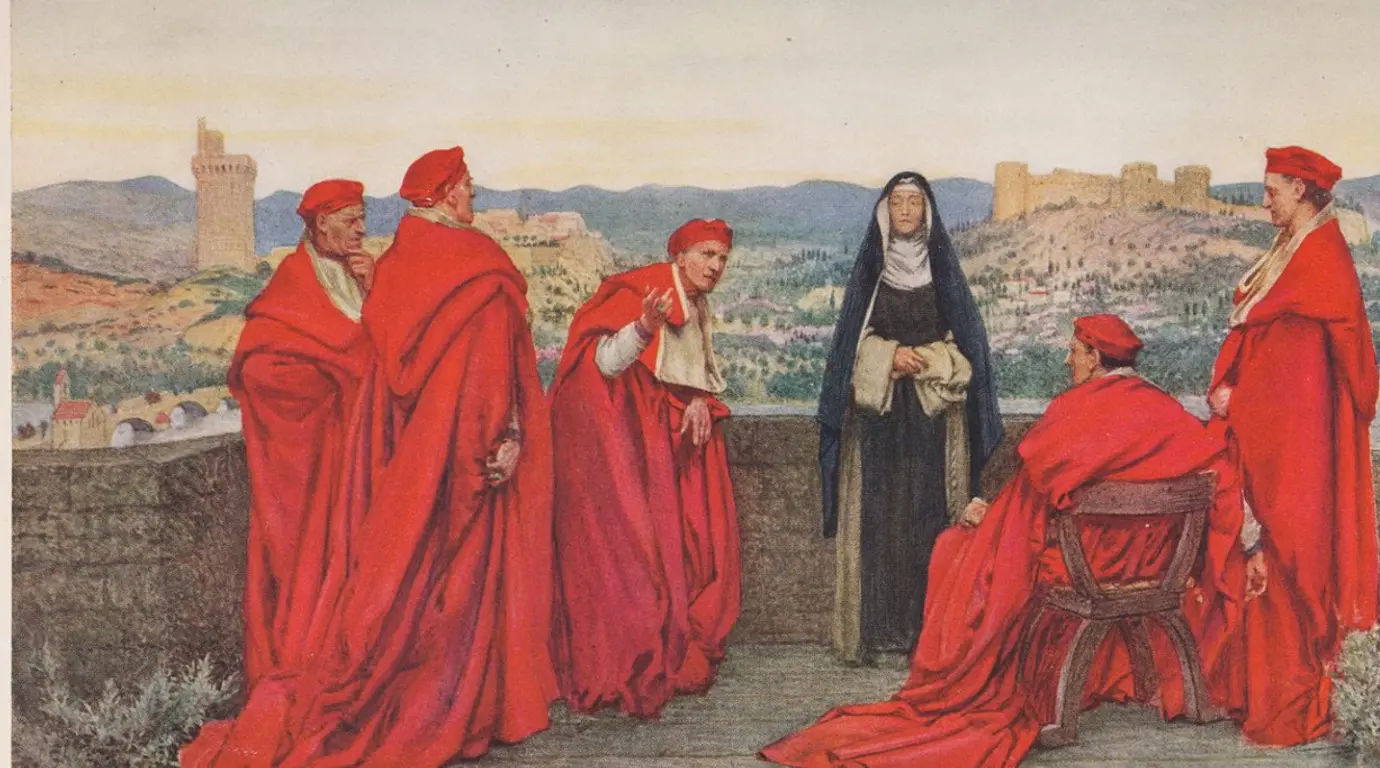
On her feast day, we remember the role of Saint Catherine of Siena in bringing the Pope back from Avignon to Rome. From an illiterate girl to a Doctor of the Church.
On April 29, the Church celebrates Saint Catherine of Siena.
One of the most influential female figures of the Christian Middle Ages, Catherine Benincasa was the twenty-fourth of twenty-five children born into a family of craftsmen in Siena. She died in Rome in 1380, at only 33 years of age.
Who Was Catherine?
At a time when female literacy was rare, especially among the lower classes, she never attended school and learned to read and write only as an adult. Yet she would go on to leave behind hundreds of letters addressed to the highest religious and political authorities of her time.
After joining the “Mantellate,” the lay branch of the Dominican Order, Catherine initially lived a life of prayer and service to the poor and the sick.
Before long, however, her spiritual reputation spread far beyond Siena. Around her formed a group of disciples, the so-called “Caterinati,” made up of clergy, nobles, and intellectuals.
Catherine of Siena, Advisor to the Pope
The role that made her historically decisive, however, was her political and ecclesial influence.
At the height of the Avignon Papacy crisis, Catherine wrote several times to Pope Gregory XI, urging him to move the papal seat from Avignon back to Rome.
In 1376, she personally traveled to Avignon and, according to many historical sources, her intervention concretely contributed to the pontiff’s decision to return to the Eternal City in 1377, a turning point considered crucial in the history of the Church.
Stay updated by subscribing to our new channels:


She Rebuked Kings, Princes, and Cardinals
Another of her great achievements was her commitment to peace among the Italian cities, then torn apart by wars, rivalries, and internal conflicts.
Catherine often acted as a political mediator, attempting to reconcile noble families and rival city-states. Her more than 400 letters to kings, princes, and bishops reveal an extraordinarily energetic and authoritative personality, capable of speaking frankly both to rulers and to prelates.
She addressed powerful exhortations to various cardinals, imploring them to pursue the moral purity necessary to heal the Church. She knew how to rebuke them severely, while never neglecting humility and respect for their office.
She was also a central figure during the Western Schism.
After the election of Pope Urban VI, Catherine openly defended the legitimacy of the Roman pontiff — whom she called the “sweet Christ on earth” — against the antipope supported by the Avignon faction, urging cardinals and European rulers to preserve the unity of the Church.
The Genius of the Daughters of the Church
After her death, the figure of Catherine continued to grow in importance.
She was canonized in 1461 by Pope Pius II, proclaimed Patron Saint of Italy in 1939 together with Saint Francis of Assisi, and named a Doctor of the Church in 1970 by Pope Paul VI, the first woman to receive this title together with Saint Teresa of Ávila.
Today she is also Co-Patroness of Europe, a title conferred upon her by Pope John Paul II in 1999.
The life of Saint Catherine of Siena is one of the clearest demonstrations of the genius of the daughters and sons of the Church, who throughout the centuries have shaped not only spirituality, but also culture, politics, and European history.
Author









0 commenti a Catherine of Siena, the Saint Who Brought the Pope Back to Rome