
The SSPX and the New Bishops: Luther’s Mistake Returns

The Society of Saint Pius X (SSPX) ordains new bishops without papal mandate, rejecting dialogue and complaining about liturgical abuses. This is what Luther did: he created a schism thinking he was correcting the Church.
The Lefebvrian issue is shaking the Church news again.
In recent weeks, the Society of Saint Pius X (SSPX) has rejected the “outstretched hand” of the Holy See, confirming its intention to proceed with episcopal ordinations without pontifical mandate.
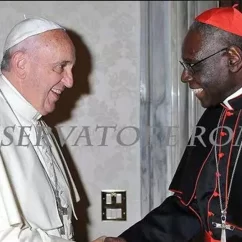
The intervention of Cardinal Gerhard Müller had no effect, even though he reiterated a key point: the Truth cannot be defended separately from communion with the Pope, because without hierarchical unity, defending doctrine slips into subjective “private interpretation.”
The same theological error committed by Martin Luther.
Dialogue between SSPX and UCCR
A few months ago, we engaged in dialogue with Don Daniele Di Sorco, a leading member of the SSPX, trying to understand their point of view.
Unfortunately, despite mutual fraternal charity, we found a fundamental incompatibility when Don Di Sorco attributed to the traditionalist Society the authority to define the boundaries of orthodoxy and to correct the Church itself.
However, as we wrote, this implies believing that the ultimate criterion of truth lies in one’s own vision/interpretation of the Magisterium, no longer in the successor of Peter in unity with the college of bishops, to whom Christ entrusted the task of faithfully guarding, interpreting, and transmitting Revelation.
Only a few months after the UCCR-SSPX dialogue, the issue has “exploded” internationally.
SSPX and the New Bishops: What It’s About
Rome had put forward a good mediation proposal: to suspend the ordinations scheduled for July 1st in exchange for opening a theological dialogue table.
The goal was to agree on “minimum” acceptance of the Second Vatican Council that would allow the Society to obtain a regular canonical status within the Church.
The rejection by Mons. Lefebvre’s followers was clear. Dialogue would be useless since their criticism concerns not only the interpretation of the Council but the text of the conciliar documents themselves, rejected in several fundamental points.
To justify the legality of ordaining new bishops without the Pope’s permission, the SSPX supports a pre-conciliar theological thesis: the governing power (munus regendi) is not intrinsic to episcopal ordination but depends exclusively on territorial jurisdiction granted by the Pontiff.
By ordaining new bishops without jurisdiction (i.e., without assigning them a diocese or territory), the SSPX considers itself not to be committing a schismatic act.
However, the Second Vatican Council clearly teaches that the three services (to sanctify, to teach, and to govern) are ontologically united in the sacrament of Orders.
The Stern Intervention of Cardinal Müller
On the matter, Cardinal Gerhard Müller intervened forcefully: “The claim that the Lefebvrians are the last bastion of true Catholicity must finally end.”
The former Prefect of the Congregation for the Doctrine of the Faith first denied that the blame for the breakdown of dialogue in 2018 was solely his own, and reiterated that “there is never a justification for distancing oneself from the Catholic Church, even though the Church is a mixture of saints and sinners.”
Pope Francis himself, like Benedict XVI, has recognized among other things liturgical abuses committed not by traditionalists but by those celebrating the Mass according to the new Missal (that of Saint Paul VI), calling them “almost unbearable”. However, nothing effective was done to correct them.
The Shadow of Luther: Correcting the Church Without Unity
The point is that one cannot defend the “true faith” from the outside, standing against the Church united with the Pope. A protest outside of communion is not only sterile but ends up repeating past mistakes.
Luther appealed to corruption and numerous abuses (mostly true) of his time and ended up creating a schism. Starting from real errors to commit another does not justify anything.
Errors, sins, and corruption must be corrected, not used as a pretext. This is what the Council of Trent said. This was the Catholic Counter-Reformation: to correct what is wrong, not to introduce doctrinal deviations (as Peter Waldo, Luther, and many others ended up doing).
Church history teaches that crises are overcome by staying within communion, not by building a parallel authority. Authentic reform arises from obedience and charity, not from self-proclaimed alternative doctrinal tribunals.
If one truly loves the Church, one purifies it from within. Without breaking its unity.
Author




1 commenti a The SSPX and the New Bishops: Luther’s Mistake Returns
The Augustana (largely penned by Melanchthon) is recently seen by the Curia to be a Catholic Confession upon which can be discussed unity of the Church with those who hold to that document. In the 16th Century it was anathematized and castigated, and those who held to the Augustana did not leave the Church so much as the Church left them, expelled them and excommunicated them. Now, some 500 years later, the Church is relooking at this document and seeing it as one which might be used to build bridges with those who believe it, and declare it to be. True.