
Jane Goodall Saw God as the Hand Behind Evolution
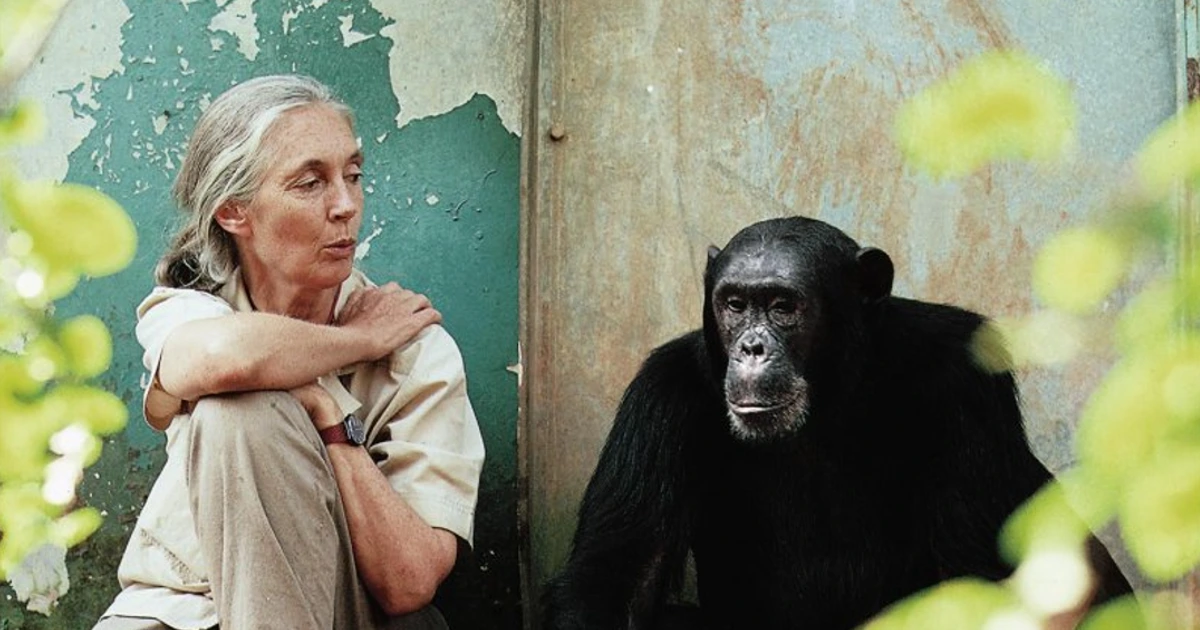
The thought of Jane Goodall on God and evolution. On the day of the passing of the well-known primatologist, an in-depth look at her anti-materialism and rejection of evolutionary chance.
Yesterday the passing of Jane Goodall occurred; she died at the age of 91.
A celebrated ethologist and paleontologist, she was among the most influential scientists of our time and is known for having pushed the defense of nature far beyond conventional boundaries.
Goodall is particularly known for her studies on chimpanzees in Gombe Stream National Park in Tanzania, research that began in 1960 based on an immersive approach. Observing the primates she always emphasized their emotionality and social relationships, discovering the use of tools that were previously thought to be an exclusive prerogative of human beings.
Champion of the ethical treatment of animals, her work revolutionized the way of conceiving the distinction with humans, widening the horizon of our empathy toward other living beings.
Far from reductive materialism
Nevertheless, the noted scientist never fell into reductionism toward the human being and, indeed, over the course of her life she cultivated a strong spiritual sensitivity, which emerged several times in her writings. She firmly rejected materialism and the idea of being able to explain life exclusively through science.
Not only did she report having perceived in animals a common “spiritual energy”, a spark she called “divine”, but she always identified a creative Intelligence behind nature itself.
She declared herself Christian (though not particularly devout) and in 2021 she won the Templeton Prize for having united spiritual curiosity with her scientific career and highlighted «a deep connection» between humans, animals and the environment that calls for a higher dimension.
On that occasion Goodall explained that «religion entered me» at the age of 16, «I felt I had a secret understanding of something that perhaps others did not share».
She was a great friend of the Christian geneticist Francis Collins, with whom she shared the idea «that we do not live in an exclusively materialistic world»; it is not mere coincidence that «in every single cell of the body there is a code of several billion instructions and there is no real reason why things should be as they are; random mutations could never lead to the complexity of life on Earth».
Jane Goodall, evolution and God
The noted ethologist was indeed strongly convinced of a teleological evolution, guided by «an intelligence behind the universe».
Her thinking on this is expressed in detail in the book “Reason for Hope: A Spiritual Journey” (Grand Central Publishing 1999), written together with Phillip Berman.
In it Jane Goodall explained that research has always strengthened both her science and her faith1J. Goodall, P. Berman, “Reason for Hope: A Spiritual Journey”, Grand Central Publishing 1999, p. 65 and that she never understood the incompatibility perceived by some between evolutionary theory and religion. Nor did she ever think that science disproved the existence of God2J. Goodall, P. Berman, “Reason for Hope: A Spiritual Journey”, Grand Central Publishing 1999, p. 68.
In the book the famous paleontologist delves into describing the moments in which she experienced transcendence when she found herself surrounded by nature: «The closer I get to animals and to nature the more I feel in tune with the spiritual force that I perceive around me3J. Goodall, P. Berman, “Reason for Hope: A Spiritual Journey”, Grand Central Publishing 1999, p. 72.
The days spent living with the chimpanzees, at the beginning of her research, she considered among the most significant of her life from a spiritual point of view, as well as scientific, and she expressed the firm conviction that human evolution was not guided by chance and necessity, rejecting the idea that our unique species is simply an “evolutionary mistake”.
Indeed, she wrote that in the universe there is «a plan, a purpose for everything»4J. Goodall, P. Berman, “Reason for Hope: A Spiritual Journey”, Grand Central Publishing 1999, p. 93.
In the foreword to the book by philosopher Ervin Laszlo, Jane Goodall wrote in 2017:
«We must accept that there is an Intelligence driving the process of evolution, that the Universe and life on Earth are inspired and in-formed by an unknown and unknowable Creator, a Supreme Being, a Great Spiritual Power»5E. Laszlo, “The Intelligence of the Cosmos”, Simon and Schuster 2017, p. 3.
Also in “Reason for Hope”, however, is the description of a mystical experience she had inside the cathedral of Notre Dame in Paris, in 1974. Here are her words:
«That moment, a suddenly captured moment of eternity, was perhaps the closest I have ever come to experiencing ecstasy, the ecstasy of the mystic. How could I believe it was the chance gyrations of bits of primeval dust that had led up to that moment in time—the cathedral soaring to the sky; the collective inspiration and faith of those who caused it to be built; the advent of Bach himself; the brain, his brain, that translated truth into music; and the mind that could, as mine did then, comprehend the whole inexorable progression of evolution? Since I cannot believe that this was the result of chance, I have to admit anti-chance. And so I must believe in a guiding power in the universe—in other words, I must believe in God.».
Author





0 commenti a Jane Goodall Saw God as the Hand Behind Evolution