
The Boy Who “Helped” Pius XII Proclaim the Assumption of Mary
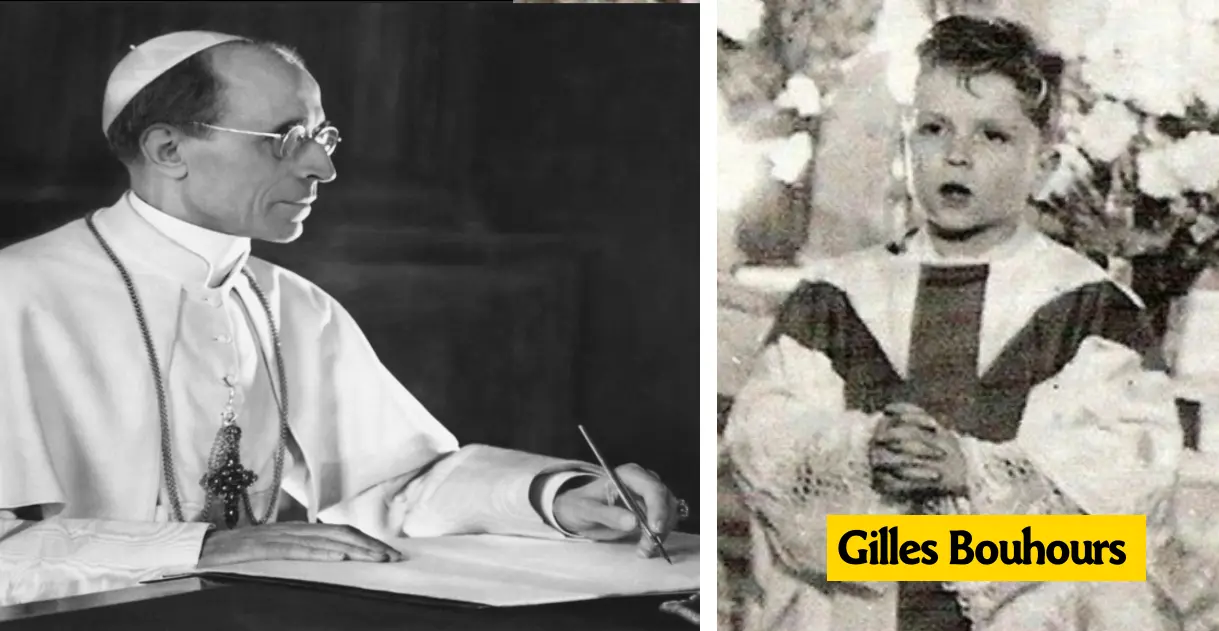
Confirmation of the correctness of the dogma of the Assumption of Mary came to Pius XII from the little boy Gilles Bouhours. A short but significant story.
On today’s feast of the Assumption of Mary we recall a story that few know.
It is the story of Gilles Bouhours, a French boy whose unusual encounter with Pope Pius XII led to the dogmatic definition of the Assumption of the Virgin, proclaimed on November 1, 1950.
The boy and the Assumption of Mary
Born in 1944 in the Mayenne region, Gilles had a childhood marked by illness. A few months after birth, he contracted meningitis and encephalitis, diseases that could have led to his death. Against all odds, he recovered.
Shortly afterward, he began telling people that he had seen the Virgin Mary and had received a precise message to deliver directly to the Pope.
In 1949, Gilles and his father left for Rome, but the attempt to meet Pius XII failed; they succeeded the following year.
On May 1, 1950 in a private audience. It was then that little Bouhours spoke for the first time about the message and personally told the Pontiff the sentence he believed came from the Virgin: Mary, at the end of her earthly life, did not know the corruption of the tomb, but was assumed into heaven in body and soul.
Pius XII listened attentively and with emotion. It is known –as explained by the online Catholic Encyclopedia– that he asked the Virgin for a sign to confirm that the dogmatic definition of her glorious Assumption into heaven, in body and soul, was pleasing to Her.
There is no direct evidence that Gilles Bouhours’ message determined the papal decision; it is likely that the theological and pastoral process had already been underway for some time. But, coincidentally, the meeting took place on May 1, 1950, and exactly six months later, on November 1, 1950, the apostolic constitution Munificentissimus Deus declared the Assumption a dogma of faith.
Gilles’ life was short. He died ten years later, in 1960, at only fifteen years old and in sudden circumstances.
The figure of little Gilles remained linked to that decisive encounter with the Pope, so much so that in 2014 in the Diocese of Laval, a preliminary investigation was opened for a possible cause of beatification.
Theological foundation of the Assumption of Mary
As always, the Church establishes a dogma of faith when it is already a centuries-old conviction of the people. It invents nothing new
And that of the Assumption of the Virgin Mary has always been a constant belief among Catholics, documented at least since the 5th century.
A great boost was provided by the studies that arose on the occasion of the proclamation of the Immaculate Conception in 1854 by Pius IX, which inaugurated the era of “Mariology”, a discipline of systematic and autonomous study on the figure of Mary.
From that moment, important biblical studies also developed in favor of the Assumption, in which Saint Anthony Mary Claret, confessor to Queen Isabella II in 1863, also took part.
A decisive contribution came from the treatise of the Franciscan Carlos Balic in 1946, in which he re-evaluated the testimony of the apocryphal gospels on the Assumption, admitting their lateness and the fantasy they contained, but also a core of truth transmitted by tradition. Moreover, he explained, it is not possible to imagine a sudden explosion of faith in the Assumption of Mary without a preceding tradition to support it.
In the dogmatic definition, Pius XII spoke of an “implicit revelation” in the sensus fidelium, in the testimony of the sacred liturgy, and in that of some Church Fathers, particularly Saint John Damascene and Saint Germanus of Constantinople, as well as ancient scholastic theologians who demonstrated the truth of the Assumption.
The Pope, however, did not intervene in the circumstances in which it occurred, infallibly proclaiming that Mary was taken up into heaven in body and soul “after having completed the course of her earthly life”, without specifying how that course ended.
It is also worth remembering that Pope Pacelli requested an opinion on the appropriateness of a dogmatic definition of the Assumption of the Virgin Mary. The response was overwhelmingly positive: only 6 of the 1,181 consulted expressed reservations.
Even though the dogma of the Assumption is based on centuries of theological reflection in the Church, God can also use the innocence of a child as an instrument to confirm the truth.
Author




0 commenti a The Boy Who “Helped” Pius XII Proclaim the Assumption of Mary