
James Tabor Targets Mary After the False Tomb of Jesus
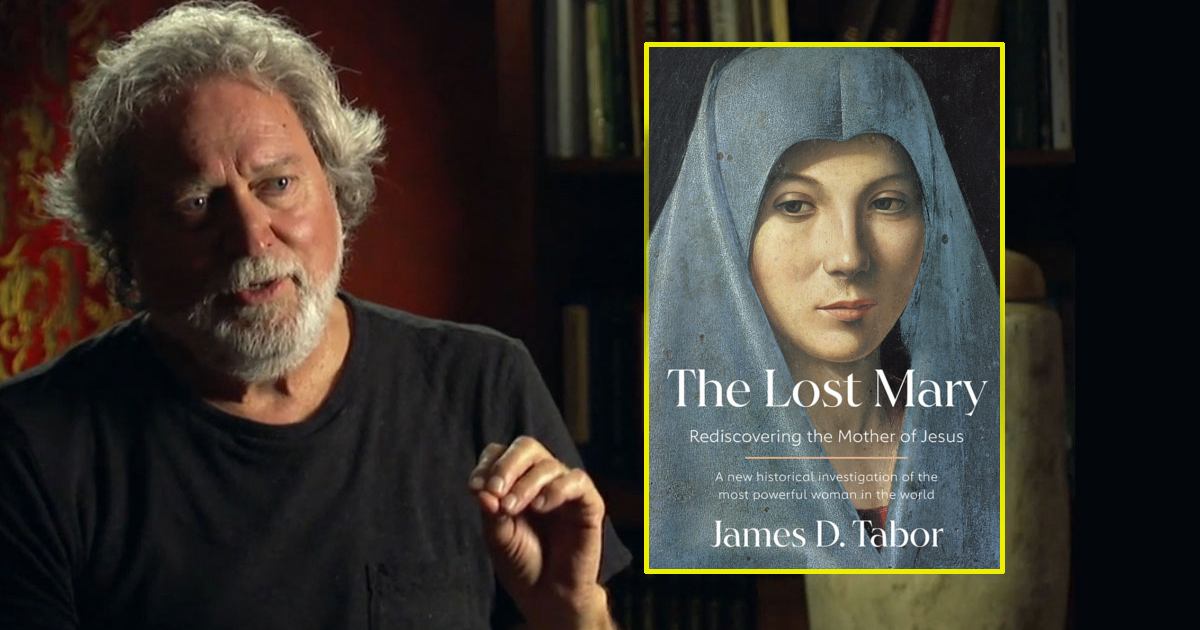
The latest book by James D. Tabor is titled “The Lost Mary”. After the Talpiot tomb attributed to Jesus, the author embarks on a psycho-historical reconstruction of the “lost” Virgin Mary.
Finally, is the “lost Virgin Mary” revealed?
Another sensationalistic claim comes from someone well known in the academic field of Christian origins research.
His name is James D. Tabor, a retired scholar who long taught Religious Studies at the University of North Carolina.
A few weeks ago his latest book was released, “The Lost Mary: Rediscovering the Mother of Jesus” (Penguin Random House 2025), a retrospective investigation into the figure of the Mother of Jesus that claims to restore a “historical Mary” through psychological and archaeological reconstructions.
Why “restore”? Because, according to the author, the true identity of Mary has been lost through centuries of Christian attempts to “depict her as a virgin and almost divine woman.” We shall see how utopian his idea is.
Who is James D. Tabor and the tomb of Jesus
As we said, the author is not an unknown figure.
James D. Tabor is known for promoting the idea of the so-called “tomb of Jesus”, discovered in 1980 in the Talpiot neighborhood of Jerusalem.
It is a rock-cut tomb containing ten ossuaries with inscriptions that were translated as “Mary”, “Yose”, “Mariamene and Mara” and “Matya”. Tabor himself claimed to interpret the few letters of another almost illegible inscription as “Yeshua bar Yosef” (“Jesus, son of Joseph”).
The scholar, together with Jewish journalist Simcha Jacobovici and filmmaker James Cameron, argued that the combination of these names matched those of Jesus’ family and hypothesized that “Mariamene and Mara” could refer to Mary Magdalene, based on two deuterocanonical passages and a (forced) interpretation of some Gnostic texts where Mary Magdalene is sometimes called “Mariamne”.
From this came a series of deductions published in “The Jesus Dynasty” (2006) and “The Jesus Discovery” (2012): if the ossuary contains the family of Jesus, if “Yeshua bar Yosef” (“Jesus son of Joseph”) and that of “Mariamene and Mara” are in the same tomb, and if “Mariamene” is Mary Magdalene, then they might have been a betrothed/lovers couple and together had a son, identified in another ossuary.
This is very close to Dan Brown’s “The Da Vinci Code”. It is no surprise that James D. Tabor has become something of a laughingstock in the field of Christian origins studies.
On the other hand:
-
According to onomastic records of the 1st century, about a quarter of women were named “Mary” and a significant percentage of men “Joseph” or “Jesus”, so the coincidence had no evidential value;
-
Nothing in the inscriptions linked the individuals through family relationships, no title of “Nazareth” or “Messiah” appeared;
-
The probabilistic analysis claiming that the combination of names was “1 in 600,000” was dismantled by statistics experts such as Camil Fuchs1C. Fuchs, The Statistics Are Not “Nil”, Biblical Archaeology Society 01/02/2008 and Randy Ingermanson2R. Ingermanson, “Jesus Family Tomb: A Statistical Analysis of the ‘Jesus Equation’”, 03/2007, who showed that the calculations were based on arbitrary and unscientific assumptions;
-
Archaeologist Amos Kloner, who supervised the discovery in 1980, stated that there was nothing extraordinary about the tomb, that it “has no connection whatsoever with Jesus of Nazareth”, and that Tabor’s identification is “pure fantasy”3A. Kloner, “A Tomb with Inscribed Ossuaries in East Talpiot, Jerusalem”, Atiqot 1996, pp. 15–22. In 2007 he explicitly called it a “fraud.”
-
The (atheist) archaeologist William Dever called it “a typical example of a shameful publicity stunt.”
-
The Archaeological Institute of America stated that it was “a set of problematic and unfounded claims […], inconsistent with all available historical and archaeological information […] sensationalistic and lacking any basis or scientific support.”
The “Lost” Virgin Mary?
After nearly twenty years, James D. Tabor seems to try again, this time placing the Virgin Mary at the center.
The book does not deviate from the controversial methods of the author and appears as a biographical-psychological investigation that claims to reconstruct historical contexts and family dynamics concerning the mother of Jesus.
The scholar arbitrarily enriches the traditional narrative about Mary with hypotheses on traumas, losses, and relationships, without any support from historical sources.
He talks about it as “a proudly Jewish woman with a life of devoted motherhood”, of whom “we can lift the veil and catch unexpected glimpses that break our preconceptions and our beliefs”.
The author ventures into Mary’s adolescence in Sepphoris (Galilee), her encounter with the possible father of Jesus, and the “arranged” marriage to Joseph. He even goes as far as hypothesizing her personality and psychology based on the teachings of her son.
A Fantasy Book More Than Historical
That “The Lost Mary” is a fantasy book rather than a historical investigation is admitted by Tabor himself when he has to justify the constant use of imagination to fill historical gaps.
“Someone might criticize the book and say: ‘You’re just imagining’”, writes the scholar. “And I will admit that yes, I am imagining. But I am imagining based on what we know about the era, the place, and its context”.
But knowing the era and the place does not authorize deducing feelings, thoughts, or inner choices of someone who lived over two thousand years ago.
Similarly, it would be unjustifiable to claim that Socrates was depressed because he lived in an era marked by wars and political crises, or that Julius Caesar felt guilt for crossing the Rubicon, simply because “we can imagine” the moral turmoil of someone violating a sacred Roman law.
What Tabor proposes is not research, but a psychological reinterpretation of Mary, which he then clumsily tries to dress up with archaeology and philology.
Against Mary’s Perpetual Virginity
Finally, in the chapter entitled “Mary’s Secret”, James Tabor analyzes the numerous theories about the identity of Jesus’ father, a secret the woman would like to “honor.”
Although he insists on not wanting to desacralize the figure of the Madonna, the book also contests the idea of perpetual virginity, claiming that she raised eight children as a single mother after Joseph’s death.
This last point is the only one that can be considered academically acceptable.
We mean not that the question of Jesus’ brothers is proven, but that it is supported by part of the scientific community (as Eusebius, Tertullian, and Irenaeus did), while other scholars consider for various reasons that they were cousins or close relatives (like half-siblings).
The important Catholic biblical scholar J.P. Meier summarized the positions at stake by writing that “there is no absolute certainty, however the most probable opinion is that the brothers and sisters of Jesus were real siblings, although the idea that they were relatives or kin in a broader sense certainly is not excluded”4J.P. Meier, “A Marginal Jew”, Vol 1 pp. 302-325.
James D. Tabor thus continues to chase the allure of a “hidden” Christianity later “revealed” through fanciful and sensationalist hypotheses.
After the Talpiot tomb, today he tries to exhume Mary, but the result is the same: a suggestive narrative that confuses fantasy with history.
Author










4 commenti a James Tabor Targets Mary After the False Tomb of Jesus
James D. Tabor’s “The Lost Mary”: A Scholarly Quest to Recover the Historical Mother of Jesus.”
Professor James D. Tabor, renowned scholar of Christian origins and longtime professor of Religious Studies at the University of North Carolina, has once again offered a compelling contribution to biblical scholarship with his latest book, The Lost Mary: Rediscovering the Mother of Jesus (Penguin Random House, 2025). Far from sensationalism, Tabor’s work is a courageous and deeply researched attempt to recover the historical Mary — a woman whose identity has been obscured by centuries of theological embellishment.
Reconsidering the Talpiot Tomb:
Tabor’s earlier work on the Talpiot tomb, discovered in 1980 in Jerusalem, remains one of the most provocative archaeological discussions in New Testament studies. The tomb contained ossuaries inscribed with names such as “Yeshua bar Yosef” (Jesus son of Joseph), “Maria,” “Yose,” and “Mariamene and Mara.” Rather than dismissing these as mere coincidences, Tabor — alongside journalist Simcha Jacobovici and filmmaker James Cameron — argued that the clustering of these names aligns meaningfully with the known family of Jesus. While critics cite statistical and interpretive challenges, Tabor’s hypothesis invites serious consideration of material culture in reconstructing early Christian history Kirkus Reviews.
Mary: The Most Erased Woman in History?:
In The Lost Mary, Tabor turns his attention to the mother of Jesus, whom he calls “the most erased woman in history.” Drawing on archaeological data, historical context, and textual analysis, he reconstructs Mary not as a passive vessel of divine birth, but as a Jewish matriarch whose life was shaped by trauma, resilience, and devotion. Tabor’s portrayal of Mary as a woman who raised eight children after Joseph’s death — including James and Simon, key figures in the early Jesus movement — is supported by early Christian sources and modern scholarship Library Journal.
Imagination Grounded in History:
Critics accuse Tabor of indulging in fantasy, but he is transparent about his methodology: he imagines within the bounds of historical plausibility. As he writes, “I am imagining based on what we know about the era, the place, and its context.” This is not fiction — it is historical reconstruction, a method used by scholars across disciplines to fill gaps in the record with informed hypotheses.
Challenging Doctrinal Constructs:
Tabor’s work also challenges the doctrine of Mary’s perpetual virginity, a theological construct not universally held in early Christianity. He engages with patristic sources like Eusebius and Tertullian, and with modern scholars such as J.P. Meier, who concluded that the most probable explanation is that Jesus had biological siblings Library Journal. Tabor’s approach does not desacralize Mary — it humanizes her, restoring her dignity as a historical figure.
A Scholarly Legacy of Courage:
Rather than chasing sensationalism, James D. Tabor continues to ask the hard questions that many scholars shy away from. His work is not about undermining faith, but about enriching it through historical understanding. The Lost Mary is a bold, respectful, and necessary contribution to the study of Christian origins — one that invites readers to see Mary not only as Queen of Heaven, but also as a woman of flesh, blood, and enduring legacy.
Ditto
Well said. Dr. Tabor desires the reader to know more about the person of Mary instead of just the mostly deified imagery that we have there are also all “based on arbitrary and unscientific assumptions”
… “that” are also all based …