
Was the Shroud Laid on a Sculpture? A Study Full of Errors

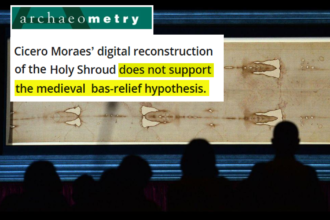
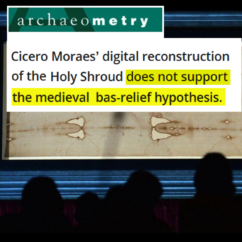
The Shroud was allegedly not laid over a body but over a bas-relief sculpture. This is the “new” theory proposed by Brazilian designer Cicero Moraes, but it is riddled with errors that undermine its methodological validity.
The Shroud of Turin, it is claimed, was not laid over a body but over a bas-relief sculpture.
This theory comes from a Brazilian designer named Cicero Moraes, known for his 3D reconstructions of the faces of many historical figures.
The Media Operation
The study was published just a few days ago in “Archaeometry“, and journalists are copy-pasting each other in their sensationalist coverage of the story.
However, the theory has been circulating since late 2024, when Moraes’ experiment—then unpublished—was presented as a “response” to the study by Italy’s National Research Council’s Institute of Crystallography (CNR), which made global headlines.
The Italian researchers, led by Liberato De Caro, compared the cellulose degradation of the linen in the Shroud with that of other cloths found in Israel dating back to the 1st century, finding a full match.
While yesterday the media ran with headlines like “The Holy Shroud dates back to Jesus’ time”, today those same outlets proclaim: “Medieval origin confirmed”.
It also seems suspicious that the study was published precisely to coincide with a major international conference on the Holy Shroud currently being held in Missouri.
This was pointed out to us by Alessandro Piana, UCCR contributor and one of Italy’s leading experts on the Shroud.
He was already familiar with Moraes’ conclusions, so we asked him for a detailed analysis to assess the actual value of this investigation.
The Shroud Spread Over a Sculpture
The Brazilian designer used free software to digitally simulate in 3D the dynamics of the fabric and map the contact area.
He then compared two scenarios: the projection of a three-dimensional human model and that of a bas-relief model.
According to his findings, the contact pattern generated by the bas-relief model is more consistent with the Shroud image, showing less anatomical distortion and greater fidelity to the observed contours.
Cicero Moraes’ Odd and Suspicious Choices
The first issue raised by Alessandro Piana is that the analysis does not address the physical and chemical elements related to the formation of the Shroud image. The focus is strictly methodological, centered on digital modeling and the comparative evaluation of contact patterns.
In doing so, the designer created a 3D model with human features, male, 1.80m tall, based on “adjustments” to Giuseppe Enrie’s 1931 photographs.
Why didn’t he use the much more modern 2002 photographs by Gian Carlo Durante?
Beard and hair were added to the model, while the eyes, nose, mouth, chest and other features were slightly modified to match the target individual, using digital deformation tools to approximate the model’s facial structure to that of the Shroud image.
Judging by the images attached to the study, the simulations were run only on the front side, not the back. Why?
This is a crucial omission: if one is to believe in the idea of a brilliant and unknown medieval forger, one must ask how he could have produced a bas-relief that reflects both the front and back imprint.
The Shroud, the Sculpture, and the Blatant Error
But, “the strangest and most absurd thing,” Piana tells us, is that the author commits a blatant error in the model’s creation: “placing the right foot over the left and the right hand over the left, whereas in reality the body is exactly the opposite.”
This clearly contradicts the Shroud: the photographic negative of the Shroud, showing how the body was laid in the cloth, reveals that the left foot overlaps the right (as it was nailed during crucifixion), and the left hand rests over the right.
The author defended himself by saying that “this approach simplifies the creation of visual material, focusing on the contact behavior as related to the most well-known Shroud photos.”
So, Piana notes, in order to stay true to the photos of the Shroud, Moraes builds a model that is the exact opposite of the Shroud.
Blunders, Errors, and Overlooked Elements
Another oddity is the author’s statement that “comparing the 3D model with the 2D image reveals a general similarity.” In a scientific study, “general similarity” may be insufficient.
The fact that Cicero Moraes likely knows little about the Shroud and the decades of research on it is evident in his claim that the bas-relief used as a matrix “could have been made of wood, stone or metal, and pigmented or even heated only in the contact areas, generating the observed imprint.”
Yet this theory has been debunked countless times since 1978, whether regarding pigment or heat. No technique has ever demonstrated that a bas-relief can produce a Shroud-like imprint with similar chemical and physical properties.
Moreover, there are no traces of pigments on the Shroud, and any image created by a heated bas-relief would be fluorescent—unlike the Shroud image.
Unsurprisingly, Moraes himself is forced to concede that it is still possible, however remotely, that the Shroud “could be the imprint of a three-dimensional human body.”
But the author’s blunders don’t stop there.
He even admitted that the simulation model used for the Shroud was configured as a dynamic fabric “using settings for generic cotton.” Someone should inform him that the Shroud is made of linen, not cotton.
And then there’s the recurring obstacle that thwarts such theories: the bloodstains on the Shroud prevented the image from forming underneath them. That is, the blood transferred from the deceased’s body to the cloth first, and only afterward did the Shroud image appear.
Another unresolved issue, Piana adds, is that this hypothetical forger would have had to find aloe, myrrh, and even pollens from plants that grow only in specific parts of the world—such as Zygophyllum dumosum, found only in the Sinai Peninsula and the Holy Land.
The pollen spectrum identified on the Shroud supports major theories about its origin: Holy Land, Turkey, continental and peninsular Europe.
Lastly, there’s the historical trail, which provides evidence of the Shroud’s existence as early as 1203, when—during the Fourth Crusade—French knight Robert de Clari saw it in Constantinople.
The Shroud Laid on a Sculpture: Nothing New
Moraes’ study, while visually interesting, adds little of value and instead seems to confirm a familiar pattern: whenever new data supports the Shroud’s historical authenticity, weak but media-hyped counter-narratives promptly emerge.
In the end, the debate continues not because the Shroud is understudied, but because none of the “skeptical” hypotheses has ever managed to replicate—even remotely—all of its features.
The only ones who came close were the physicists at ENEA in Frascati, who managed for the first time to create a coloration similar to that of the Shroud using a powerful excimer laser.
Those who truly seek the truth should start here.
Follow the author’s blog SHROUD insights
Author






5 commenti a Was the Shroud Laid on a Sculpture? A Study Full of Errors
Dear friends of this site, it seems that whoever wrote this article either didn’t read the article I wrote or didn’t understand what was written there. An example that easily refutes this approach is the complete involvement of the body with the fabric, which would generate even greater deformation. In other words, the fact that I simply placed the fabric on the body already highlights the structural problem and the inconsistency of the mark being a human being. I recommend carefully reading my article in Archaeometry. Best regards!
Thank you again for your work, that digital 3D approach give a measurable, visualizable and shareable experiment for a centuries‑old problem
Their critique are sterile and sidesteps your modeled principle entirely, If UCCR wants to engage in a meaningfully way they should attempt to reconstruct cloth-body vs. cloth-relief under your same software conditions and providing comparative visual contact maps, mesh data and then explain where they believe your simulation fails
Moraes’ article is simply junk science, and it’s a mystery how Archaeometry agreed to publish something like that. The referees were likely not experts on the Shroud and let inaccurate claims and unsupported conclusions slip through—neither backed by the results presented nor by existing scientific literature.
I know that more detailed analyses from actual experts will be published in the coming days.
The bas-relief theory was already debunked by Shroud scientists in 1978, and the only meaningful approach to the formation of the Shroud image remains the one involving excimer lasers.
Moraes should stick to reconstructing the faces of Beethoven and Santa Claus and leave the study of the Shroud to competent and qualified researchers.
Message from Alessandro Piana:
Dear, Cicero Moraes, the article was read and carefully evaluated. The blame for the media coverage of this work lies not with the author but with the journalists who—contrary to their professional ethics—did not evaluate the source. In other words, they didn’t read the article published in Archaeometry but merely read the abstract. It’s unfortunate to say, but it’s true. If only they had done more research, they would have noticed a passage (one of many) like this: The simulation model of the Shroud used for the support tests on the body model and the bas-relief was configured as a dynamic fabric “using the settings for a generic cotton.” However, let’s remember that the Shroud is a linen fabric, not cotton…
It is really strange that a journal like Archaeometry has published a work of this kind.
But the primary criticism of the Moraes study should be that Moraes is assuming that the image itself (not the blood stains) was generated by direct contact, whereas it is clearly photographic in nature, that is to say, a projection onto a more or less contoured plane.