
The Myth of Church Opposition to Heliocentrism: Copernicus Did Not Hide
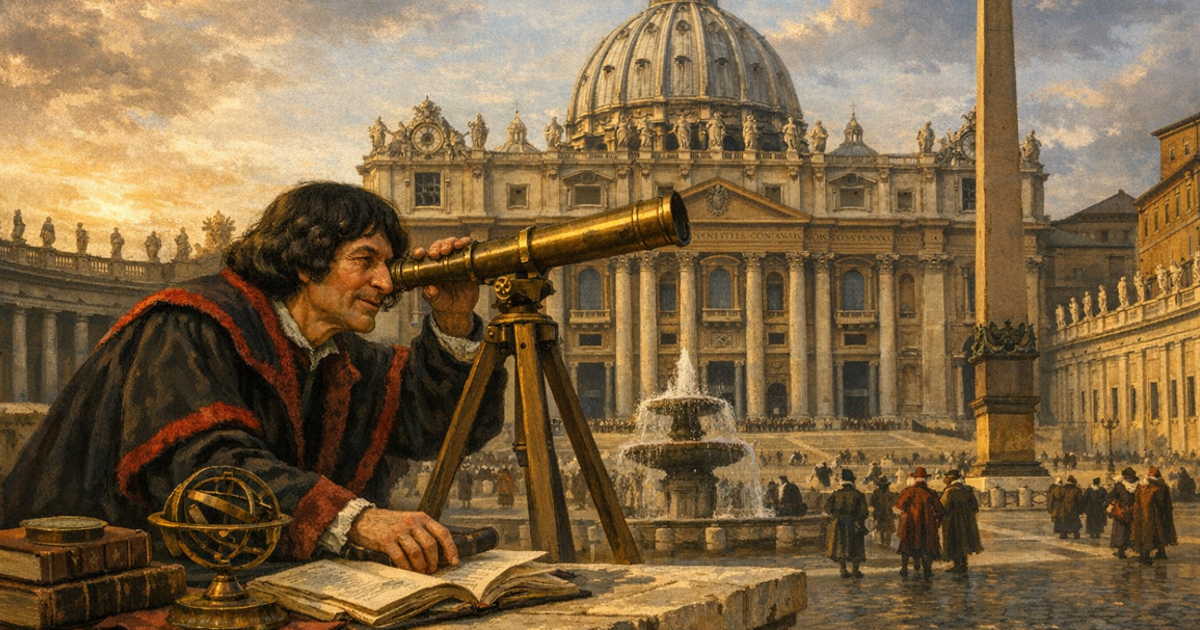
The false myth of the Church’s opposition to heliocentrism. Not only did Copernicus not keep his ideas secret, but he was sponsored by Popes and ecclesiastics.
The idea that Nicolaus Copernicus hid the heliocentric theory out of fear of the Church, publishing it only on his deathbed, is among the most widespread historical myths.
This narrative originated in the nineteenth century with the “conflict thesis” of Andrew Dickson White and John William Draper, now considered outdated by historians.
According to this view, Copernicus would have avoided ecclesiastical persecution thanks to secrecy and a delayed publication. It is not surprising that such “juicy” elements were repeated many times starting from 1896, becoming part of anticlerical folklore.
But the facts tell a different story.
In this article we briefly present the thirty-year research conducted by the renowned Harvard University historian of science, Owen Gingerich, contained in “The Book Nobody Read: Chasing the Revolutions of Nicolaus Copernicus“ (Penguin Books 2005).
No ban on replacing geocentrism
Copernicus was a practicing Catholic and worked for about thirty years as a canon in Warmia; he took minor orders and it is unclear whether he was ever ordained a priest.
He did not live in isolation or persecution, but was part of a network of ecclesiastics and humanists who supported his work, the most notable being Tiedemann Giese (bishop), Alexander Scultetus (canon), and Feliks Reich (canon).
Moreover, the cultural context was far from intellectually closed.
Already in the Middle Ages, scholars such as Nicole Oresme had hypothesized the motion of the Earth, while Thomas Aquinas acknowledged that astronomical models were not absolute truths but tools to describe phenomena that “some other theory might explain better”1“Summa theologica”, I, q.32, a.1, ad. 2.
Thinkers such as Nicolaus Cusanus, in his “De docta ignorantia” (1440), and Celio Calcagnini of Ferrara, in his “The heavens stand still, while the Earth moves” (1544), also discussed similar ideas without experiencing hostility, censorship, or condemnation.
Five years before Copernicus, Girolamo Fracastoro published “Homocentrica” (1538), in which he described in detail a complex system that eliminated Ptolemy’s epicycles and eccentrics, replacing them with a model based on concentric spheres.
Like Copernicus, Fracastoro also dedicated his book to Pope Paul III. And as we have already documented, the Pope was among the first supporters of Copernican heliocentrism.
There was no doctrinal ban against alternative models to geocentrism. The Ptolemaic system prevailed mainly for scientific and philosophical reasons, linked to Aristotelian physics and to the traditional interpretation of certain biblical texts.
Stay updated by subscribing to our new channels:


The Pope fascinated by heliocentrism
Copernicus also did not keep his ideas secret at all.
As early as around 1514 he circulated the “Commentariolus”, a summary of the heliocentric theory that spread among European scholars and Catholic bishops (such as his friend Tiedemann Giese), reaching figures such as Erasmus of Rotterdam.
Copernicus’s ideas were also known in Rome, so much so that in 1533 they were presented by the theologian Johann Albrecht Widmannstetter, secretary to Clement VII, before the Pope and members of the Curia in the Vatican gardens, arousing interest and curiosity. Present were Cardinals Franciotto Orsini, Giovanni Salviati, and the Bishop of Viterbo, Giampietro Grassi.
The pope was so fascinated by the heliocentric theory that he rewarded Widmannstetter with a precious manuscript by Alexander of Aphrodisias, who proudly noted on the first pages the circumstances in which he received the gift.
Not only that: Copernicus was explicitly encouraged by various ecclesiastics to publish his work.
Cardinal Niccolò Schomberg wrote to him directly in 1536, urging him to make known his discoveries about the “Earth in motion; that the Sun occupies the lowest, and therefore central, position of the universe”, inviting him “most earnestly, unless it troubles you, to communicate this discovery to scholars and to send me as soon as possible your writings on the sphere of the universe (Rome, 1 November 1536)”. He even offered to pay the shipping costs.
It is difficult to reconcile all this with the idea of a Church hostile or threatening toward heliocentrism.
Why did Copernicus publish late?
Why then did Copernicus publish the “De revolutionibus” so late?
The answer can be seen in the dedication of “De revolutionibus” to Pope Paul III, where Copernicus explains that he had feared ridicule and criticism from Aristotelian philosophers, not religious censorship.
In the Renaissance context it was normal to share new ideas first in private form, precisely to avoid premature attacks.
Another reason was awareness of the scientific difficulties of his theory. Heliocentrism at the time presented unsolved problems, especially with respect to Aristotelian physics. It is therefore not surprising that Copernicus hesitated.
It was finally thanks to the mathematician Georg Joachim Rheticus and his friend Bishop Tiedemann Giese that the work was published in 1543.
The main criticisms in religious circles came from Martin Luther (though the sources are unclear) and Philip Melanchthon.
In the Catholic sphere, negative reactions were rare and marginal, such as that of the Dominican Giovanni Maria Tolosani, whose work was never even published (though it may have influenced Tommaso Caccini, the Dominican preacher who in 1614 initiated the Galileo affair).
More generally, objections to heliocentrism were mainly scientific and lasted until the seventeenth century.
Some exceptions included astronomers such as Erasmus Reinhold, who used Copernicus’s calculations to improve astronomical tables, contributing even to the calendar reform promoted by Pope Gregory XIII in 1582.
When in the sixteenth century the Inquisition described Copernicanism as “absurd in philosophy,” it simply reflected the scientific consensus of Europe at the time.
Only with the arrival of “Philosophiæ Naturalis Principia Mathematica” by Isaac Newton in 1687 did the scientific consensus definitively shift toward heliocentrism.
The 2015 work of Christopher Graney2Setting Aside All Authority: Giovanni Battista Riccioli and the Science against Copernicus in the Age of Galileo, University of Notre Dame Press 2015, a member of the Vatican Observatory, shows how strong the scientific arguments against heliocentrism still were a generation after Galileo and why scientific consensus did not change until Newton.
The Church and heliocentrism: a false myth
In conclusion, Copernicus did not suffer any persecution or opposition from the Church regarding heliocentrism, nor was this the reason he delayed the publication of his book.
In late medieval culture, the Ptolemaic and Aristotelian orthodoxy was already being questioned, seeking a more elegant and accurate mathematical foundation for astronomy.
Copernicus did not keep his theories secret and was strongly encouraged in his work by important ecclesiastics, including several bishops, three cardinals, and the Pope himself.
His hesitation stemmed from the perception that Aristotelian scholastics would reject his thesis for physical and theological reasons. This indeed happened, and while Catholic objections were scarce, scientific ones persisted until the seventeenth century, when consensus shifted in favor of heliocentrism.
Author






0 commenti a The Myth of Church Opposition to Heliocentrism: Copernicus Did Not Hide