
Regnerus on Same-Sex Parenting Challenges: “Evidence Supports My Findings”
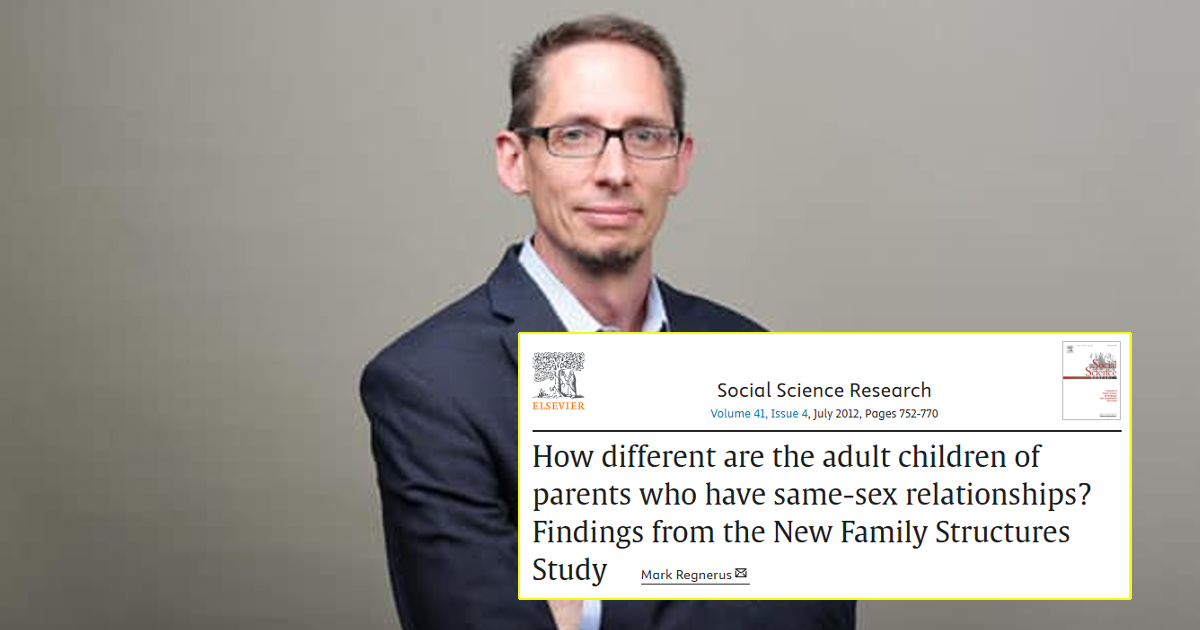
Guest of UCCR is researcher Mark Regnerus, whose study on the challenges faced by children of same-sex parents has recently been recognized by scholars at Cornell University.
It has been almost a year since the study by Cornell University.
A year of silence in which no one has dealt with it (except UCCR!). Why is that?
The fact is that an academic review of numerous studies concluded that no solid results emerge in favor of same-sex parenting, while critical issues remain in various social and family outcomes, especially those related to stability and family structure.
New research on same-sex parenting
In particular, sociologists at Cornell University stated that they were “surprised by the robustness of Regnerus’s results.”
They are referring to the American researcher whose 2012 study sparked an international uproar by concluding that children raised in same-sex couples showed worse outcomes in academic performance, employment status, mental health, substance use, incarceration rates, depression, and involvement with public assistance.
A kind of vindication for Mark Regnerus, who was falsely accused for years of poor methodological conduct, despite the fact that his research had passed both peer review and an internal investigation by the University of Texas.
Today, Regnerus is a guest of UCCR, and we asked him several questions 14 years after his study and one year after its endorsement by Cornell University researchers.
Stay updated by subscribing to our new channels:


The interview with Mark Regnerus
QUESTION – Professor Regnerus, in your well-known study you used the largest random national sample of young adults whose parents had same-sex relationships. Is it still the only one with such a large sample?
ANSWER – There are a variety of larger studies from multiple countries that yield some measures of interest—things like educational achievement, workforce participation.
But so far as I know, there has not yet been a comprehensive data collection effort that can evaluate many different types of outcomes, from the social to the economic to the psychological. It may well exist, but I’m not aware of it.
QUESTION – How did your study differ from most of the scientific literature on this topic?
ANSWER – My 2012 study differed in a few ways, including its comprehensive look at 40 different outcomes, ranging from retrospective evaluations of the respondent’s youthful experiences to their present-day situation. I am not familiar with another study so broad.
However, one point must be clarified: a large sample is not necessarily more important than a representative one. It is the latter that provides a reliable picture of reality.
Many studies, in fact, rely on “opt-in” samples, meaning people who voluntarily choose to participate. This ends up analyzing already motivated subjects whose characteristics inevitably influence the results.
This type of sampling is still very common in studies on sexuality.
“My study still holds up today”
QUESTION – Many critics raised methodological concerns at the time. More than a decade later, how do you respond to those criticisms today?
ANSWER – Then as now, none of those criticisms have convinced me, except for some minor observations that I had already acknowledged in 2012, relating to a few incorrect cases.
None of those methodological criticisms moved me then or now, except the minor ones I already noted in print back in 2012 (i.e., greater scrutiny of a small number of mistaken cases).
Thirteen years later, the disputes remain the same.
QUESTION – In what sense?
ANSWER – My critics refuse to consider whether key pathways to adult success in life—things like household stability—pose endemic problems for children raised by same-sex couples at levels beyond that noted in male-female couples.
The same is true for the biological connections to both a mother and father. These cannot be manufactured in a laboratory. Nor can they be manufactured by two men or two women. .
My opponents think these are irrelevant or to be “controlled for.” I disagree.
First, I knew my own data well, having collected it. It’s a hallmark of careful studies to know what its data reveals both at a basic, bivariate level and at a more complicated, multivariate level.
“I am not surprised by the endorsement”
QUESTION – As you know, a recent “multiverse” analysis conducted by two sociologists at Cornell University re-examined your study with millions of methodological variations, confirming its robustness. Did you expect it?
ANSWER – I was pleasantly surprised by the multiverse analyses conducted on my study and its data by the pair of sociologists. I was aware that such capacity existed, but was unaware of anyone working actively on it, let alone employing the method to assess my 2012 study, as well as that of its critics.
I was not surprised at their conclusions, for a few reasons. I knew my data well, having personally collected it, and a serious study must be robust both in simpler analyses and in more complex ones. If the data itself had contained spectacular problems, I would know it and would never have published the study using it.
Weaknesses in studies on same-sex parenting
QUESTION – And what do you say about the methodological weaknesses found in studies critical of yours and, more generally, in those supporting same-sex parenting?
ANSWER – That does not surprise me either.
I already knew at the time of their original publication that they were sculpted to undermine confidence in my results, using techniques to disallow cases (and hence diminish statistical power) from the models, employing outcomes as predictor variables, or displaying only statistical significance while hiding effect sizes.
In the end, all of this boils down to methodological disputes about how to analyze data between groups that have fundamental distinctions between them.
While I have no problem with such banal conclusions like the fact that same-sex households can yield children who perform well academically -in part the product of greater wealth than the average married mother and father enjoy- I have yet to see comprehensive analyses of a host of social and psychological outcomes that are at least as important as how one fares on standardized tests.
Read all the other “Friday interviews”
Author














0 commenti a Regnerus on Same-Sex Parenting Challenges: “Evidence Supports My Findings”