
Atheist Day: How New Atheism Gloriously Failed
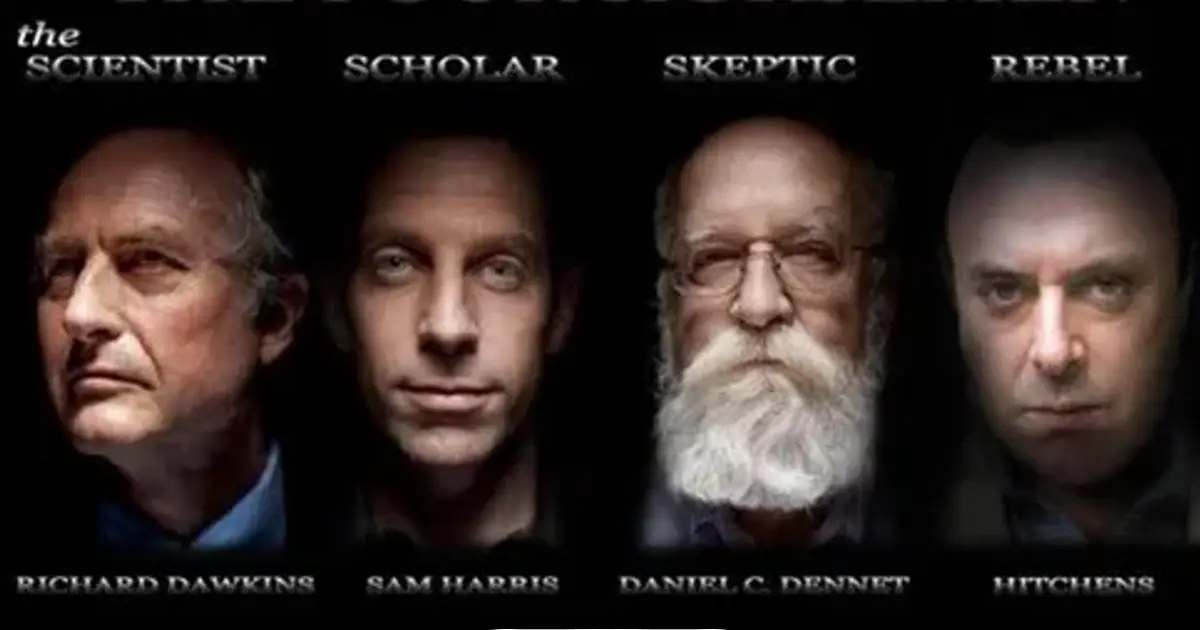
A few days ago it was Atheist Day: here are 5 reasons why the “New Atheism” movement died a natural death.
A few days ago, on March 23, “Atheist Day” was celebrated, to affirm the freedom not to believe.
On this occasion, we ask a question: what went wrong for the champions of “New Atheism”?
We are referring to the titanic intellectuals who for a decade pursued the greatest goal—after the Soviet one—of establishing a social culture radically devoid of God, turning irreligion into an aggressive and dogmatic fundamentalism.
The main figures were Richard Dawkins, Sam Harris, Daniel Dennett, Christopher Hitchens, Jerry Coyne, Michael Onfray, Michael Shermer, and PZ Myers.
Why did New Atheism fail?
Numerous observers have tried to explain the astonishing failure of new atheism, despite a society that was intellectually lazy, affluent, and consumerist, and that agreed with them on everything: the supposed anachronism of religious thought, the bigotry of moral judgments, the violence generated by religions, and the unhealthy mixing of politics and religion.
And yet, as the rationalist Scott Alexander observed, “in the bubble where no one believes in God anymore and everyone is fully concerned with sexual minorities and Trump, it is less painful to be a Catholic than a fan of Dawkins.”
Indeed, Alexander continues, only in the case of “New Atheism”, “modern progressive culture turned toward the ‘new atheists’ and, seeing itself, said: ‘This is truly stupid and annoying.’”
UCCR was born precisely during the years of fame of the “new atheists,” out of the need to provide a tool for believers “surrounded” by opinion-makers, intellectuals, and journalists. We followed the evolution of the phenomenon and its deflation, despite predictions that it would dominate the scene.
Having familiarity with the topic, we suggest five decisive factors to explain the disastrous end of “New Atheism.”
Stay updated by subscribing to our new channels:


1) The election of Obama
It may seem incredible, but former U.S. President Barack Obama delivered the first major blow to the “new atheists.”
First of all, his election removed the “common enemy” that had ensured unity within the movement.
Before 2008, the glue binding activists was the much-hated conservative George W. Bush. Biologist PZ Myers and Richard Dawkins (today bitter enemies) appeared together publicly to oppose Bush and became idols celebrated by the progressive establishment.
Secondly, the Obama administration—supported by major media and cultural circles—pulled the rug out from under them: it reshaped American (and thus Western) culture by making criticism of Islam politically incorrect.
In fact, “New Atheism” emerged in the aftermath of September 11, and for years Islam was the preferred tool for generalizing about religious violence.
Under Obama, however, it became a minefield, and the first to step on it were two leading figures, Sam Harris and Michael Onfray, who began to be viewed negatively and portrayed as racists even by progressive media.
2) Rejection by the academic world
After the publication of his bestseller “The God Delusion” (2006), Dawkins, together with the other “horsemen,” began to denigrate agnostics and “moderate atheists,” accusing them of tolerating religious opinions and refusing to take sides.
Over time, the entire academic world was accused of cowardice for not joining the attack on religion. One example was Coyne’s media campaign against the agnostic historian Bart D. Ehrman, author of works defending the historicity of Christ.
Another emblematic case was the media pressure by Sam Harris in the New York Times and against the scientific community to prevent the Christian geneticist Francis Collins from remaining head of the National Institutes of Health (NIH).
The attempt of “New Atheism” to enter and influence the academic world was explicitly stated at the 2006 Beyond Belief conference.
But the resounding failure was confirmed by the deep embarrassment expressed by non-believing academics themselves. For example, Nobel laureate Peter Higgs stated: “The problem with Dawkins is that he focuses his attacks on fundamentalists, but clearly not all believers are like that. In this sense, I think Dawkins’ attitude is fundamentalist, from the opposite side.”
Having lost the academic world, all their visibility depended entirely on media support, which gradually began to crumble, as seen above.
3) The response of believing intellectuals
Another reason for the decline of “New Atheism” lies in the entry into the debate of various Christian scientists, philosophers, and thinkers.
A new generation of believing intellectuals succeeded in presenting reasonable arguments in support of faith, showing that the “New Atheists” spent much of their time constructing straw-man arguments about religion, only to knock them down.
In his books, for example, Richard Dawkins strongly opposed a god that no one has ever believed in: the famous “god of the gaps”.
Some of these Christian intellectuals engaged directly with “New Atheism” by publishing books explicitly opposed to it, catching irreligious activists off guard. Among them:
- John Lennox, emeritus professor of Mathematics at Oxford University, author of “God’s Undertaker”;
- Amir D. Aczel, professor of Mathematics at the University of Massachusetts, author of “Why Science Does Not Disprove God”;
- Francis Collins, renowned geneticist, author of “The Language of God”;
- Kenneth R. Miller, emeritus professor of biology at Brown University, author of “Finding Darwin’s God”;
- Owen Gingerich, emeritus professor of Astronomy and History of Science at Harvard University, author of “God’s Universe”;
- Arthur Peacocke, theologian and biochemist at Oxford, author of “Paths From Science Towards God”.
More briefly, we also mention philosophers Alvin Plantinga, William Lane Craig, Robert Spaemann, Roger Trigg, Richard Swinburne, and Richard Schroder; physicists Gerald Schroeder, John Polkinghorne, and Russell Stannard; and sociologist Rodney Stark.
Finally, significant impact came from the surprising conversion to deism in 2005 of the “most famous atheist in the world,” philosopher of science Antony Flew, once a mentor of Dawkins.
4) The “elevatorgate” scandal
In 2011, a minor dispute about the behavior of participants at an atheist convention became known as “elevatorgate” and sparked the first major internal feud among irreligious activists online.
Feminist Emma Watson was sexually harassed in an elevator and publicly reported it, but was rebuked by leaders of “New Atheism” for risking negative publicity for their movement.
This episode marked the beginning of a break between the movement and feminism.
The situation worsened when Richard Dawkins made sexist remarks about the victim, hosted on the blog of PZ Myers. The community split between feminists and Dawkins supporters.
At that point, PZ Myers turned against Dawkins, labeling him racist and Islamophobic, alongside Sam Harris.
The media amplified everything and even named Dawkins among the worst misogynists of the year—a devastating blow to the movement.
Gradually, more commentators began to turn against the “priests of atheism”. Biologist Jerry Coyne tried for a time to defend Dawkins and Harris but eventually burned out. Today, much of his blog focuses on cats.
Finally, the premature death of Christopher Hitchens in 2011 further weakened the movement.
The elevatorgate scandal was a fatal crack that led to the implosion of the movement, later amplified by the recent discovery that its leaders remained linked to financier Jeffrey Epstein even after his conviction.
Today the community is fragmented into a free-for-all, also divided over gender issues.
5) Richard Dawkins
The creator himself turned out to be the worst cause of his creation’s demise.
Richard Dawkins was the most prominent figure, a YouTube celebrity and tireless preacher. After “elevatorgate,” however, he became a target of internal criticism.
His downfall, however, came with social media—especially Twitter. Without editorial filtering, the zoologist revealed aspects of himself that had previously remained hidden.
With nearly a million followers, his sexist and racist remarks, his defense of “mild pedophilia”, encouragement of infidelity, and criticism of mothers who give birth to children with Down syndrome did not go unnoticed.
For years he has become a mockery online, especially after opposing the transgender movement.
According to Vice, “he has dishonored atheism”. His books have flopped, and even his most important scientific theory, the “selfish gene”, has been challenged by physiologist Denis Noble.
In recent years, Dawkins has tried to regain ground, first calling himself “agnostic”, then even a “cultural Christian.” In 2015, he even defended the presence of the Lord’s Prayer in UK cinemas.
The natural death of New Atheism
Primatologist Frans De Waal accused the “new atheists” of being “obsessed with the non-existence of God, going on media campaigns, wearing T-shirts proclaiming their lack of faith, and calling for militant atheism.”
But he also asked: “What does atheism have to offer that is worth fighting for in this way?”
This is the question that remains. Defining oneself as “anti-” allows only limited survival; without offering meaningful answers to life’s meaning, failure is inevitable.
Philosopher Philippe Nemo wrote a remarkable epitaph for “New Atheism,” which we reproduce in full:
“Despite attempts to eradicate Christianity, atheism has died a natural death; it was not killed, since the modern world has given—and continues to give—it every opportunity to defend its cause and offer humanity new reasons for living. Opportunities wasted, because it failed to keep its promises, did not fulfill the intellectual programs that constituted its only attraction, and did not succeed in showing that man is less miserable without God than with God.”1P. Nemo, The Beautiful Death of Modern Atheism, Rubbettino 2016, pp. 5–6.
Author











0 commenti a Atheist Day: How New Atheism Gloriously Failed