
Unpublished Letter of BXVI: “The Eucharist Is the End of Paganism”
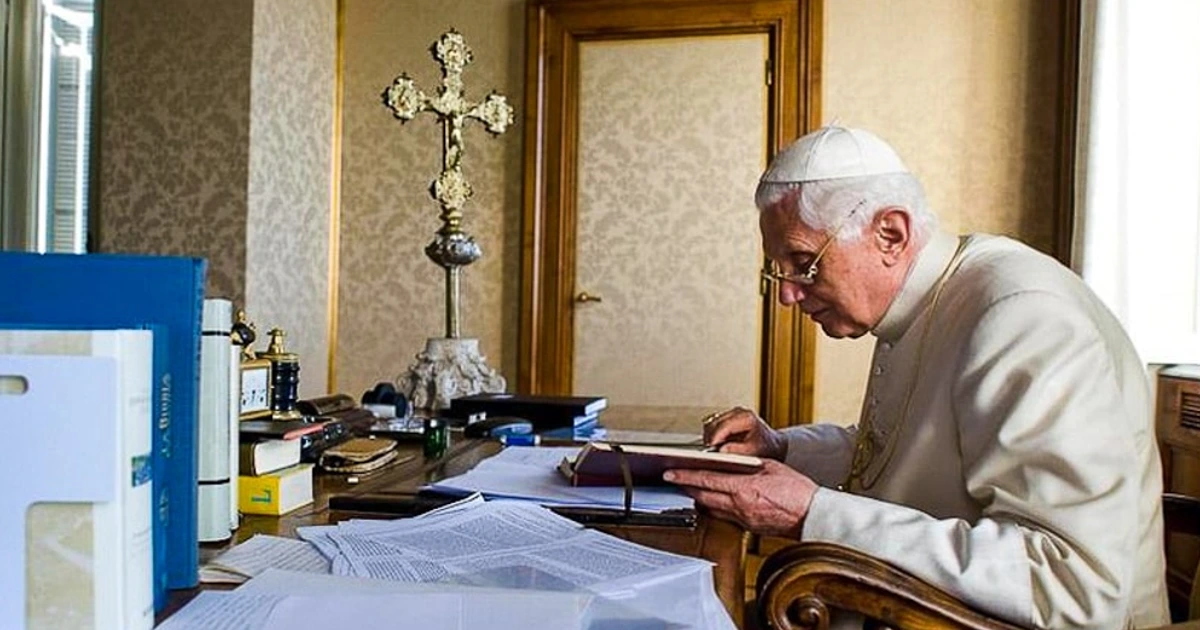
One year before his death, Benedict XVI wrote a profound reflection on the Eucharist and Christian prayer. Here is the full text.
A few days ago, a previously unpublished letter by Benedict XVI was made public.
It is dated April 27, 2021, just over a year before his death.
The text appears in the volume “The Faith of the Future“, published by Cantagalli, which collects rare or previously unpublished writings of Joseph Ratzinger.
The work opens with a preface by Cardinal Pietro Parolin, Vatican Secretary of State, who notes that the question of the future of faith is now central in a world marked by uncertainty, fear, and rapid change.
In this context, Benedict XVI’s letter – titled “Introduction: Thoughts on Christian Prayer” – appears as a kind of spiritual synthesis of his theological thought in the final years of his life.
Below is the text of the letter reproduced in full.
by
Benedict XVI
In general terms, prayer is the fundamental religious act: it is, in a certain sense, the attempt to enter concretely into contact with God.
The distinctive feature of Christian prayer is that one prays together with Jesus Christ and, at the same time, one prays to Him. Jesus is true man and true God and can therefore be the bridge – the pontifex – that makes it possible to overcome the infinite abyss between God and man.
In this sense Christ is also, in general, the ontological possibility of prayer. For this very reason He is also the concrete guide of prayer. His disciples, who had seen Him pray, therefore addressed Him with this request: “Lord, teach us to pray” (Lk 11:1).
They remembered that John the Baptist had also taught his disciples to pray, but they knew that Jesus was infinitely closer to God even than the greatest religious figure: John the Baptist.
The two characteristics of prayer
Two fundamental characteristics of prayer thus emerge: one concerns being, the other awareness.
They are deeply intertwined. The profound bond with God consists, in general terms, in dwelling with Him.
In the school of Jesus’ prayer our knowledge of Him grows, and our closeness to Him also increases. In this context we must also recall the criticism of Jesus directed at erroneous or insufficient forms of prayer.
The reference to the Cross, evident throughout His preaching and already present in the prophetic words that precede Jesus – “To obey is better than sacrifice, and to listen better than the fat of rams” (1 Sam 15:22) – appears here with clarity.
Christian prayer, insofar as it is prayer together with Jesus Christ, is always anchored in the Eucharist, leads to it, and is fulfilled in it.
The Eucharist as the end of paganism
The Eucharist is prayer carried out with one’s whole being. It is the critical synthesis of worship and true adoration. In it, Jesus pronounced His definitive “no” to mere words and His “no” to animal sacrifices, and in their place He set the great “yes” of His life and His death.
The Eucharist thus represents the definitive critique of cultic worship and, at the same time, of worship in the broadest sense of the term.
The Fathers of the Church rightly characterized it on the one hand as the end of paganism as a religious custom, and on the other as the defining mark of Christianity itself as prayer.
I believe we should reflect much more deeply on this fundamental opposition.
This fundamental orientation of the dramatic history of Jesus’ prayer allows us to understand the full realism with which He carried out His proclamation. The parable of the man who did not want to get up to give bread to his friend clearly says that prayer is always also a overcoming of our inertia, which inspires so many excuses for not getting up.
To pray means to oppose this inertia of the heart, and therefore it also means the humility of bringing before God even the small things of our daily life, asking for His help.
Can we disturb God with our needs?
One final point.
Often, the realistic and humble way of praying is presented as an objection to prayer of petition as such: the idea that proper prayer should always and only be praise of God, not continual begging.
This would be senseless, as if God could not or should not be disturbed by our small needs.
In reality, we need God precisely in order to live our daily life starting from Him and orienting it toward Him.
We must not forget that our Father is the One in whom we place our trust. The Lord’s Prayer, in fact, is composed of seven petitions.
To ask God means above all to purify our desires, so that we may present them to Him and insert them into the “we” of the family of Christ.
Author






0 commenti a Unpublished Letter of BXVI: “The Eucharist Is the End of Paganism”