
The Brain Has a Sex: The Real Myth Is Feminist Ideas
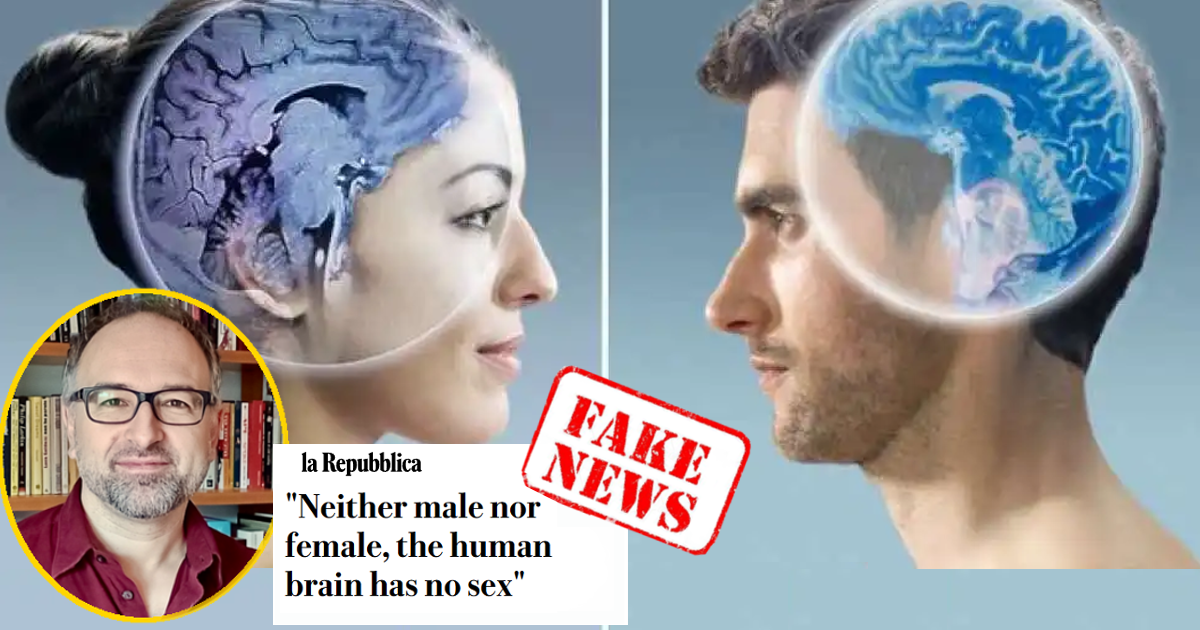
Neuroscientist Martina Ardizzi argues that sex differences in the brain are myths. Here is what expert Marco Del Giudice (University of Trieste) thinks in this interview.
The human brain has no sex: masculine and feminine are just clichés!
This is what neuroscientist Martina Ardizzi stated at the recent Festivaletteratura in Mantua, explaining that neither the brain nor hormones can distinguish men from women.
The watchwords of the interview published in “Repubblica” are “myth”, “false myth”, “cliché”, with the aim of reducing or eliminating biological differences to emphasize environmental conditioning. An approach typical of gender studies.
Ardizzi cites studies and research in support of her view; this is why we sought a comment from Marco Del Giudice, professor of Psychometrics at the University of Trieste and author of over 120 scientific publications on behavior, evolution and psychological development with particular attention to evolutionary psychology and gender differences.
Prof. Del Giudice had already been a guest of UCCR in 2022 precisely on the topic of gender studies.
The brain and sex: the interview
QUESTION – Prof. Del Giudice, let’s go straight to the point raised by Dr. Ardizzi: are there “two brains”, male and female, or is that a cliché?
ANSWER – There is no such thing as two rigidly distinct kinds of brain; however, there are many average differences between male and female brains (in size, conformation of the cortex, connections between different areas, and especially neurochemical functioning) which, taken together, create a substantial difference at the statistical level.
Of course, there is also enormous individual variability within the two sexes, in the brain as in behavior, and countless different ways of being male or female.
QUESTION – What does this mean?
ANSWER – Saying that there are large statistical differences but also enormous individual variability may seem paradoxical, but just think of people’s faces: there are not two rigidly distinct kinds of faces, one for men and one for women.
On the contrary, there are countless different faces, with features mixed in varying degrees so that many men have at least some feminine characteristics (for example eye size, mouth shape, eyebrow shape, jaw width, etc.) and many women have at least some masculine characteristics.
And yet, with only rare exceptions, our combination of facial features clearly identifies us as men or women, and it would be absurd to claim that masculine and feminine faces do not exist. The same type of reasoning can be applied to differences at the level of the brain, or to those in personality traits.
QUESTION – So the idea that there is no clear separation has some truth in it?
ANSWER – Yes, but this idea is often ideologically exaggerated, and used to deny or minimize differences that do in fact exist. That of gender differences is obviously a hot-button topic, one with lots of important implications for schools, work and society.
Unfortunately, the cultural and scientific circles most influenced by feminism have locked themselves into a self-referential “bubble”; even if they are often motivated by a sincere intention of “debunking myths”, they end up disseminating and reinforcing what are in fact myths inherited from the 1970s.
For istance the idea that gender differences are a product of culture and socialization, that differences at the brain level are non-existent or in any case unimportant, that gender stereotypes are always unfounded and harmful, and so on.
Gender studies are outdated
QUESTION – And yet, these statements are still presented as scientifically modern and even cutting-edge.
ANSWER – Those who follow mainstream sources usually don’t know how deeply these ideas have been called into question, because everything that confirms the beliefs of the “bubble” is given space and dissenting voices are not even considered.
To counter this cultural inertia I wrote a short primer (in Italian) where I take stock of the state of the science and offer a fairly substantial bibliography for those who want to learn more about these topics.
I have also worked to build bridges of dialogue between researchers with contrasting positions, for example by organizing this international workshop, with presentations, discussions and debates all available online.
Biological and environmental influences on the brain
QUESTION – Returning to the interview, Dr. Ardizzi argues that because the brain is highly plastic, it is difficult to distinguish between biological and environmental influences.
ANSWER – Plasticity is certainly a foundational quality of the brain; without plasticity it would be impossible to even learn new information and behaviors.
But plasticity at the individual level does not imply that the statistical differences between males and females are due to environmental influences; this “leap” is not justified either from a logical or empirical standpoint.
Here’s an analogy: muscles are also plastic and can be strengthened with training, but men have greater muscular strength and mass thanks to biological factors, not only because they train more. Indeed, gender differences remain large even among athletes who train at the highest levels (such as weightlifting champions).
One should also note that it’s easy to overestimate the plasticity of the brain: genetic studies show that both brain anatomy and functioning have a substantial hereditary basis, which is often stronger than the environmental component.
Distinguishing biological and environmental influences is by no means trivial, but we have several methods that provide valuable information, from cross-cultural research to studies on developmental anomalies linked to sex hormones (for references on these topics see here).
That said, in my opinion the more interesting question is how biological differences can modulate and “channel” the effects of the environment (for example by attenuating them, amplifying them, or causing males and females to seek different kinds of experiences) in ways that lead to different outcomes in the two sexes.
QUESTION – Ardizzi argues that not even hormone levels reflect markedly biological differences. For example, although men have “a bit more” testosterone than women, the levels of this hormone change depending on environmental stimuli. She cites in particular a study in which, by having actors play dominant roles, testosterone levels rose especially in women.
ANSWER – It may be useful to clarify that “a bit more” means at least ten times as much, a difference so clear-cut that the minimum normative testosterone levels for men are higher than the maximum levels for women.
Saying that testosterone is not a “male” hormone because women also produce it would be like saying that a beard is not a male trait because women have facial hair. That strikes me as an ideological stance that easily leads to losing sight of the facts.
The actor study Dr. Ardizzi refers to is probably this one from 2015. It was conducted on a very small sample of just 41 people, with methodological weaknesses that were noted right away.
Over the years. there have been several other studies that attempted to raise testosterone levels by having people adopt dominant postures; to date, the verdict is that these interventions can briefly influence subjective experience, but not hormone levels. It is also increasingly doubtful whether they can actually change behavior (for full details see here and here).
I want to stress that there is nothing strange about the possibility that testosterone and other hormones may respond in a “plastic” way to environmental circumstances, especially if prolonged over time; as I noted earlier, plasticity at the individual level does not mean that differences between males and females are mainly due to the environment.
However, the idea that simple social manipulations (such as assuming a dominant posture) are enough to appreciably alter testosterone levels has been proven unfounded. In light of the last ten years of research, this hormonal system appears to be decidedly less malleable than it is sometimes believed to be.
Feminist myths about men and women
QUESTION – Is it true that women are considered more emotional only because society allows them more freedom to express certain emotions?
ANSWER – This is a “classic” feminist assumption: to many, it feels almost obvious that it must be so, but in fact there is no evidence that this is the correct explanation.
On the contrary, this explanation clashes with the fact that differences between men and women in emotional expressiveness, and in particular in the frequency of crying, tend to increase (rather than decrease) in countries with greater gender equality (see for example here and here).
It is true that differences are more marked in people who identify with traditional gender roles, but this does not mean that identification is the main cause of the differences. It is very likely that, for example, men with more masculine personality traits (partly due to genetics and exposure to androgens in early development) are less emotionally expressive, and at the same time more likely to identify with traditional male roles.
In this regard, it is very interesting to consider the reports by girls who start taking male doses of testosterone during gender transition: one of the most common psychological experiences is that some emotions suddenly become less intense and urgent; the need to cry diminishes, while the aggressive aspects of anger are amplified. People often report being taken by surprise by these emotional changes, which suggests they are not simply self-fulfilling expectations.
QUESTION – Moving to more cognitive aspects, Ardizzi argues that males develop better spatial skills because they are permitted to explore the environment more and play more active games.
ANSWER – What I said earlier about emotions applies just as well to cognitive abilities: it is true that spatial skills are to some extent “plastic” and can be improved with practice, but there is no convincing evidence that the difference between males and females is explained by disparities in how children are treated (I discuss this issue in some more detail here).
The fact that, from a very early age, males tend to prefer more active games and explore more than females is a constant across different cultures, and probably contributes to amplify and consolidate different cognitive predispositions.
Too often, discussions of sex differences are simplified in all-or-nothing terms: if plasticity exists, then biology does not matter, and everything can be explained by social factors. I think this is a highly misleading way to approach these topics.
The fact that certain differences have a biological basis does not mean they cannot respond to certain aspects of the environment; conversely, the existence of certain forms of plasticity does not mean that sex differences are arbitrarily created by the environment—in fact, they can still prove robust and deep-rooted.
QUESTION – In her intervention, Ardizzi refers to a new study claiming that the differences in mathematical abilities that emerge in the early years of school are not due to biological factors.
ANSWER – The study cited in the interview is a really good one, both rigorous and statistically sophisticated.
The authors show that gender differences in mathematical abilities emerge between first and second grade, and that this trajectory does not depend on the fact that children simply grow older, but rather on how long they have attended school.
These findings are compatible with the idea that the differences are entirely due to what happens in school, which is the preferred interpretation of both the study authors and Dr. Ardizzi. But they are equally compatible with the possibility that the differences do not manifest themselves until children actually begin to learn mathematics, and become increasingly apparent as children learn more advanced concepts (a process likely amplified by differences in interests between males and females).
First grade might be a particularly effective period for interventions, but it is far from clear that gender differences will prove so malleable, or that the potential effects of interventions will be maintained over time, particularly if (as I believe) cognitive abilities develop in an interplay with interests and preferences.
As in many other cases, a biologically oriented perspective helps keep one’s feet on the ground, without expecting “miraculous” results, and—most importantly—without automatically treating every difference as an injustice that must be remedied as soon as possible.
Read all the other “Friday interviews”
Author










0 commenti a The Brain Has a Sex: The Real Myth Is Feminist Ideas