
Shroud, A Rumor in a Medieval Document Peddled as Proof

A 1370 rumor in a medieval document about the Shroud is turned by the media into evidence against its authenticity. Nicole Oresme, without ever having seen it, reports a “they say that” the Shroud was used to deceive the faithful. Where is the news?
by Alessandro Piana*
*scholar and international specialist on the Shroud
Since the beginning of August, the Shroud has been under attack.
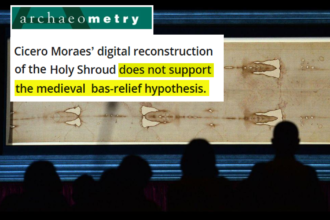
First the study by Cicero Moraes, which we already discussed.
Yesterday a preview in the Italian newspaper “La Stampa” of a publication in the journal Journal of Medieval History, which the Turin daily presented as follows: “The University of Louvain has found in a medieval document the oldest testimony about the Shroud. It dates back to 1370 and confirms that already in the Middle Ages it was known that the relic was not authentic”.
The news was picked up today by major international newspapers, such as The Independent.
What the new study on the Shroud says
According to the study conducted by researcher Nicolas Sarzeaud of the Catholic University of Louvain, a passage from the Problemata of Nicole Oresme, a French theologian and philosopher of the 14th century, would prove that already in 1370 the Holy Linen was known as an artifact made to defraud the faithful.
But what are the real facts?
During the review of an unpublished treatise by Nicole Oresme, the two researchers Alain Boureau and Béatrice Delaurenti highlighted a mention of the Shroud of Turin, written between 1350 and 1382 (probably after 1370), the date of Oresme’s death.
According to what Sarzeaud writes in his study, the interest would be to underline the existence of the Shroud of Turin about twenty years earlier than previously known: the well-known period of the Lirey Controversy (1389–1390), which has already been discussed on UCCR (in Italian).
In what way does this document enter specifically into the field of the Shroud?
For Sarzeaud, Nicole Oresme’s approach is that of a rationalist ante litteram, as can be inferred from this passage presented in the article:
«The originality of Oresme’s position lies in his attempt to provide rational explanations for unexplained phenomena, whether miraculous or prodigious, rather than interpreting them as divine, demonic, or due to an “unknown influence” (influentia ignota). His is the epitome of a naturalistic approach, derived from the transformation of Scholasticism in the 13th century, which approached so-called magical phenomena such as miracles from a new perspective. However, this naturalistic approach was increasingly challenged in the mid-14th century, when magical practices and their demonological interpretations gained ground, justifying new methods of repression».
From this premise follows the presentation of the text with the reference to the Shroud, relegated to a bibliographical note, and which should be cited in full:
«I do not need to believe those who say: “So-and-so performed this or that miracle for me,” because in this way many clerics deceive others, inducing them to bring offerings to their churches. This is clear from the example of the church in Champagne, where it was said that it was the Shroud of the Lord Jesus Christ, and from the seemingly endless number of others who have invented this or that».
This is the only reference to the Shroud!
The Medieval Document on the Shroud? Just a “Rumor”
This fragment proves nothing, and does not say that Nicole Oresme ever saw the Shroud of Lirey directly.
Somewhat as did Pierre d’Arcis, Oresme also speaks by hearsay («it was said that…»).
The short passage becomes the pretext in the study to recall the well-known bishop of Troyes, Pierre d’Arcis, and his beliefs about the artificial fabrication of the Lirey cloth, as well as his extremely rational approach like that of the men of his time (for those who do not understand the reference we refer to a previous article).
How the media invent evidence
Now it is only necessary to understand how a testimony based on «it was said that» can corroborate the subtitle of the article published by the newspaper La Stampa: «Confirms that already in the Middle Ages it was known that the relic was not authentic».
The passage just quoted simply speaks of the possible (especially economic) deception perpetrated against the faithful.
Without detracting from the importance of the direct study of historical documents, fundamental to the understanding of the past, where is the news?
That around 1370 there was a person who, by hearsay, considered the Shroud a forgery? And, in doing so, would be the second to leave testimony of his thought? The second, moreover, in an entire century.
Step by step—or rather, ten years at a time—we will come to discover other authors who considered the Shroud a forgery without ever having seen it, but only by simple hearsay.
The forger and the unrepeatability of the Shroud
But if in the 21st century, with all the technology possible available and with an exorbitant number of scientific articles demonstrating the impossibility of reproducing the Shroud image, there are people who believe in the artificial and medieval origin of the artifact, should we really be concerned about a 14th-century commentator who speaks by hearsay?
Here he comes again on the horizon: the medieval forger.
A phantom luminary of falsifications with foresight, who, though he could have become rich and famous thanks to his skill in creating still irreproducible images of the Christus patiens and in complete contradiction with the iconography of the time, instead of enjoying his skill and distributing fake relics throughout Christendom, decides to make only one copy to send to Lirey with the precise intent of making everyone gullible.
Including us, almost 700 years later.
If the Middle Ages produced such a man capable of surpassing 21st-century technology, then we have not discovered the Shroud, but the greatest forgotten genius in history.
Too bad that no one ever saw him, just as Nicole Oresme never saw the Shroud on which he doubted authenticity based on hearsay.
Follow the author’s blog SHROUD insights
Author








0 commenti a Shroud, A Rumor in a Medieval Document Peddled as Proof