
Moses found by archaeology? “Why I defend my discovery”
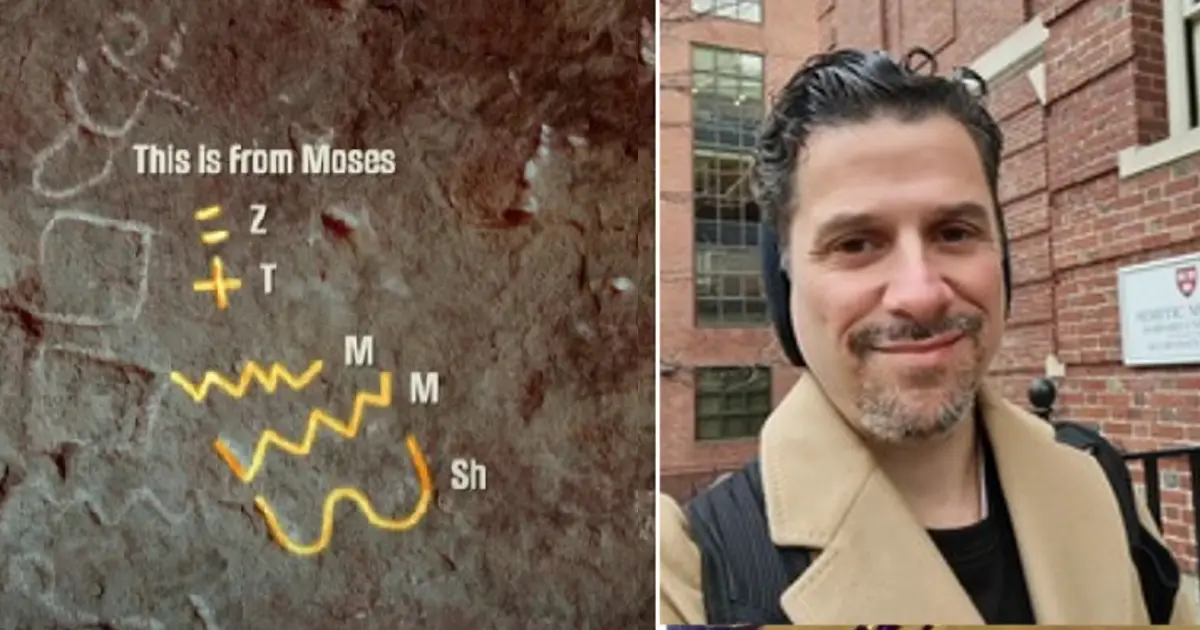
The Moses of the Bible and archaeology: traces found in a Sinai mine. UCCR interviews the author of the potential discovery, epigrapher Michael Bar-Ron.
• The name of Moses among the rocks of Sinai? An explosive discovery (08/08/2025)
At the beginning of August we talked (article in Italian) about a potential discovery: an archaeological trace of the Biblical Moses.
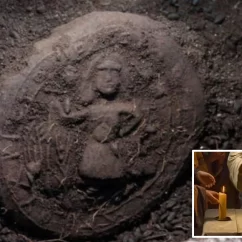
A proto-Sinaitic writing was indeed found in an Egyptian mine at Serabit el-Khadim, in the Sinai, and it is said it could refer to Moses.
The author of this interpretation is Michael Bar-Ron, an epigrapher specializing in proto-Sinaitic writing and a researcher at Ariel University (Israel).
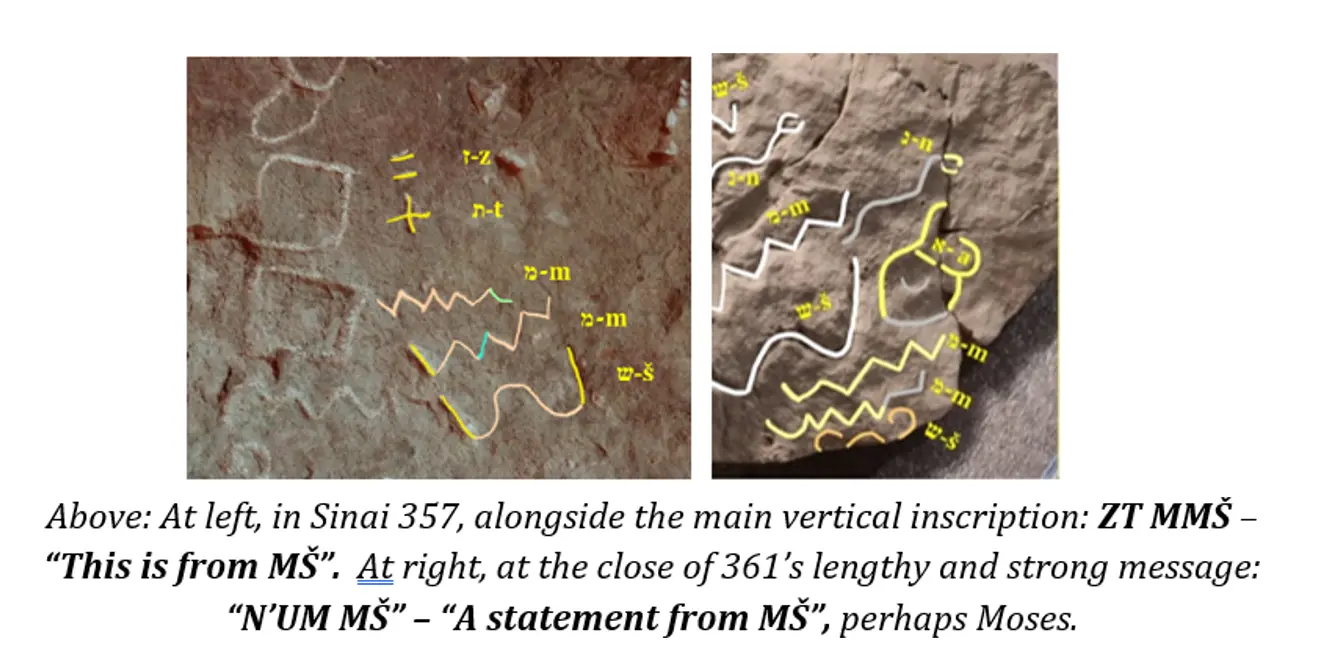
He is the one who has codified two inscriptions, in particular, with the phrases “this comes from Moses” and “a saying of Moses”.
It could be the first extra-biblical testimony of the great biblical leader, but some scholars have criticized the interpretation, while others, such as Bar-Ron’s academic supervisor, Pieter van der Veen, have expressed support. The discovery is still awaiting peer review.
In the meantime, we wanted to learn more; below is the interview with the author of the discovery.
Interview with epigrapher Michael Bar-Ron
QUESTION – Prof. Bar-Ron, what epigraphic and paleographic evidence convinces you that the inscriptions contain a reference to the Biblical Moses?
ANSWER – My reading is grounded in a systematic, multi-year comparative study of the entire Proto-Sinaitic corpus from Serabit el-Khadim and related sites.
I examined originals and casts (including at Harvard’s Museum of the Ancient Near East) using shifting-light photography and high-resolution imagery, and then compared letter forms across dozens of inscriptions.
In both Sinai 357 and Sinai 361, the sequence of signs aligns closely with expected forms for zayin, tau, mem, mem, and shin, in early that early Semitic script, yielding the phrase zot m’Moshe (“this is from Moses”).
In Sinai 361, we’re speaking of the glyps for nun, aleph, mem, mem, mem, and shin, yielding the phrase n’um Moshe (“so says Moses”). Both in the same, corresponding place on the stone surface in relation to the rest of the text.
QUESTION – And is there consistency with the other inscriptions found at the same archaeological site?
ANSWER – Yes, the identification is strengthened by parallel letter shapes in all other proto-Sinaitic inscriptions found at the site, and by consistent spacing, sign order, and contextual syntax.
My letter ID’s are based on the work of giants in the field, of earlier generations down to today. There is nothing controversial in that alphabetic sign base.
In Part I, they are organized as a definitive list of the proto-Sinaitic letter-signs, based on their hieroglyphic and cuneiform roots. In Part II an epigraphic analysis is made by which several inscriptions, these included, are revealed to be by the same common hand.
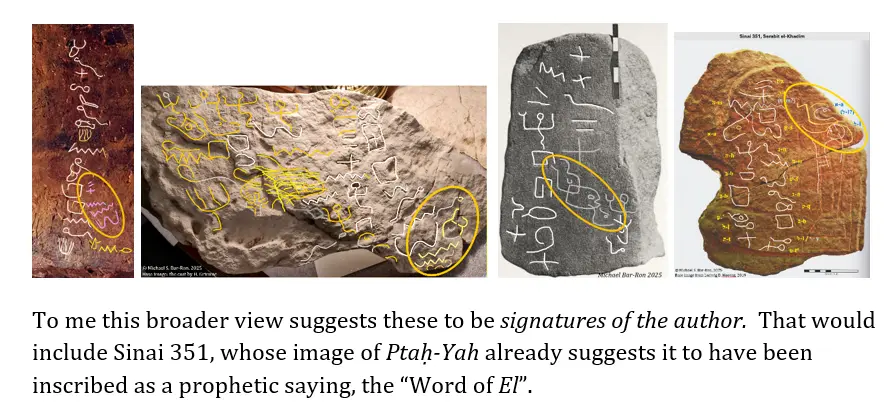
Moreover, these two name attribution elements are among 4 across the broad set of inscriptions I studied. in which we find such attributions/signatures of the speaker or author.
The discovery of Moses, response to criticisms
QUESTION – You will know that some scholars, such as Egyptologist Thomas Schneider, have called this interpretation “completely unproven and misleading,” arguing that arbitrary identifications of letters can distort ancient history. How do you respond to these criticisms?
ANSWER – I agree entirely that Proto-Sinaitic is challenging, and I welcome critical review.
However, my readings are not isolated guesses at letter shapes — they are part of a coherent framework I call “clades,” groups of inscriptions linked by vocabulary, phrasing, letter forms, and thematic content. The same patterns recur in multiple pieces, making the identification less arbitrary and more a matter of pattern recognition.
It’s important to note that the possible Moshe references were discovered very late in my research and are not the foundation of my thesis. My broader argument for Mosaic influence rests on many mutually reinforcing inscriptions, with or without explicit name attributions.
QUESTION – But what do you answer to Prof. Schneider?
ANSWER – Anyone in the field who actually studies the 214 page work –which I cannot believe that Schneider did — would find his comment unfair to the point of obscene.
On one hand, no work is above the constructive peer critique. I, for one, have eagerly sought out such criticism over the past years. At times I felt forced back to the drawing board on several inscriptions, even publicly recanting earlier readings.
So with no false humility, aware that my readinigs my evolve further, I have yet to learn of anyone who has pursued precision and accuracy more relentlessly in this field. In my Introduction, I even discuss to the role of inner bias among scholars.
No one who reads the work can escape the presentation of a strong critical methodology, relating to the work of my predecessors and even to differing opinions among my colleagues. In transparent fashion, the conclusion even reveal points of doubt I still have on a certain inscription that requires future study.
QUESTION – Did you collaborate with anyone in the realization of your study?
ANSWER – Yes, I have Hebrew philologists helping me to avoid anachronism, concerning how Proto-Hebrew has evolved.
That besides the fact that, with no arrogance, I am an Israeli Torah scholar, deeply fluent in our TaNa”Kh, the Hebrew Bible, and oral traditions. This work is easier for me than those for whom Hebrew is no more a living language than Akkadian or Sumerian, not harder.
The author of the writings is an educated leader
QUESTION – You claim that the linguistic style and poetic structure of the inscriptions indicate a single educated scribe, consistent with the biblical figure of Moses. Why couldn’t they simply be anonymous carvings made by common people?
ANSWER – Several factors point to a single, trained Semitic scribe behind a subset of 7–8 inscriptions, including 357 and 361:
- Recurrent vocabulary and rare word forms;
- Consistent poetic and parallelism structures;
- Uniformity in letter morphology despite variations in medium;
- A shared thematic focus on El worship and rejection of the Baʿalat/Hathor cult, including altered or defaced votive inscriptions
This level of stylistic and theological coherence is not what we expect from unrelated, casual carvings. It fits better with the output of a literate leader or high-level scribe — which in biblical tradition, Moses is portrayed as being.
QUESTION – And couldn’t it have been another Moses?
ANSWER – I never said they couldn’t have been written by another Moses, other than the biblical Moses.
But as I mentioned above, we’re speaking of one scribe for a group of inscriptions, not plural scribes.
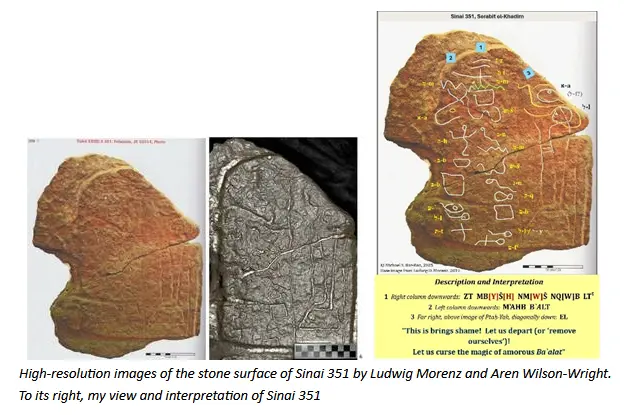
Inscriptions that bear readings that clearly laud and pray to El, and utterly denigrate the cult of Ba`alat – the very likely source identification of the ‘Golden Calf” tradition – even inciting violence against the cult. They bear the signs of poetic and prophetic flare, as seen in Sinai 351 and Sinai 358.
Considering the evidence of the Temple of Ba`alat having been burned down at an appropriate time, and all this occurring within close view of the twin mounts “Jebel Saniyah” and “Jebel Ghorabi” (a hidden, ancient group’s “Mount Sinai and Mount Horeb).
Two words found across these inscriptions are בש-“Bosh”, “be ashamed”, and נמש-“Nimosh”, “let us depart”, are only too appropriate for a Moses-like figure, as are many other elements found.
Below is a Sinai 353, my interpretation and reading at right, next to an original high-resolution image in Morenz (2019).
Moses and archaeology: the date of the inscriptions
QUESTION – Some scholars argue that the dating (around 1800 BC) and the linguistic context of the inscriptions are too uncertain to link them to Moses or the story of the Exodus. How do you justify the chronological and cultural correlation between the inscriptions and the biblical tradition?
ANSWER – The site’s archaeological context, ceramic evidence, and inscription style place the relevant pieces in the late 12th through 13th Dynasties (Middle Bronze Age), broadly in line with some scholarly models for an early Exodus context.
Even if one prefers a later Exodus chronology, the inscriptions’ location, content, and cultural setting — a Semitic workforce in a major Egyptian mining center — fit the kind of environment the biblical account presupposes.
My argument does not depend on one narrow date; rather, it shows that the inscriptions plausibly belong to a horizon in which a Mosaic-type figure could have operated.
How soon for peer-review publication?
QUESTION – Your research has not yet been peer-reviewed. How important is this missing process to validate such an extraordinary claim? Do you intend to publish in peer-reviewed venues?
ANSWER – Contrary to some reports, my Proto-Thesis has undergone extensive internal review.
It has been twice critically reviewed by my co-supervisor, Prof. Pieter van der Veen (University of Mainz), and further reviewed by Dr. David Ben-Shlomo (Ariel University), both of whom provided substantial corrections and refinements. Over 100 substantive corrections have been incorporated.
This work has now been accepted by the Department of Archaeology at Ariel University as the basis for my M.A. and Ph.D. theses, which will be submitted for formal academic peer review and eventual publication. I view that process as essential for exploring any quality, constructive critique I may receive, and I look forward to broader scholarly engagement.
This corrects the notion that I am merely an “independent researcher”. Together with this thesis material, I now operate as a proud part of Ariel U’s Department of Archaeology.
I hope this clarifies both the scope and the caution with which I approach these inscriptions. While the possible Moshe attributions in 357 and 361 are exciting, they are part of a larger, multi-layered case for early Mosaic influence at Serabit el-Khadim, and must be weighed in that full context.
Read all the other “Friday interviews”.
Author










0 commenti a Moses found by archaeology? “Why I defend my discovery”