
Behind the Myth of Hypatia: What Is Hidden
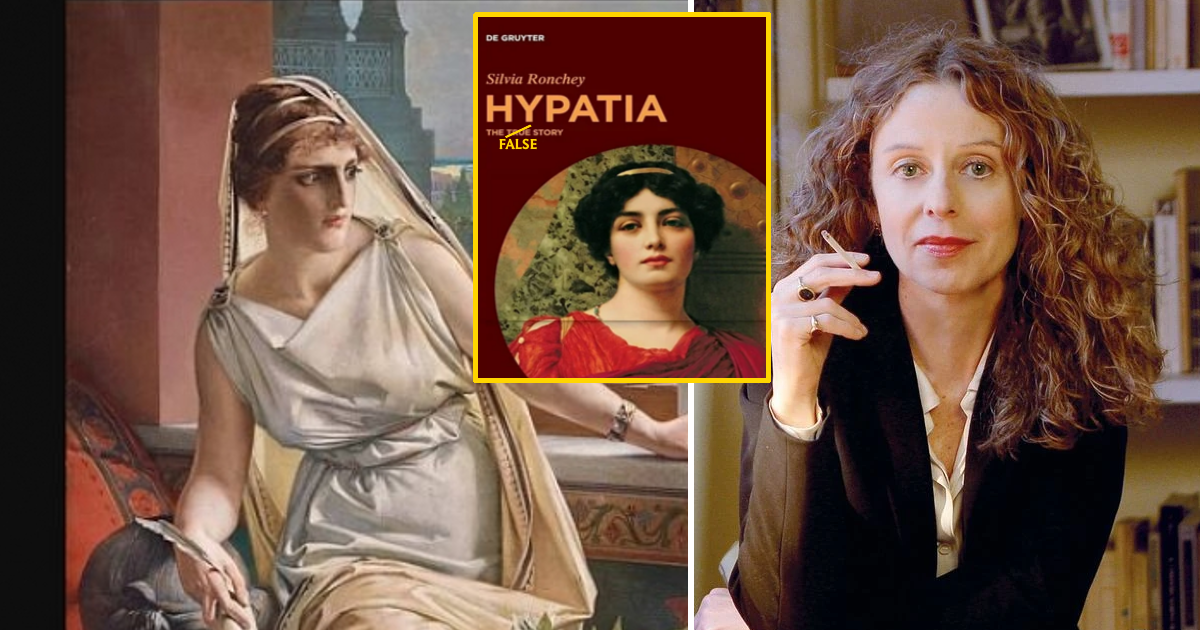
The legend of Hypatia of Alexandria. The Byzantine scholar (feminist) Silvia Ronchey speaks of the “secular martyr,” praises her science, her killing in the name of Christianity, and blames Bishop Cyril. All false.
For years, Silvia Ronchey has been talking to us about Hypatia of Alexandria. Or, more precisely, about the myth of Hypatia.
In her latest article in “Repubblica” (also here), the noted Byzantine scholar and professor at the University of Roma Tre restates a suggestive but unfounded thesis: that Saint Catherine of Alexandria is a kind of Christian transfiguration of the pagan philosopher Hypatia.
Following the interpretation of Anna Jameson — a self-taught, nineteenth-century art historian and pioneer of female studies — Ronchey presents Catherine as a “ghost-saint” and Hypatia of Alexandria as the usual martyr of rationalism, victim of Christian brutality.
But behind this narrative lie historical distortions and a careless use of sources that deserve to be examined.
Saint Catherine modelled on Hypatia?
The thesis of the “hagiographic transfer” between Catherine and Hypatia is well-known: it was born precisely with Jameson, who reinterpreted many historical and legendary figures in a proto-feminist light.
Certainly, the issues surrounding the historicity of Saint Catherine are known — one need only recall her temporary removal from the liturgical calendar in 1969, later reinstated in 2002 for her symbolic value. Some modern scholars have suggested affinities between the two figures, based on shared narrative traits: culture, virginity, violent death.
Christine Walsh, however, while recognizing some parallels, concludes that there is insufficient evidence to support the claim that Catherine is a creation based on Hypatia1C. Walsh, The Cult of St Katherine of Alexandria in Early Medieval Europe, Aldershot 2007, p. 143.
Ronchey revives the Hypatia myth
Ronchey’s long-standing effort — always sensitive to feminist themes — on Hypatia rests on a distorted image of the events. Proudly transformed into a proto-feminist and, while we’re at it, into a “secular saint”, martyr of scientific thought and persecuted by Christianity.
Ronchey writes that Hypatia, daughter of Theon, “a famous mathematician”, studied philosophy and science from childhood, soon directing one of Alexandria’s main schools.
She is described as an expert on Plato, Euclid, and Apollonius of Perga, author of “scientific books”, beautiful (could she ever have been ugly?!), pure and indifferent to vanity. Silvia Ronchey also tells us she was determined to “declare herself Christian” and was a friend of Alexandria’s governor, Orestes.
Thus, the scholar continues, “a band of those miserable fanatics” murdered her “with revolting barbarity”. A “secular saint, virgin and secular martyr”, Ronchey specifies, massacred not by the emperor but “by the ‘pharaoh’ of Egyptian Monophysitism, Cyril”, that is, the city’s bishop.
The legendary concoction of Hypatia of Alexandria is served up once again, shamelessly.
Fortunately, the Italian scholar avoids some of the classic details used to further emphasize the Hypatia myth: false quotations, scientific inventions (astrolabe, heliocentrism, etc.) and the infamous scraping of bones with oyster shells (see Edward Gibbon).
Still, one fact remains: what Ronchey writes is, at best, selective and inaccurate. We are not quite at the level of Alejandro Amenábar’s film Agora (2009), but not far off.
Hypatia, a celebrated scientist?
Let’s start with the myth of the “scientist”, perhaps even a rationalist.
It is true that she was introduced to studies by her father Theon, but Ronchey omits that he wrote extensively on divination and omens readable from birds’ behavior. Not exactly hallmarks of an irreproachable rationalist.
Hypatia herself invented nothing and left no original works: she merely commented on previous authors. According to Wilbur Knorr, historian of mathematics at Stanford, her work on Diofantes’ Arithmetica is of a “so low level as not to require any real mathematical understanding”2W. Knorr, “Textual Studies in Ancient and Medieval Geometry”, Birkhäuser 1990.
The exaggerated emphasis on Hypatia’s “scientific vision” clearly serves only to bolster the historical myth of the “martyr of science” killed by religious ignorance”.
Hypatia, astrology and the Chaldean Oracles
According to sources, Hypatia was instead a great teacher — a quality overlooked by Ronchey — who gave lessons in her home to a select group of students.
Philosophically, she adhered to Plotinus’ Neoplatonism, with its metaphysical vision of the One, Intellect and Soul: a system much closer to Christian thought than commonly believed. Plotinus himself was a student of the Christian Ammonius Sacca and influenced Christian thinkers such as Origen, Gregory of Nyssa and Gregory Nazianzen.
Another omitted detail is that among her students were Christians like Synesius of Cyrene, a future bishop.
Following in her father’s footsteps, Hypatia also discussed the Chaldean Oracles linked to Egyptian wisdom, and a commentary on Ptolemy’s Almagest is known, addressing what we would today call astrology. Like other Neoplatonists of the time, she believed in many deities and angelic beings, and modern readers would find her teachings quite bizarre.
This is also why Silvia Ronchey makes no mention of all this.
The Disarming Beauty of Young Hypatia
Regarding her exuberant beauty, the only source that mentions it is Damascio, author of the Life of Isidore (a lost work cited in the 10th century).
Unfortunately, Damascio never actually saw Hypatia, having been born half a century after her death. He is also the one who calls her a virgin, information not confirmed by older sources such as Socrates Scholasticus, although it aligns with Neoplatonic ethics.
There would be nothing wrong in Hypatia’s beauty, but it is overlooked that at the time of her death, the woman was probably around 65-70 years old. A fact hardly compatible with the myth of the young beautiful martyr.
Hypatia of Alexandria, Christian Martyr?
Finally, her murder.
It was indeed a barbaric crime, committed by Christian fanatics known as parabalani. But Ronchey misunderstands the motive: it was not a rejection of Christianity that caused her death, but rather the tragic outcome of a tumultuous political clash, typical of the city of Alexandria.
There was no rivalry between Hypatia’s thought and that of Alexandria’s Christians; the various Christian students who came to her are proof. Synesius of Cyrene remained in contact with her even after his election as bishop.
The aforementioned Socrates Scholasticus, the only source close to the events, clearly speaks of a “political jealousy” as the cause of the murder and, although he favors governor Orestes and opposes Bishop Cyril, does not accuse the latter, but rather a group led by “the reader Peter”. If he had evidence against Cyril, he certainly would have written it down.
For all the details and to consult the bibliography supporting these claims, we refer you to the thorough dossier we dedicated to Hypatia of Alexandria and her tragic death.
Hypatia Deserves Respect
It is regrettable that a scholar of the caliber of Silvia Ronchey, known for her erudition, yields to mythology when discussing Hypatia. She has done so repeatedly, including in her books.
It is also regrettable that she never devotes the same attention to analogous cases, such as the Christian virgins of Heliopolis, stripped, dismembered, and killed during the reign of the pagan emperor Julian for refusing to practice sacred prostitution.
Perhaps Christian martyrs count for less?
The figure of Hypatia deserves respect, not manipulation. Turning her into a “secular saint, atheist and rationalist” killed by Christianity is an ideological operation. Such efforts rely on reconstructions that do not withstand the scrutiny of historiography.
The real “phantasma“, upon closer inspection, is not the biography of Saint Catherine, but the idealized — and profoundly distorted — image of Hypatia.
Read the UCCR dossier (in Italian):
“The False Myth of Hypatia, Her Death and Bishop Cyril”
Author










0 commenti a Behind the Myth of Hypatia: What Is Hidden