
Jerry Coyne Responds to UCCR, But Can’t Save “New Atheism”
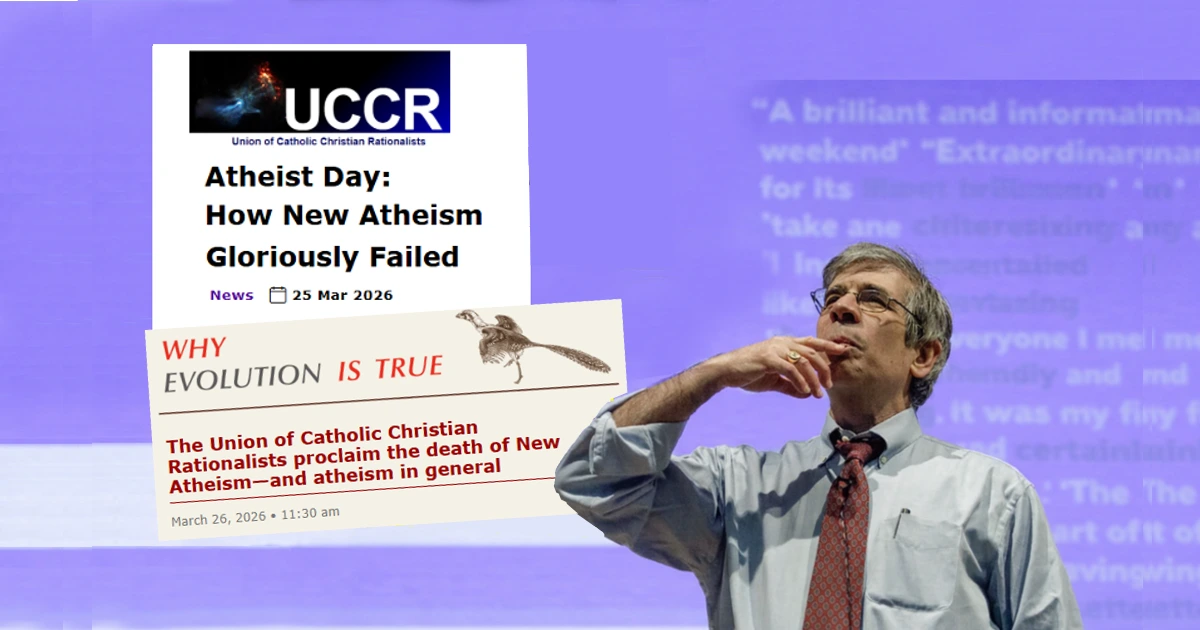
The American biologist disputes the collapse of “New Atheism” in response to our article. But Jerry Coyne makes three major mistakes.
It was fascinating to briefly awaken the last remnants of “New Atheism.”
We are referring to the response that the well-known biologist Jerry Coyne offered to the 5 reasons we listed to explain the failure of the movement of which he was one of the leaders.
Coyne is Professor Emeritus of Biology at the University of Chicago, a committed determinist, right-hand man of Richard Dawkins and, together with him, one of the old dinosaurs of “New Atheism.”
We are talking about the Anglo-Saxon movement that for over a decade turned irreligiosity into fanaticism, seeking to establish a culture not only without God but intolerant of any form of religion.
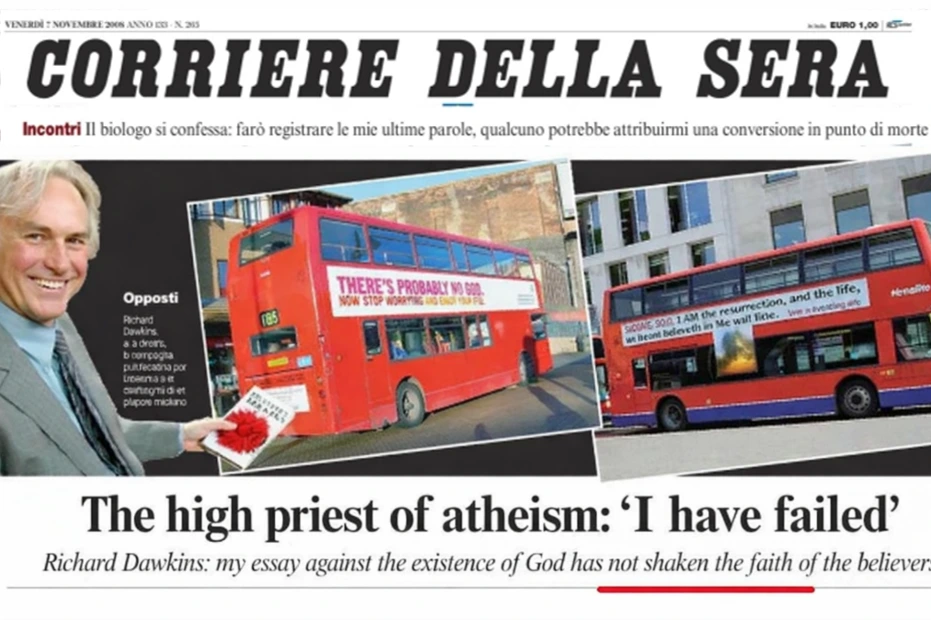
Despite its promising claims, the attempt collapsed resoundingly, as even the movement’s leading figure Richard Dawkins himself admitted back in 2008.
Jerry Coyne responds to UCCR
Naturally, the remaining activists still in the field do not share this interpretation, so Jerry Coyne devoted a blog post to respond to UCCR.
It was enjoyable to read and, we admit, also somewhat nostalgic to encounter the old talking points of “New Atheism” repackaged as new after so much time.
The American biologist cited the arguments we presented, essentially replying that his movement has increased the number of non-believers in America and that today’s leaders “are no longer obsessed with the need to emphasize the lack of evidence for God’s existence and have moved on to other things.”
It is curious how Coyne admits the “obsession” (“no longer consumed by a need”) that drove their campaign, and we agree with him that the major leaders have now moved on to other things.
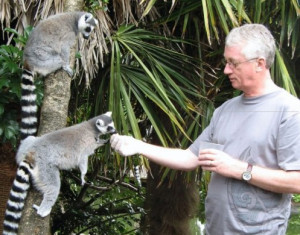
He, for example, has turned his blog into a hub for lovers of cats, ducks, and wildlife, while Dawkins and Lawrence Krauss have preferred to devote themselves to their dear friends, in particular the financier Jeffrey Epstein.
Jerry Coyne’s response, however, contains at least three major and fatal errors (while he accuses us only of having confused the name of the feminist bullied by Dawkins—not Emma but Rebecca: a grave mistake!).
1) Confusion between “New Atheism” and “atheism”
First of all, the biologist fails to notice that he confuses atheism with the cultural project of “New Atheism”: they are two different things.
In our article we did not question that in America and in some parts of the world there is a growth in the number of people without faith (even though he says the number “may have reached a temporary plateau”); rather, we argued how a specific atheist movement imploded.
Saying that “New Atheism” has failed does not imply that irreligiosity has disappeared, just as acknowledging the failure of Soviet Marxism does not mean denying the spread of socialist ideas.
Moreover, Coyne speaks only about the United States, while there is an entire world beyond it which, although influenced by the books of “New Atheism,” produces different statistics—assuming they matter at all.
2) Statistics used without criteria
Coyne’s second mistake is to arbitrarily assume that “New Atheism” has been successful because the number of American atheists has increased—at least according to the graph he uses as evidence.
Coyne is a biologist, not a logician or a statistician, yet one would expect him to know the difference between correlation and causation. The former indicates two phenomena occurring at the same time; the latter that one causes the other.
To say that during the rise of “New Atheism” the number of atheists increased does not prove causation, only that the two occurred in the same period.
He should instead have shown that, without Dawkins, atheism would not have grown, or that the increase in irreligious people was significantly greater because of him compared to a scenario without his influence.
Technically speaking, one must isolate the effect of “New Atheism” from all other variables, demonstrate a causal (not merely temporal) relationship, and compare groups exposed and not exposed to the phenomenon.
Moreover, he should prove that the increase in people who share a certain idea is related to the intellectual correctness of that idea and that such an increase is stable over time. This is the great naivety of all those who rely on a numbers game.
If we adopted Coyne’s method, we could say anything. For example, one could use graphs to correlate atheism with the increase in Netflix series, antidepressant use, organic food consumption, and cases of femicide.
The rise of secularization in the West is multifactorial and largely depends on the serious shortcomings of the Church rather than on the merits of its opponents.
This is demonstrated by the fact that most people without faith do not adhere to the dogmas of “New Atheism” and are not firmly antagonistic toward God or believers. No graphs are needed to see this.
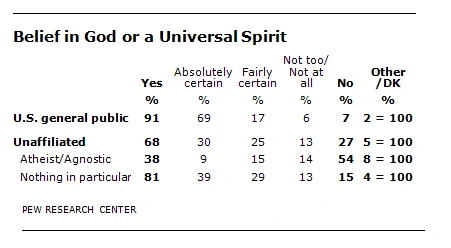
For those interested in further study, we also recommend a survey by the “Pew Research Center” on the 38% of atheists and agnostics who believe in God (or a universal Spirit), of whom 9% are absolutely certain of His existence, and a more recent study regarding the 45% of so-called “nones” who hold some form of belief.
3) Ineffective talking points
Jerry Coyne’s third mistake is failing to realize that he repeats in his response to UCCR the same absurdities that led “New Atheism” to be considered irritating even in the most secularized areas of the West.
According to the American biologist, it is evident that “if you accept things based on evidence, you will not embrace religion, and as the power of science grows, the grip of faith weakens.”
We ask: is it really possible that in 2026 a respected 76-year-old university professor still believes that scientific proof is required to believe in God, that science is the only valid way to explain reality, and that it is a direct alternative to faith?
Is it a sign of intellectual strength to count religious and irreligious adherents to declare a winner between faith and atheism, like children comparing football stickers?
Is it a sign of intellectual maturity to claim, as Coyne does, that “for every believing and deluded academic I could name five true intellectuals who are atheists”?
Coyne insists heavily on the idea that scientists are mostly atheists, as if God were a scientific object like a meteorite and they therefore had a more competent opinion than others on the matter.
Moreover, research studies (see also here) by Elaine Howard Ecklund on scientists’ beliefs actually point to the opposite of the surveys cited by the biologist.
Thank you, Jerry Coyne
We nevertheless thank Jerry Coyne for his response.
His attempt to revive a patient he believes to be merely bored is commendable, but it would be more appropriate to accept and acknowledge its natural death.
“New Atheism” collapsed because it claimed to be an intelligent cultural revolution, yet proved capable only of arguing by belittling others’ intelligence and through a naïve instrumentalization of science.
As the mathematician John C. Lennox wrote: “‘New Atheism,’ when examined with the same rigor it demands of faith, reveals a structural weakness in its philosophical foundations and, above all, an inability to articulate meaning beyond the mere derision of others.”
Author












0 commenti a Jerry Coyne Responds to UCCR, But Can’t Save “New Atheism”