
Garden Found Beneath the Holy Sepulchre Confirms the Gospel of John
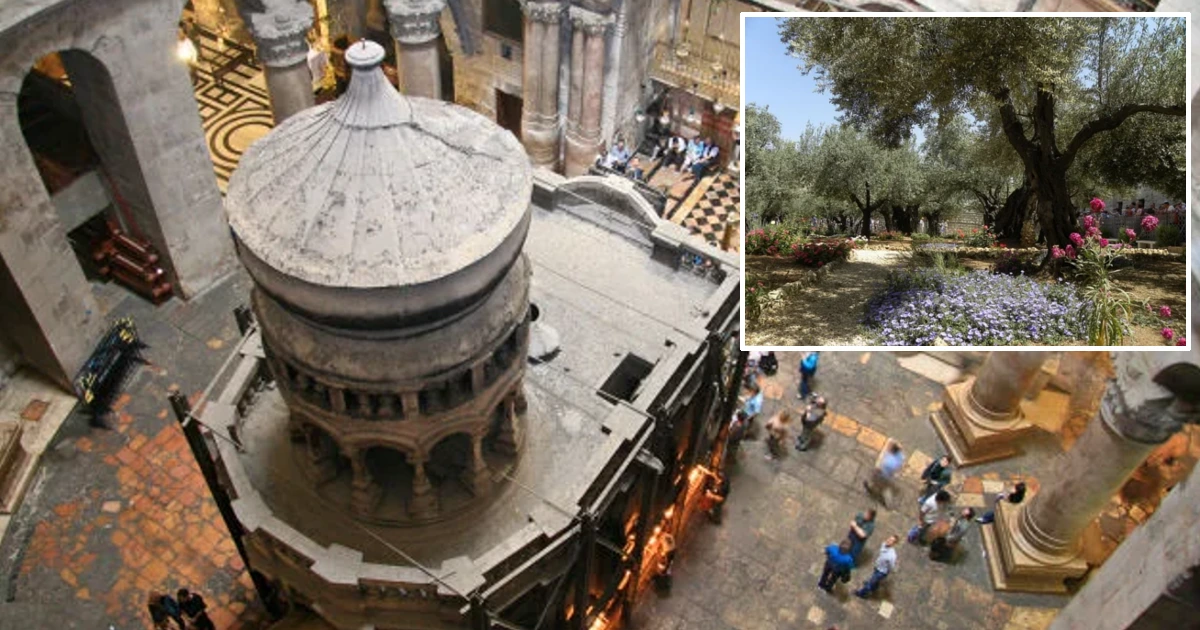
Archaeologists have found evidence of an ancient garden beneath the Basilica of the Holy Sepulchre, just as the Gospel of John describes. It is yet another indication that the Fourth Gospel rests on solid historical ground.
When modern archaeology confirms the historical reliability of the Gospels.
This occurred a few months ago when archaeological excavations conducted beneath the Basilica of the Holy Sepulchre in Jerusalem uncovered an ancient garden next to the place of the crucifixion.
The Garden Beneath the Basilica of the Holy Sepulchre
Researchers from the University of Sapienza in Rome, led by Prof. Francesca Romana Stasolla, identified pollen and plant remains traceable to olive trees and grapevines dating back more than two thousand years.
These are traces that confirm a scene mentioned exclusively in the Gospel of John.
In chapter 19 we read: “Now in the place where He had been crucified, there was a garden, and in the garden a new tomb in which no one had yet been laid” (Jn 19:41).
This very description appears to find confirmation in the archaeobotanical analyses performed by the scientists: the soil layers can be traced to an agricultural area of pre-Christian Jerusalem, not yet part of the fortified city under Herod, but rather cultivated land outside the walls.
The archaeologists also found low stone structures filled with soil, suggesting the use of the land for cultivation—consistent with the Gospel’s description of a garden.
The site, as mentioned, exhibits layers that predate the Christian era, indicating that the area was already in use well before the construction of the 4th-century Constantinian basilica.
The Historicity of the Gospel of John
This finding is important because it concerns precisely the Gospel of John, often regarded as less “historical” or less closely tied to actual events than the synoptics Matthew, Mark, and Luke.
Many critics have argued that John is a less reliable witness: more theological, symbolic, and late.
However, many scholars have long begun to rehabilitate the Fourth Evangelist. We have noted this when discussing the latest book by biblical scholar Craig Blomberg, who has called for a fourth quest for the historical Jesus, drawing precisely from John—a source widely neglected, often intentionally so.
Not only was it a text entirely independent of the synoptic Gospels, as we have recently shown, but it often preserves earlier and more historically reliable material than the other Gospels.
For example, regarding John the Baptist, the dating of the Last Supper, and the dating of the death of Jesus.
The scholar B.D. Ehrman (University of North Carolina) even writes: “Some sources behind the Gospel of John come from the early years of the Christian movement, from the first days of the movement, some decades before the writing of the Gospel of Mark.”1Ehrman B.D., “Did Jesus Exist? The Historical Argument for Jesus of Nazareth”, HarperOne 2013, p. 265.
Author











0 commenti a Garden Found Beneath the Holy Sepulchre Confirms the Gospel of John