
Why Panpsychism Is Replacing Materialism
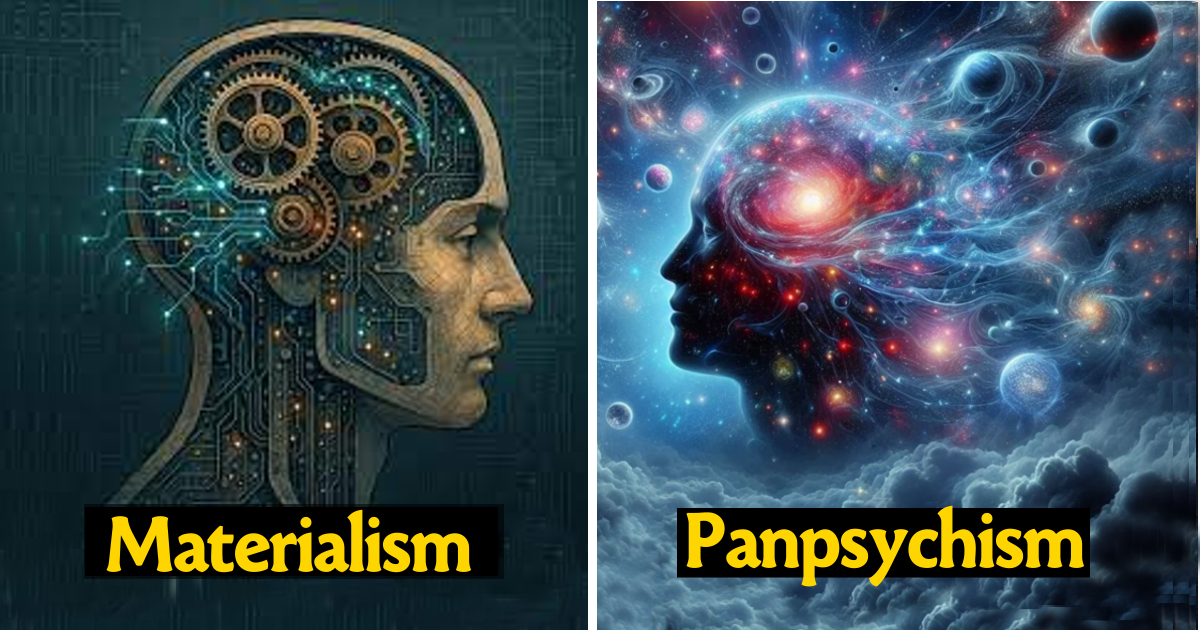
What is happening in the neurosciences? A slow paradigm shift in favor of panpsychism after the crisis of materialism due to modern science.
A quiet change, but deep.
Something is happening year after year in the current philosophical and neuroscientific scenario. Materialism is in crisis and interest in alternative, radically opposite positions is slowly growing.
We already talked about it a year ago, noting the death of physicalism and taking note of the observation by the specialist Marc Wittmann that “the absurdity of self-denial and the denial of phenomenal consciousness is today challenged by a form of idealism that proclaims that consciousness is all that exists.”
While materialism has always promised to be able to explain every phenomenon starting from physical or chemical processes, including consciousness, thoughts and emotions, new scientific theories have transformed that dream into an illusion. That worldview has become unsustainable.
This is how interest in alternative positions has emerged in academia, and panpsychism is currently the most popular model.
What is panpsychism?
But what is it about? And what does panpsychism mean?
Modern panpsychism goes back to an ancient philosophical belief according to which some form of consciousness can be found in all things, in every element of reality. It derives from the Greek pan, meaning “all”, and from psyche, meaning “soul, mind”.
While materialism radically denied every “non-material” aspect, panpsychism holds that all of reality possesses a form of experience or interiority. From one extreme to the other.
It should be clarified that panpsychists do not claim that everything is “conscious” like humans are, but that even elementary particles, atoms or physical systems have a primitive mental aspect, a kind of “proto-consciousness.”
Who are the panpsychists
But why is panpsychism having such success? Why is it discussed as a serious theory in specialist journals such as New Scientist?
The reason is that it is now commonly believed that consciousness could not have suddenly emerged, by chance, out of nothing.
For panpsychists, consciousness is rather a fundamental property of the universe, a constitutive dimension of being, just like space, time or mass.
More and more scientists, neuroscientists and philosophers are embracing this doctrine, albeit in different forms.
Among the best known is Christoph Koch, known for having lost the famous bet with David J. Chalmers when in 1999 he argued that within 25 years the neural mechanism producing consciousness would be found.
Today argues that “consciousness is an intrinsic and fundamental aspect of reality” and that such experience “is found in unexpected places, including all animals, large and small, and perhaps even in raw matter itself.” Going so far as to acknowledge that “the universe turns out to be a well-ordered place, much more rational than modernity, blinded by its technological supremacy over the natural world, believes.”
Koch adheres to the Integrated Information Theory theorized by the Italian Giulio Tononi, a form of “soft panpsychism” attributing consciousness only to what contains a certain degree of irreducible cause-effect power.
Panpsychism, an escape route for consciousness
The explanation of consciousness is therefore the stumbling block of materialism — after all it cannot answer this simple question: if our minds are only illusions or cerebral noise, why should we trust materialism or anything else our brain produces?
The philosopher Galen Strawson is among those who have slowly moved from physicalism to panpsychism recognizing that it is more sensible to argue that consciousness emerges from electrons rather than that it does not exist.
According to many Christian scientists, panpsychism, however, appears more like an escape route to avoid falling into theism — that is, to avoid having to introduce an external transcendent subject. Sensing the difficulty, some materialists have turned to panpsychism as a fallback position.
These are typical dynamics that recur in history.
It happened, for example, when from the observation of the crisis of abiogenesis (the spontaneous origin of life from non-life) people moved to directed panspermia (the origin of life caused by aliens).
Or when, faced with the principle of cosmological fine-tuning (the laws and fundamental constants of nature seem specially set for the emergence of life), the response was to invoke the Multiverse theory (our universe is only one of infinite parallel universes, each with different physical laws and conditions).
It should still be said that panpsychism proves to be an intellectually finer option than the crude materialist approach.
The limits of panpsychism
Panpsychism is not, however, free of problems, among them the fact that it merely shifts the problem of the origin of consciousness by simply turning it into an intrinsic property of matter.
In doing so it also introduces an additional principle (intrinsic consciousness) which needlessly increases complexity enormously.
Attributing consciousness to elemental levels of being does not even explain the qualitative and unified character of the specific human experience.
Perhaps the value of panpsychism therefore does not lie in providing answers, but in reminding us that consciousness remains one of the deepest mysteries of the universe and of our own existence.
Author










2 commenti a Why Panpsychism Is Replacing Materialism
The claim that panpsychism needlessly increases complexity enormously by introducing the additional principle of intrinsic consciousness seems a bit odd. Panpsychism assumes the ubiquitous mechanism of weak emergence over the bizarre materialist notion that consciousness strongly emerges from non-conscious stuff. Rejecting the notion of weak emergence which has overwhelming support, in favor of strong emergence which has never been observed ever in the history of mankind, is the very definition of needlessly increasing complexity enormously.
Panpsychism doesn’t actually simplify things—it multiplies the number of conscious entities without explaining how micro-consciousnesses combine into unified experience (the “combination problem”).
Materialism, despite invoking strong emergence, at least restricts consciousness to systems where it’s observed—brains—rather than attributing it to every particle.
So while panpsychism avoids one mystery, it creates a far deeper one about how “little minds” form a single conscious subject.