
Catholics and the Most Convincing Arguments for God
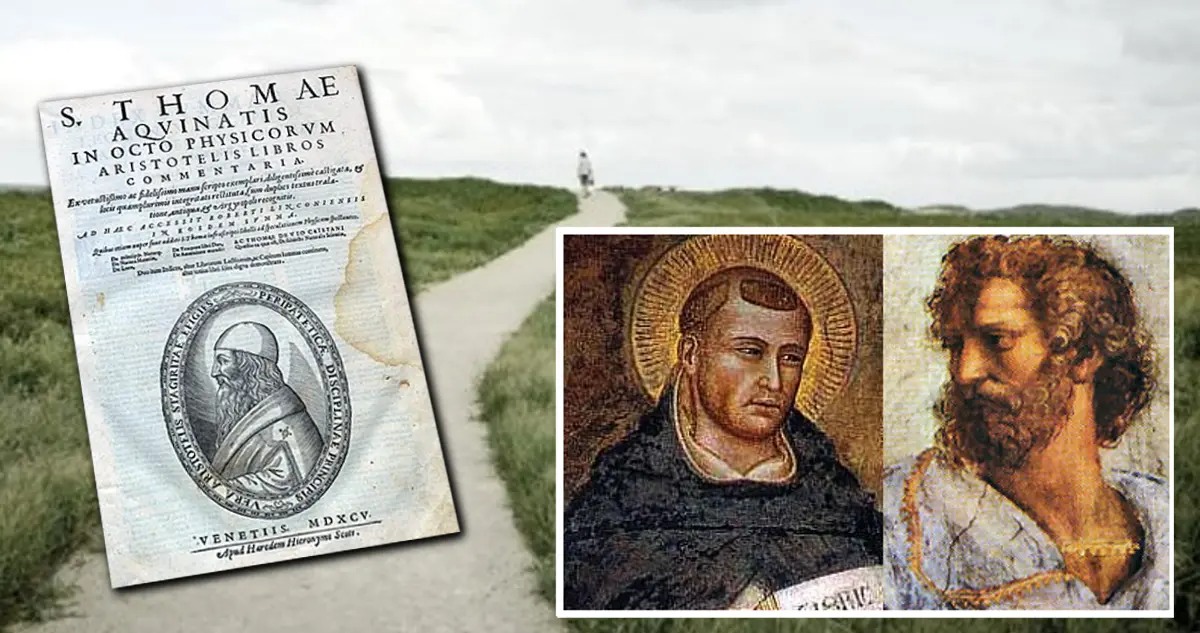
What are the rational arguments for the existence of God preferred by Catholics? A survey investigates the views of 50 apologists, finding differences compared to results directed at Protestants.
What are the most convincing arguments to say that God exists?
It is not a central theme for European Catholics, who rarely resort to the “classic” proofs to support their faith, focusing more on the value of the Christian encounter and the journey of recognizing God in the face of the community in which they live.
On YouTube this is often discussed in dedicated videos, such as the one where Shawn McDow shows the answers received from 100 Christian apologists (almost all Protestant) to the question of what they considered the best argument for the existence of God.
The American influencer Trent Horn repeated the same experiment by interviewing 50 well-known Catholic apologists online, interested in observing any differences.
Obviously, this is not a representative survey of Catholicism or of scholars who work on these topics.
Catholics and the arguments in favor of God
Among Catholics, the results were different.
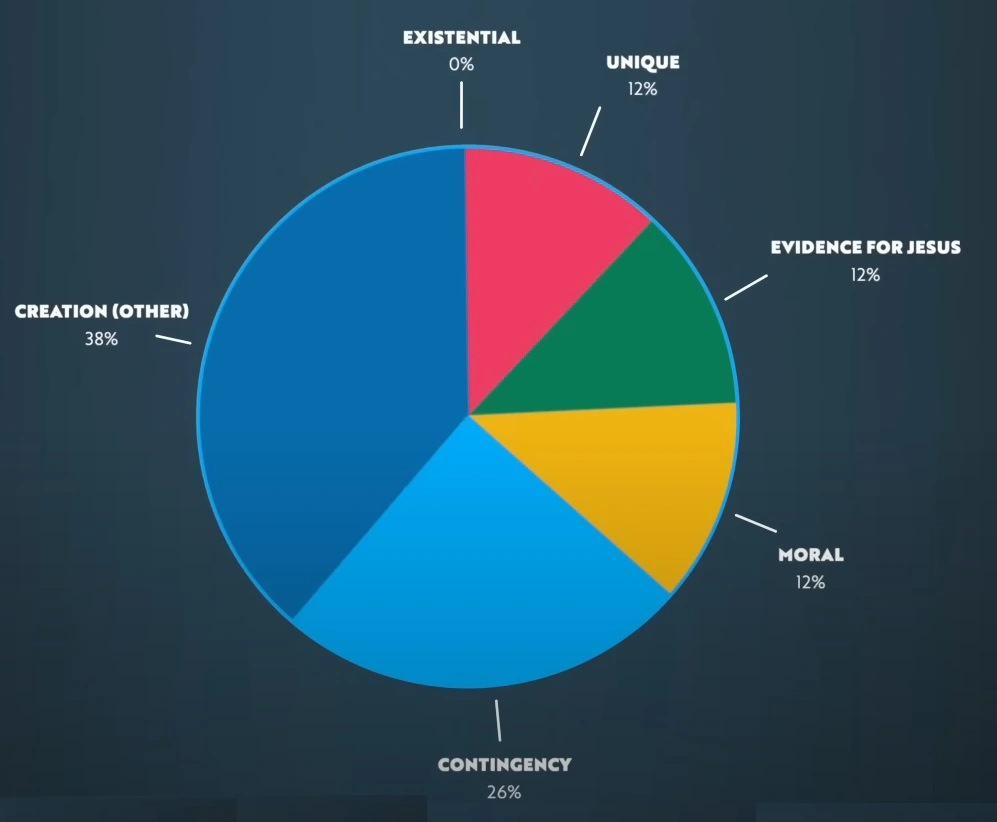
No one chose existential arguments; about 12% opted for “unique” arguments (universal consent, abstract objects, beauty), another 12% for arguments about Jesus (resurrection, teachings, Eucharistic miracles), another 12% chose the moral argument, while a full 64% opted for arguments about creation.
Arguments for God: consent, beauty, and abstract objects
Let us start with the 12% of respondents who chose what Horn calls “unique” arguments, meaning very particular and specialized ones.
The favorites were:
- The argument from universal consent: in all cultures and at all times, the majority of men have believed in God or a higher reality; this widespread and constant belief is a strong indication of its truth;
- The argument from abstract objects: the existence of immaterial entities such as numbers, laws, and mathematical truths requires a transcendent mind (God) to make them possible and intelligible;
- The argument from beauty: the experience of beauty, perceived as something objective and transcendent, points to the existence of a supreme and creative principle, identifiable with God.
Arguments for God based on Jesus
Let us move to the answers from the 12% of respondents who opted for arguments related to Jesus.
Among them, the most cited were:
- The argument from the resurrection: as we have detailed in our dossier, it holds that the cumulative weight of the historical evidence for what happened at the end of Jesus’ life leads to regarding the Resurrection as the only adequate and acceptable explanation;
- The argument from Jesus’ teachings: the moral depth, authority, and universality of His teachings indicate that it is far more probable, rather than not, that they could not have come from an ordinary man and Jew but that He really was what He said He was;
- The argument from Eucharistic miracles: unexplained phenomena such as the transformation of the host into human tissue and blood indicate a divine manifestation proving the real presence of Jesus and therefore the existence of God.
Arguments for God based on morality
Another 12% of Catholics interviewed preferred to indicate as the most convincing argument the moral argument.
This argument holds that the existence of objective moral values and duties, shared universally and independent of human opinions, and the voice of conscience that distinguishes good from evil, cannot be explained solely by evolutionary mechanisms or social conventions.
They seem instead to point to a transcendent Foundation, a natural law whose origin lies in God.
Many Catholics said they felt this argument was closer to daily experience: while contingency speaks to the intellect, morality directly addresses life, choices, and the desire for justice.
We have spoken about this several times on UCCR, focusing especially on the possibility of an alternative “secular morality” that is not just an embrace of amorality.
The arguments for God based on contingency
The majority of Catholics (64%) finally chose arguments related to creation.
Among these, almost no one opted for the Kalam cosmological argument (rejected by Thomas Aquinas), of Arabic origin and recently developed by Christian philosopher William Lane Craig. This is good news as we consider it weakened by a flaw, namely its link to the fact that the Universe must necessarily have had a beginning.
Very briefly: everything that has a beginning has a cause; the universe had a beginning; therefore the universe has a cause beyond space and time, namely God.
Nor were arguments related to the cosmological fine-tuning and Intelligent Design (highly criticized in Catholic circles) chosen.
On the contrary, one of the most chosen answers was the argument from contingency, which was never present among the “Protestant” answers collected by McDow.
It is a truly interesting argument that develops Leibniz’s famous provocation: “Why is there something rather than nothing?” Nothing we see is necessary; everything could not exist. If everything depends on something else, there must exist a Being that depends on nothing, who explains the very existence of the world.
This is essentially the Aristotelian-Thomistic argument (not undermined by the trivial objection of “who created God?”) that identifies in God the “necessary being” upon which every reality depends by appealing to the so-called “hierarchical series”.
Many interviewees pointed to this path as the clearest and most rational, a sign that the legacy of medieval theology has not died in philosophy history manuals but continues to produce its effects even today.
The survey also showed that many opted for the famous five ways of Thomas Aquinas.
Thomas argued from motion (everything that moves is moved by something else), from the distinction between essence and existence (there must exist a Being whose essence and existence coincide), and from the actualized act (everything that exists only potentially must be actualized by something that is already pure act). He concludes that nothing begins without a cause but the chain cannot be infinite: there must be a First Cause.
The difference between Catholics and Protestants
In the survey conducted among Protestant apologists, no one mentioned Thomas Aquinas, even though the first Protestant reformers (starting with Luther) preserved much of the scholastic method.
Today they continue to prefer the analogy of the watchmaker of William Paley from 1802, which considers the universe more like a great and perfect machine created by God in the past and proceeding autonomously under His loving oversight.
This also explains the close alliance between the American Intelligent Design movement and Protestantism (capable, however, of involving many Catholic scholars as well).
Catholics interviewed, on the contrary, opted for the vision of classical theism, according to which God is not only creator but constantly sustains the existence of the universe, He is Being itself.
Why Protestants do not use Saint Thomas
According to the author of the survey, Trent Horn, Protestants’ lack of recourse to Aquinas’ thought depends on the fact that it is feared and considered an “entrance door” to Catholicism.
The book by Doug Beaumont, Evangelical Exodus (Ignatius Press 2016), describes, for example, how several students at the Southern Evangelical Seminary became Catholics precisely because of that seminary’s emphasis on studying Thomas.
Philosopher Frank Beckwith, former president of the Evangelical Theological Society, also resigned in May 2007 after deciding to return to the Catholic faith, attributing the reason precisely to the study of Thomistic thought1F. Beckwith, “Never Doubt Thomas: The Catholic Aquinas as Evangelical and Protestant”, Baylor University Press 2019.
Author











0 commenti a Catholics and the Most Convincing Arguments for God