
Massacre of the Innocents: confirmation from a non-Christian source?
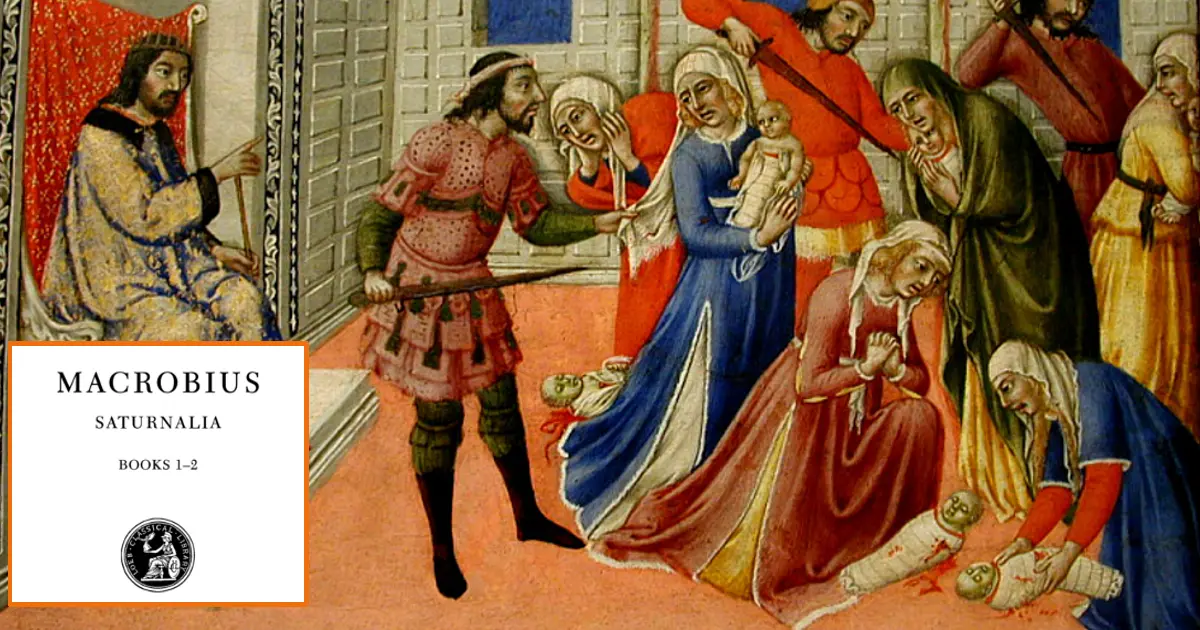
Giorgio Maselli (University of Bari) presents on UCCR his study explaining why Macrobius mention of the Massacre of the Innocents has historical value and should be used as a non-Christian source.
by Giorgio Maselli*
*Professor of Latin Literature at the University of Bari
The account of the “Massacre of the Innocents” is reported only by Matthew (Mt 2:16) and not by the other two Synoptic evangelists, nor by John.
A single, very brief reference can be found in Macrobius (Saturnalia, 2.4.11), who, however, lived at the beginning of the 5th century, when Christianity was already widespread. For this reason, scholars tend not to attach much importance to this reference.
Even Abbot Giuseppe Ricciotti, author of the famous “Life of Jesus Christ”, believed that the mention of the “massacre” was not among the many sources of the Saturnalia, but had been inserted by Macrobius himself, based on an unspecified Christian text.
Macrobius refers to the Massacre of the Innocents
Macrobius’s reference to the “Massacre of the Innocents” appears, without particular emphasis, in the following witticism attributed to Augustus:
“(Augustus), having heard that among the infants under two years of age, whom in Syria Herod, king of the Jews, had ordered to be killed, a son of his had also been slain, said: ‘It is better to be Herod’s pig than his son.’”
The joke—better appreciated in Greek due to the similarity between “son” (uƒÒj) and “pig” (áj)—plays on the Jewish prohibition against pork.
However, three elements, in my opinion, have not been sufficiently considered by scholars:
- The fact that Macrobius was not a Christian;
- The broader context in which the brief mention is found;
- The very wording of the reference to the “massacre.”
1) Macrobius was not a Christian
Regarding the first point, it should be noted that in the vast work of the Saturnalia there is no reference whatsoever to Christianity—even though Christians were widespread in the Empire and many officials were Christian. One of the characters in the work, “Euangelus“, is a detractor of Virgil, crude and lacking artistic taste, while the Saturnalia as a whole shows clear admiration for the Mantuan poet.
It is not far-fetched to suppose that the name “Euangelus” (recalling the Gospel) was chosen as a subtle expression of aversion towards the religion that had by then established itself and was permeating many aspects of Roman society.
For this reason, it seems highly improbable to me that Macrobius would have adopted a Christian detail (the “Massacre of the Innocents”) that added little to Augustus’s biting witticism.
Greater clarification is required regarding the macro-text in which the mention of the “massacre” appears.
2) Macrobius’s source dates to the 1st century
One of the characters in the Saturnalia, Avienus, recounts a series of 17 witticisms attributed to Augustus, followed by another series of 12 jokes (written, gestural, or oral, even insolent) addressed to Augustus by his interlocutors. Finally, there are some quips attributed to Julia, Augustus’s daughter (later banished from Rome).
Some of these jokes are also found in other authors, and Macrobius’s method of composition is well known: only the “frame” of the narrative in the Saturnalia can be directly attributed to him—what we would today call “his own work”—while the content of the various speeches is drawn from multiple sources, sometimes copied verbatim, sometimes summarised in various ways.
The search for the origin of the jokes in Book II—especially by German scholars—has suggested the “Ineptiae” or “Ioci” (in no fewer than 150 books) by the freedman Gaius Melissus, a friend of Augustus and secretary (grammaticus) to Maecenas (and a contemporary of Ovid).
If the witticisms by or about Augustus were clearly taken from a single source, it seems entirely implausible that Macrobius would have inserted on his own initiative the reference to the “massacre,” which merely provided a marginal historical-geographical setting for a joke hinging on Herod’s cruelty and a witty wordplay.
3) The hypothesis of a Christian interpolation
Regarding the third point, I find it unconvincing that a Christian forger before Macrobius, based on Matthew’s Gospel, would have added the detail of the “massacre” into the text of Melissus (or, in any case, into the source from which Macrobius drew the long series of jokes).
Such a hypothetical interpolator would almost certainly have specified the reason for the “massacre”—namely, the prophecy about the birth of the “king of the Jews,” which would have prompted Herod to issue his cruel order.
Furthermore, the description of the killing of infants as taking place (generically) “in Syria” is incongruous with a Christian interpolator, since New Testament and apologetic writings make it clear that Christians understood Judea administratively as part of Syria, but distinguished Judea—as well as Galilee, Samaria, and other neighbouring areas—from the broader Syrian region, both in relation to events in Jewish history in the Old Testament and in connection with the places visited by Jesus as recorded in the Gospels.
By contrast, in the Roman ethnographic view, Syria had a poor reputation. For example, in ancient comedy, Syrus was a stock name for various eastern slave characters, while in Livy we read of the Syri as vilissima genera hominum et servituti nata (“a race of men most contemptible and born for slavery”).
Augustus’s witticism predates Matthew’s Gospel
Augustus’s witticism also contains a notable historical inaccuracy: there is no record of any son of Herod being killed by his father in infancy. However, according to Josephus, Herod had his (already adult) sons Alexander and Aristobulus executed (around 7 BC) and, shortly afterwards, also his eldest son Antipater.
But this inaccuracy in the witticism actually supports its priority over the spread of Matthew’s Gospel.
It is possible to suppose that news of Herod’s killing of his sons and his order for the “massacre” reached Rome simultaneously or within a short time of each other.
Whether Augustus actually uttered the witticism (as is likely) or it was attributed to him by Melissus (or by another writer from the early years of the Common Era) based on various reports from a distant region, is secondary to what can be inferred from the joke: in Rome, between the late 1st century BC and the early 1st century AD, there was news of a massacre of children ordered by Herod.
The compiler of the Ioci was not concerned with historical accuracy, but with the purpose of humour (ridiculum).
I therefore feel justified in concluding that the “Massacre of the Innocents” mentioned by Matthew is corroborated by a reference dating to several decades before the writing of his Gospel.
It therefore constitutes a genuine second source for this event, whose historical value has often been—and still is—prejudicially called into question.
Bibliography and textual references can be found in:
G. Maselli, Macrobius, Augustus and the ‘Massacre of the Innocents’1in “Bollettino di Studi Latini” 37, 2007, pp. 643–648.
Author





0 commenti a Massacre of the Innocents: confirmation from a non-Christian source?