
J.K. Rowling and that “God-shaped vacuum”: our response
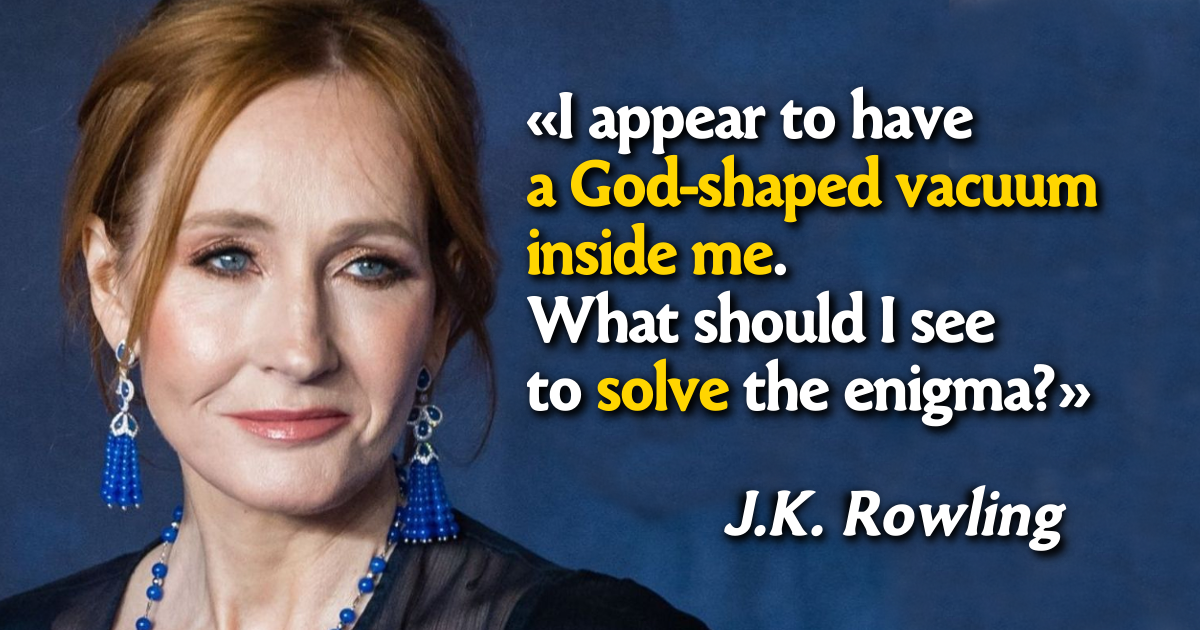
A post by J.K. Rowling about God hides a radical question. What evidence for faith? Do people believe without seeing? Here is what we answer to the unease she spoke about.
JK. Rowling asked a question to believers and offered a reflection to non-believers.
The author famous for the Harry Potter saga, in a post already read by almost 1 million people (and therefore long pondered), the well-known British feminist confesses to having a “God-shaped vacuum” in her heart that will probably accompany her to the grave.
And then she asks: what would I have to “see” in order to decide? A radical question that we take up and to which we respond, albeit briefly.
J.K. Rowling and God: “What would I have to see to believe?”
First of all, the context of the question.
The confession about God emerges from J.K. Rowling speaking about her changed convictions over the years, among which she cites assisted suicide and the non-dangerousness of drugs (marriage to a doctor, she says, opened her eyes and today she opposes them).
The writer recounts that “since adolescence I have struggled with faith” but, while perceiving this divine “vacuum” within her, “I never seem quite able to make up my mind what to do about it”.
Among all the convictions that could change based on concrete opposing evidence, the only exception, Rowling writes, is the “God conundrum, because I’d have to see to make me come down firmly on either side”.
She herself tries to answer: “I suppose that’s the meaning of faith, believing without seeing proof, and that’s why I’ll probably go to my grave with that particular personal matter unresolved.”.
What evidence is needed to believe?
The nostalgia expressed by J.K. Rowling is also called the “religious sense”, that is, the original and ineradicable perception of an ultimate Meaning, though considered unattainable.
Too bad that, as a good Anglo-Saxon, she concludes by falling back on the difficulty of “believing without having evidence” that she would need in order to decide.
Thus the theme of how faith is born returns, of “seeing to believe”. But what kind of “objective evidence” does she expect? A mathematical explanation? Or a divine apparition? That is the point.
Christian faith was born and spread throughout history always in the same way: from a human encounter, physical, with someone who already lives faith authentically and radically, an exceptional witness of Christ in whose face an Other who acts is glimpsed.
Are the “objective proofs” of God missing or are authentic witnesses missing, who generate in the human soul clues and proofs of an opening of the heart and reason toward the Mystery?
But that encounter has not occurred, has not yet taken place. Well, what to do? J.K. Rowling asks what “to see to believe” and to decide about God?
The “proof” of the religious sense
What we would tell her is to begin to look seriously at this “God-shaped vacuum” that lies within. Is it a bizarre personal creation? A self-deception?
Or is it the very same shape that synchronically extends through times and places to all humanity and on which Christian history has focused?
This “God-shaped vacuum” was described by Blaise Pascal as the “infinite abyss” that only an infinite and immutable being — that is, God — can fill. Equally famous is the thought of St. Augustine: “You have made us for yourself, Lord, and restless is our heart until it rests in you”. St. Francis exclaimed: “Quid animo satis?”, that is: what is enough for the human soul?
But it goes back even further, to the primitive peoples who began with unease to prepare for death and the Hereafter.
It is a common experience to all major religions that man is never truly free and at peace with himself, that an ultimate dissatisfaction remains within. What is this common nostalgia, present in every man and woman who seriously reflects on himself?
The theologian Hans Küng wondered: “Why is man forced to live separated and estranged with respect to that hidden, ultimate and highest reality, which is his true homeland, constitutes his freedom and indicates his true identity: a reality that man calls the Unconditioned, the Ineffable, the Absolute, the Divinity, God or by other similar names?”1H. Kung, On the Dignity of Dying, Rizzoli 2010, pp. 12-16.
This perception is all the less perceived the more one throws oneself headlong into the frenetic activities of life, into entertainments, into pastimes.
For contemporary man, only in the most difficult moments of life (called “limit-situations”) is the trivial briefly interrupted and it is the opportunity for many to realize not so much the lack of an ultimate meaning, but the desire that it fulfill the expectations of the human heart, that existential need that we have not given ourselves and that we cannot entirely remove.
Martin Heidegger understood it, when he wrote that “in certain moments of deep despair, when every solidity of things seems to fail and every meaning to darken, the question rises again”2M. Heidegger, Introduction to Metaphysics, Mursia 1986, p. 13.
The philosopher and psychiatrist Karl Jaspers went one step further, writing: “The shipwreck of every defined image of the world, the failure of our plans in the world […], the incompleteness of the human being himself, lead us to the limits in which, facing the abyss, there is nothingness or God”3K. Jasper, “Philosophical Faith”, Marietti 1973, pp. 77, 78.
J.K. Rowling speaks of “a God-shaped vacuum”, Jaspers speaks of “the incompleteness of the human being himself”. It is the same experience of all, the same unease in all historical epochs. How can one not see it?
We ask ourselves: could this perennial nostalgia for the Infinite be a wound in the heart, a “signature” placed purposely by God so that man, in his free roaming, has a hold so as not to stray too far from the truth about himself?
The author of Harry Potter maintains that this “not having certain answers” will always keep her distant from God. While waiting for an encounter, she could begin to reflect seriously precisely on the nature of this lack, so long and so deeply perceived.
Author






0 commenti a J.K. Rowling and that “God-shaped vacuum”: our response