
The Arab Historian Defends the Crusades: “Legitimate Defense”
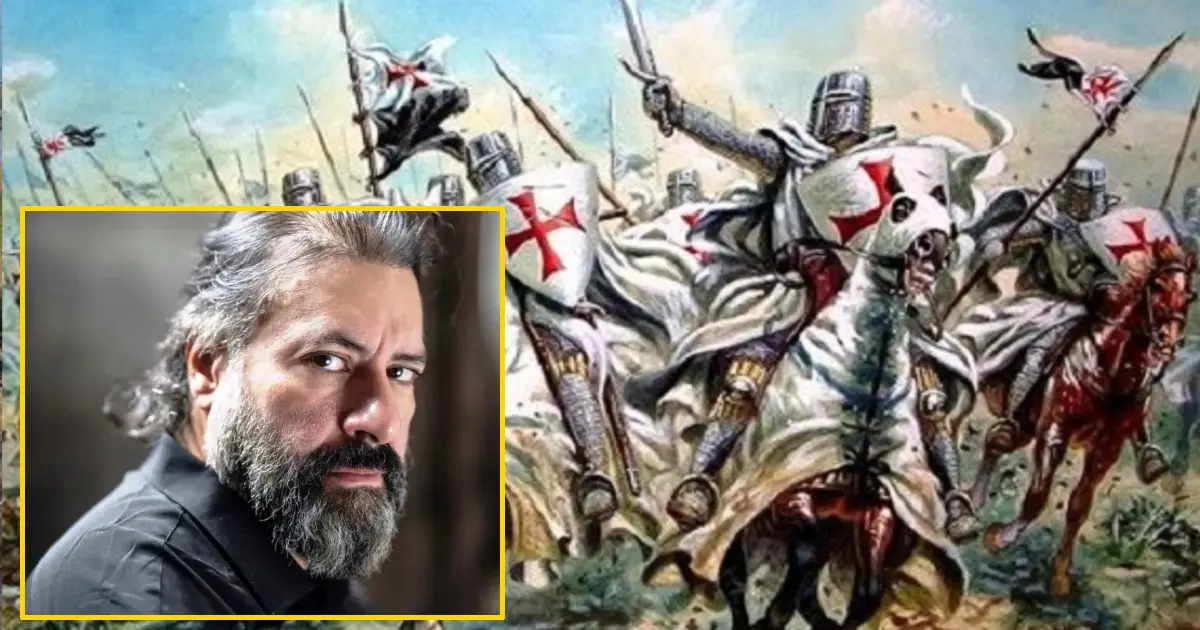
Raymond Ibrahim speaks on a podcast and deals with the legitimate initiative of the Crusades as defensive wars and to halt the Muslim armed invasion of Europe.
If even Arab scholars consider the Crusades a legitimate defensive war.
This is what Raymond Ibrahim states, a historian of Egyptian origin, specialized in military history and in relations between the Islamic world and Christianity.
Born in 1973, a researcher at the Gatestone Institute and the Middle East Forum, he is the author of several essays, including Sword and Scimitar (2018), in which he analyzes the 14 centuries of clashes between Islam and the West. He is appreciated and known for his ability to draw on original Arabic sources and has repeatedly proposed in his books a critical reading of secularized historiography on the Crusades, arguing that they were wars of defense and not mere imperialistic aggressions.
He did so, for example, in Defenders of the West: The Christian Heroes Who Stood Against Islam (Bombardier Books 2022) and reiterated it in a podcast in which he recently intervened.
Crusades, necessary responses to Muslim expansion
The Crusades, Ibrahim explained, were heroic and necessary responses to centuries of Muslim expansion and invasion that had reduced and conquered Christian territories and aimed to defend Western civilization by reconquering lands historically Christian, such as Syria, Egypt and Palestine.
Contrary to the view of some historiography, these wars were not unleashed by imperialistic motivations, but by a need for cultural and religious defense. Furthermore, the Arab historian points out that the Crusaders — notwithstanding violence and abuses, which there were — were not “barbarians” without culture, but individuals deeply motivated by faith, ready to sacrifice themselves to defend their lands and traditions.
Within 100 years, after the death of Muhammad in 732, the Muslims conquered Europe. Well before the First Crusade of 1095, Islamic armies had conquered vast Christian areas from the Middle East and North Africa to Spain and as far as the gates of Vienna.
Christian communities were decimated and forced to the blackmail of paying the Jizya (money paid by non-Muslims to continue their religion) or die. Churches were destroyed and pilgrims brutally attacked, including those traveling to Jerusalem.
Thus, Ibrahim explains, the Crusades were a desperate attempt to repel the siege, to defend Christians, to reconquer what had been invaded and what guaranteed a safe passage for pilgrims.
The Crusades and violence, what history says
Like every human war and conflict, there were also atrocities in the Crusades.
In the podcast, the historian does not deny this at all but insists that they must be understood in their historical context, not presented as proof of the intrinsic violence of Christianity, ignoring the often greater and systematic brutality of the opposing forces.
The interpretation of the Crusades as defensive wars fits into a broader debate among historians. Some years ago during a conference organized by the Society for Military History, the majority of the historians present sided precisely with considering them defensive-type wars.
When the First Crusade was proclaimed, in fact, the Eastern Christians and the Byzantine Empire lived under the constant threat of Muslim armies, with territories continuously eroded and populations forced to suffer conversions or discrimination.
The Byzantine emperor Alexios I Komnenos‘s request for help to the West, against the Seljuk Turks, has always been seen as the proof that the Crusade was born as an act of assistance, not as a colonial adventure.
Author













0 commenti a The Arab Historian Defends the Crusades: “Legitimate Defense”