
Sapolsky Against Free Will, but Scientists Push Back

Further criticism of Robert Sapolsky and his work on free will: he has unduly shifted the issue from philosophy to science and relied on discredited studies. The book’s scientific reception is increasingly less favourable.
• Robert Sapolsky on free will: why he’s got it all wrong (31/01/2025)
530 pages to convince the world that human beings experience only the illusion of freedom.
That’s what biologist and primatologist Robert Sapolsky spent five long years trying to do, with his book reaching Italy in 2024 under the title “Determined: A Science of Life Without Free Will” (Penguin Press 2023).
The media offered widespread praise, but within the scientific community, the reception has been far less friendly.
Back in January, we published (in Italian) a review of Sapolsky’s work.
We also cited the sharply negative verdict of John Martin Fischer, Professor Emeritus of Philosophy at the University of California, who concluded: “Despite all the hype, it offers nothing new or illuminating about free will or moral responsibility.”
In truth, Sapolsky has contributed something: he is one of the few who have attempted to follow through consistently with the idea that absolute determinism implies there is no guilt — and therefore no responsibility — even for murderers and pedophiles. This left even the secular philosopher Telmo Pievani stunned, prompting him to rush to interview Sapolsky as soon as the Italian edition was released.
Sapolsky turns free will into a scientific issue
But the academic criticisms of Sapolsky have continued over the months.
In February 2025, Jessica Riskin, a historian of science at Stanford University (a student of Stephen Jay Gould and a university colleague of Sapolsky), criticised his extreme reductionism in depicting human beings, classifying people according to “social class, biology, and cultural stereotypes.”
In his view, the sum of genetic, environmental, cultural, and familial factors determines that the garbage collector ends up a garbage collector and the conformist must inevitably be conformist. “Add up all the scientific findings from all the relevant fields,” he writes, “and there is no room for free will.”
Too bad, Riskin explains, that this conclusion is anything but scientific, and that “presenting free will as a scientific rather than a philosophical issue is a textbook case of scientism — extending science’s claims beyond its proper bounds.”
Accusations of “junk science” against Robert Sapolsky
Even harsher criticism has come from statistician Andrew Gelman, professor at Columbia University. Beginning with the title of his post: “Junk science used to promote arguments against free will.”
Gelman’s rebuttal centres on Sapolsky’s repeated use of studies with serious limitations (small samples, unreplicated findings, publication bias, etc.) to support radical conclusions.
This improper and ongoing use of such research is what the American statistician labels “junk science.”
Then again, Gelman notes, Sapolsky is a biologist — not a psychologist or a statistician — and lacked any specific expertise to recognise the poor quality of the evidence he cited. “But it’s now 2025,” the statistician adds, “and Sapolsky should know better… but, hey, he’s a busy guy and probably doesn’t have the time or energy to revisit his assumptions. It’s a shame, but maybe it was to be expected.”
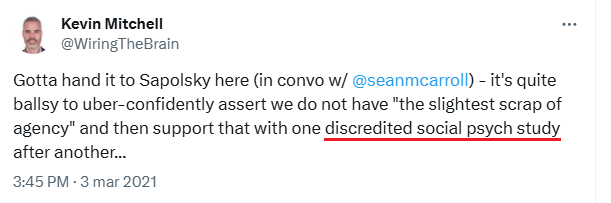
A criticism echoed by neurogeneticist Kevin Mitchell, who commented a few years ago:
Author








0 commenti a Sapolsky Against Free Will, but Scientists Push Back