
Albania, The Frescoes That Survived the Atheist Fury

In a small church, ancient frescoes appear, hidden under whitewash. They survived the atheist dictatorship of Hoxha’s Albania, when churches were destroyed and clergy persecuted.
They had tried to cover them with a layer of white plaster.
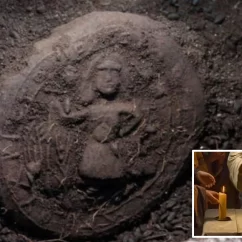
Recent excavations in a small church in Albania have brought to light Byzantine frescoes, hidden under whitewashed walls.
The 13th-century frescoes under the plaster
This is the church of St. Nicholas in Mesopotam, and the mural paintings date back to the 13th century. They depict figures of saints painted with vibrant plant-based colors at a height of eight meters, a feature that contributed to their preservation for hundreds of years.
The Monastery of St. Nicholas seems to have been built during the reign of Emperor Constantine Monomachos, around 1050 A.D.
The destructive fury of atheist Albania
The building was among the few churches that survived the atheist regime of Enver Hoxha, remaining intact as a cultural monument, while almost all other places of worship were demolished and converted.
Albania was the first nation in the world to officially declare itself atheist, establishing in 1967 – and then with Article 37 of the 1976 Constitution – that “the State does not recognize any religion and supports atheist propaganda to instill in the population a materialistic-scientific worldview.”
Every religious expression was systematically erased or destroyed, and Hoxha’s iconoclastic fury struck believers: almost all churches and religious structures were destroyed or converted. It is estimated that about 2,200 churches, mosques, and monasteries were destroyed or turned into warehouses, cultural centers, and gyms.
Priests were brutally persecuted: over 200 were imprisoned or exiled, hundreds of priests, imams, and friars were tortured or sentenced to death, especially Catholics associated with the Vatican, labeled as “fascists.”
Even marrying in church, celebrating baptisms, or keeping religious objects became a crime: anyone found with Bibles, icons, or sacred texts risked up to ten years in prison.
Only with the fall of communism, starting in 1990, was freedom of worship allowed again.
The Catholic Church, the Orthodox Church, and even the Evangelical communities began a reorganization almost from scratch: thousands of churches were reopened or rebuilt, seminarians were re-ordained, and martyrs were recognized and beatified (such as the 38 Catholics beatified by Pope Francis in 2016).
A symbol of faith’s resistance
In this context of intensified secularization (contrary to those who claim that no one was ever persecuted in the name of atheism), the survival of a small church is more than significant.
The reemerged and restored frescoes thus represent the symbol of a cultural and faith-based resistance that, despite secular repression, was never completely erased.
Author




0 commenti a Albania, The Frescoes That Survived the Atheist Fury