
Shroud: New Study Indicates an Origin Through Radiation
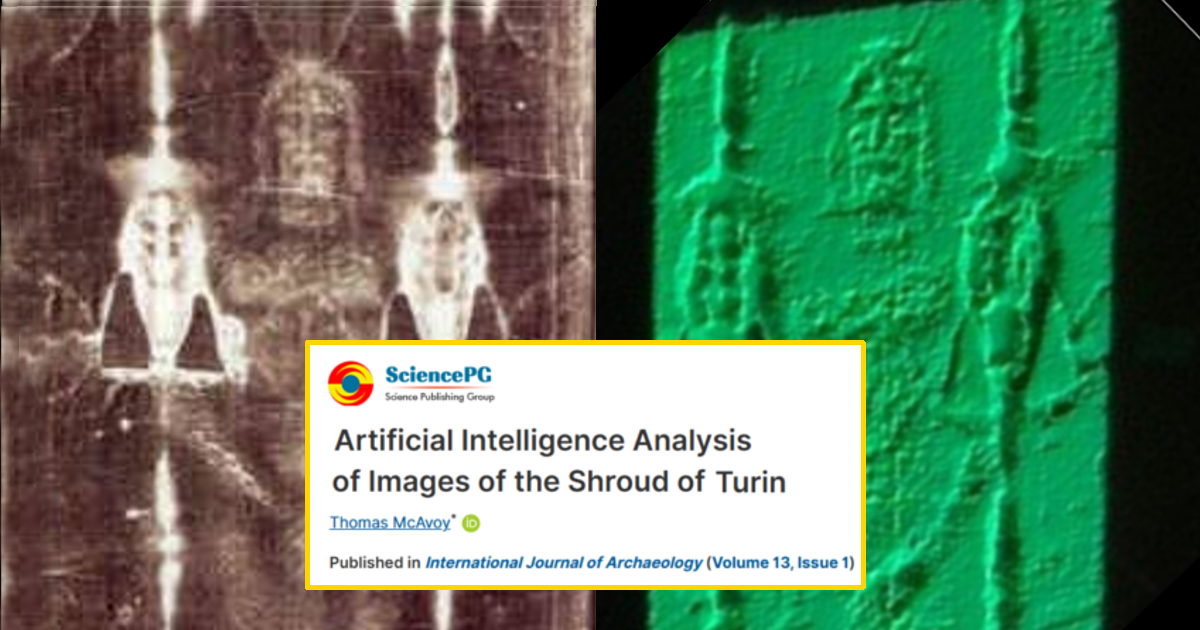
Research supports the thesis that the image on the Shroud was formed as a result of radiation emission. The study by Thomas McAvoy has been ignored by the media; UCCR contacted him.
The debate on the Shroud never dies, despite being fought on an uneven playing field.
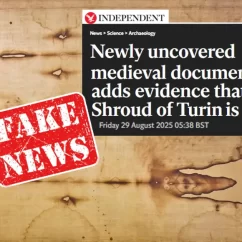
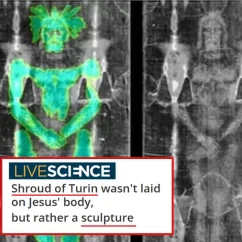
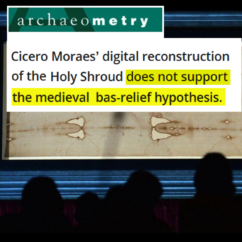
On one side, the massive media apparatus has given international prominence to the recent study by Cicero Moraes, according to which the image of the Shroud corresponds to that produced by contact with a bas-relief sculpture, showing less anatomical distortion and greater adherence to the observed contours.
A study that, as we have documented, however, recycled old information—the theory of the image as an orthogonal projection was already known from the first studies by Vignon and Delage in 1902!—is full of clumsy errors and deliberately ignores (by the author’s own admission) the explanation of the Shroud’s photographic characteristics and the bloodstains.
No one, however, has reported on another study on the Shroud, published in the “International Journal of Archaeology“ last June by Thomas McAvoy, emeritus professor of Chemical and Biomolecular Engineering at the University of Maryland.
New study: the Shroud formed through radiation
The author is an international expert in Principal Component Analysis (PCA), a data approach technique used in machine learning and image analysis.
Applying this technique to the Shroud, McAvoy concluded in support of the thesis that the formation of the Shroud image was the result of radiation emission.
Contacted by UCCR, the chemical engineer explained to us that the Shroud image is formed by the three primary colors (red, green, and blue, i.e., RGB), each with its own intensity. Normally, to analyze them one would need to consider all three pieces of information together, but the application of PCA makes it possible to obtain the same result by looking only at the sum of these values.
Thus, McAvoy explains, by analyzing the images in white light, “the resulting image highlights three-dimensional properties!”, while the one-dimensional intensity analysis of the Shroud’s UV images shows that the molecular bonds of the fabric vary depending on the area of the Shroud.
Other studies, including those by the author, also show that various types of radiation (such as electric discharge, intense UV radiation, or neutrons) can alter the properties of linen.
Therefore, McAvoy tells us, “my research provides strong support for the hypothesis that a radiation process was involved in the formation of the Shroud image.”
What types of radiation on the Shroud
But what type of radiation?
In his study, the author mentions four that can cause variations in the intensity of UV fluorescence in linen, such as those observed in the Shroud: corona discharge, deep ultraviolet radiation, neutron radiation, and gamma radiation (the latter has been found, in the meantime, not to affect the UV fluorescence of linen).
According to the American engineer, it is likely that in the formation of the Shroud image “more than one type of radiation was involved.” In particular:
- Corona discharge could have produced the image and at the same time generated neutron radiation;
- Neutron radiation can explain the results of the radiocarbon dating to the medieval period but cannot generate the image;
- Deep ultraviolet radiation can reproduce the coloration of the Shroud image but does not account for the medieval dating of the fabric;
“Therefore, in my opinion,” McAvoy tells us, the formation of the image seems to be due to the contribution of multiple types of radiation.
The Shroud and its unique and unexplained characteristics
The American engineer has also confirmed the astonishing and unexplained characteristics of the Shroud, namely its behavior as a photographic negative, its three-dimensional properties, and its variable UV fluorescence.
“I am not aware of any other images or artifacts with such characteristics,” McAvoy admits, and “even today, with all our technical knowledge, no one has been able to reproduce the Shroud image with all its peculiarities.”
Moreover, even more surprising, the Shroud behaves like a photographic negative except for the bloodstains, which “are positive, and under them there is no image; a possible interpretation is that the blood was deposited on the cloth before the formation of the image.”
What non-destructive studies can be carried out
Finally, we asked Thomas McAvoy what non-destructive studies could be conducted on the Shroud to further the investigation.
His answer was the radiocarbon dating of the charred material taken in 2002 from various areas of the Shroud.
In fact, he explains, “if the Shroud had been exposed to neutron radiation, this new dating should show age variations depending on the location on the Shroud. If instead the date turns out to be medieval, it would confirm the results of the 1988 dating.”
Finally, new ultraviolet spectroscopy analyses could be carried out on various areas of the Shroud, like those performed in 2002 (but still unpublished).
The reception of the study among Shroud experts
Before publishing this article, UCCR submitted McAvoy’s study to one of the leading scientific experts on the formation of the Shroud image, who expressed some reservations about the overall validity of the conclusions, as it is a reverse engineering work.
However, he tells us, several aspects of the American engineer’s investigation “are interesting and would deserve further exploration.” We will therefore have the opportunity to revisit the topic in a few weeks.
Author






0 commenti a Shroud: New Study Indicates an Origin Through Radiation