
The Crucifixion and Burial of Jesus: The Historical Evidence
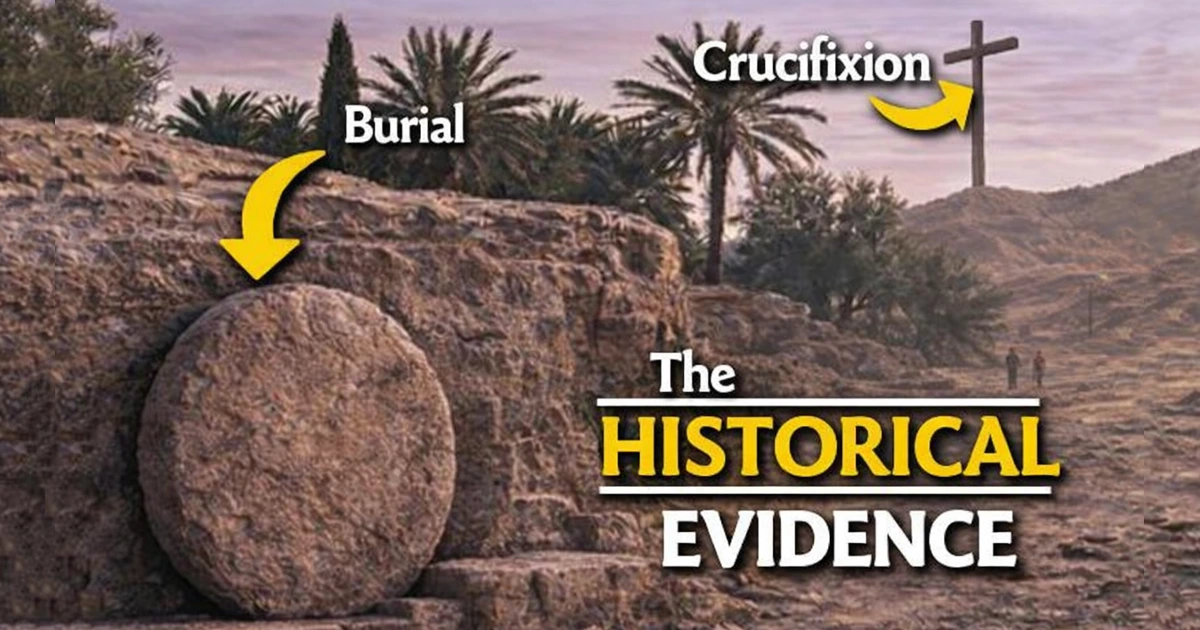
The evidence scholars use to support the historicity of Jesus’ crucifixion and burial. This dossier presents the key arguments and answers to the main objections.
The crucifixion and the burial of Jesus of Nazareth are among the most debated events in ancient history.
In recent decades, historians, biblical scholars, and specialists in early Christianity—both believers and non-believers—have critically analyzed the available sources, both Christian and non-Christian.
Through tools such as the comparison of independent sources, analysis of the historical context, and the criteria of authenticity used in historical research, a surprising level of consensus has emerged regarding certain fundamental events in Jesus’ life.
Among these, one of the most solidly attested facts—as documented in this dossier—concerns his death by crucifixion under the Roman governor Pontius Pilate.
The consensus is less unanimous, however, regarding the burial of Jesus through the initiative of Joseph of Arimathea, yet all the objections raised have received more than convincing answers.
This dossier (unique on the web), based on the analyses of leading scholars of early Christianity, presents clearly and with documentation what contemporary historical research considers most reliable regarding these events, addressing the most widespread objections raised by skeptics.
This dossier is a continuation of the previous one dedicated to the 10 historical evidences in favor of the Resurrection.
—————————
1. THE HISTORICAL DATE OF JESUS’ DEATH
Before historically analyzing the events of Jesus of Nazareth’s crucifixion and burial, it is necessary to establish whether there is a scholarly consensus on the date of his death.
1.1 General timeframe: AD 26–36
All scholars agree on the general chronological framework, namely the years during which Pontius Pilate served as Roman prefect of Judea: between AD 26 and 36.
Jesus’ death within this timeframe is attested by various sources: the Jewish historian Josephus1Jewish Antiquities, 18.89, the Roman historian Tacitus, the four Gospels in their earliest traditions, and the Acts of the Apostles.
“Therefore,” comments the biblical scholar Giuseppe Barbaglio, it is in these years that “the Nazarene met his miserable end on the cross”2G. Barbaglio, “Jesus, the Jew of Galilee”, EDB 2002, p. 85.
1.2 Only two possible dates
However, there are strong reasons to be much more precise.
While Josephus confirms3Jewish Antiquities, 18.3.3/63 what is stated in Luke 3:1—namely that Jesus’ entire ministry took place during Pilate’s administration—scholars are also certain that Jesus was not executed toward the end of Pilate’s tenure.
This is established from Paul’s letters, the Acts of the Apostles, and extra-biblical sources such as the Delphi inscription (which confirms Acts 18:12–17): from these it is inferred that Paul arrived in Corinth around AD 49–51. Considering all the events that must have occurred between Jesus’ death and Paul’s arrival in Corinth (including Paul’s conversion and first missionary journey, the founding of the church in Antioch, etc.), it is impossible to place Jesus’ execution as late as AD 36.
The date must be moved back by several years.
A famous study published in the journal Nature4Dating the Crucifixion, Nature, vol. 306 (1983), pp. 743–746, authored by Colin J. Humphreys and W. Graeme Waddington, used astronomical calculations and the first-century Jewish calendar to determine the date of the crucifixion.
After reconstructing the lunar phases between AD 26 and 36, determining the date of 14 Nisan (Passover), and identifying which years coincided with a Friday during Pilate’s governorship, the study concluded that within Pilate’s tenure there are only two realistic dates: April 7, AD 30, and April 3, AD 33.
The historian Raymond E. Brown, one of the most important Catholic biblical scholars of the 20th century, in his monumental study on the Passion likewise concluded that these two dates are the only ones seriously defensible from a historical standpoint5R.E. Brown, “The Death of the Messiah”, 1994.
1.3 April 7, AD 30
Between the two dates, one in particular enjoys greater support among leading scholars.
Prominent academics such as Geza Vermes6“Jesus the Jew: A Historian’s Reading of the Gospels”, 1973 and Rainer Riesner7“Paul’s Early Period: Chronology, Mission Strategy, Theology”, 1998 indeed favor April 7, AD 30 as the most probable date.
They are joined by the eminent American biblical scholar J.P. Meier.
In his monumental study on the historical Jesus, the author reconstructs all the historical reasons (including the beginning of the fifteenth year of Tiberius, the start of John the Baptist’s ministry, the duration of Jesus’ ministry, the years in which 14 Nisan fell on a Thursday, etc.) why the majority of scholars lean toward identifying April 7 of the year AD 30 as the day of Jesus’ death8J.P. Meier, “A Marginal Jew: Rethinking the Historical Jesus”, 2008, pp. 356–361, 403, 404.
Many other scholars arrive at the same conclusion, despite holding different views on other issues. Among them are U. Holzmeister9“Chronologia Vitae Christi”, Pontifical Biblical Institute 1993, pp. 205–215, J. Blinzeler10“The Trial of Jesus”, 2001, pp. 89–97, E. Ruckstuhl11“Chronology of the Last Days of Jesus”, pp. 1–9, J. Finegan12“Handbook of Biblical Chronology”, Hendrickson 2015, pp. 298–301, and S. Dockx13“Chronologies néotestamentaires et vie de l’Église primitive”, Éditions Peeters 1984, pp. 9–10.
If academic consensus has any value, the predominance of most specialists in favor of April 7, AD 30 is a significant factor.
In any case, as the biblical scholar J.P. Meier observes:
“In light of our usual ignorance regarding the exact year of death of many important figures of the ancient world, we should be pleased to be able to be so precise about the year of Jesus’ crucifixion.”14J.P. Meier, “A Marginal Jew: Rethinking the Historical Jesus”, 2008, p. 403
—————————
2. THE HISTORICITY OF JESUS’ CRUCIFIXION
Determining whether the crucifixion of Jesus under Pontius Pilate was a truly historical event is rather straightforward.
In fact, no scholar has ever denied it, not even the most skeptical ones.
2.1 Academic consensus
The American biblical scholar J.P. Meier examined every work on the historical Jesus, written by both proponents and critics, concluding: «No one denies the fact that Jesus was executed by crucifixion»15J.P. Meier, “A Marginal Jew: Rethinking the Historical Jesus. Companions and Competitors”, vol. 3, Queriniana 2003, p. 159.
Biblical scholars Benjamin C.F. Shaw and Gary Habermas (Liberty University) also conclude that proclamations regarding Jesus’ death are found in the earliest Christian teaching, and «this material, including the crucifixion, has solid grounding as widely acknowledged by nearly all critical scholars across the academic spectrum»16B.C.F. Shaw, G. Habermas, “Crucifixion in the Ancient World: A Historical Analysis”, Eleutheria 2021, p. 11.
Even the German scholar Gerd Ludemann (notoriously an atheist), author of various and sometimes eccentric alternative theories to the Gospel accounts, had to acknowledge that «the fact of Jesus’ death as a consequence of crucifixion is indisputable, despite hypotheses of apparent death or deception that are sometimes proposed. There is no need to discuss it further»17G. Ludemann, “The Resurrection of Jesus Christ: A Historical Inquiry”, Prometheus 2004, p. 50.
For the eminent scholar John Dominic Crossan (DePaul University), also known for his secular stance, «Jesus’ death by crucifixion under Pontius Pilate is as certain as any historical fact can be».
There are good reasons for this.
2.2 Historical criteria satisfied
The crucifixion of Jesus satisfies several criteria that historians use to assess the authenticity of an event.
a) Criterion of dissimilarity
The first historical criterion satisfied is that of dissimilarity.
The agnostic scholar B.D. Ehrman (University of North Carolina) explains: «It is highly unlikely that the earliest followers of Jesus, being Palestinian Jews, would have invented out of whole cloth the idea of a crucified messiah»18B.D. Ehrman, Did Jesus Exist?, HarperCollins Publishers 2013, p. 190.
No Jew expected a crucified messiah.
The messiah was supposed to destroy the enemy and take his place on the throne in Jerusalem, where he would rule his people with authority, nobility of spirit, and justice. Other Jews did not even envision a merely earthly ruler, but rather a cosmic figure, a powerful angelic being sent by God to annihilate the enemy.
If a historical datum cannot be traced back either to the cultural context in which the figure was raised or to the interests of the community that wrote the text after his death, then the probability of its authenticity increases significantly. Indeed, Ehrman adds: «The criterion of dissimilarity is satisfied»19B.D. Ehrman, Did Jesus Exist?, HarperCollins Publishers 2013, p. 190.
Where does the idea of a crucified messiah come from? «From historical reality», the scholar replies. And «since no one would have come up with the idea of a crucified messiah, Jesus must have truly existed, must have genuinely raised messianic expectations, and must have actually died on the cross»20B.D. Ehrman, Did Jesus Exist?, HarperCollins Publishers 2013, p. 166.
It is almost «impossible to explain a crucified messiah in that place, at that time, among those people», the American scholar concluded, «unless there really was a man named Jesus who was crucified»21B.D. Ehrman, Did Jesus Exist?, HarperCollins Publishers 2013, p. 171.
The biblical scholar J.P. Meier (University of Notre Dame) is even more emphatic on this point: «No symbol more horrendous and repulsive» than crucifixion could have occurred to a Jew.
«The shocking and repugnant image of a naked condemned criminal forced to take upon himself the horizontal beam of the cross and carry it to the place of execution», Meier continues, «could not have been imagined by a first-century Palestinian Jew, who was already all too familiar with this kind of execution»22J.P. Meier, “A Marginal Jew: Rethinking the Historical Jesus. Companions and Competitors”, vol. 3, Queriniana 2003, pp. 93–94.
Here is instead what Donald Juel, a scholar at Princeton Theological Seminary, writes:
«The idea of a crucified Messiah is not only without precedent in Jewish tradition. It is so contrary to the idea of a Davidic deliverer, so out of harmony with the constellation of biblical texts we can identify from various Jewish sources focused on the royal figure later known as “the Christ,” that terms such as “scandal” and “folly” are the only appropriate responses. Irony is the only way to tell such a story, so counterintuitive is it»23D.H. Juel, “The Trial and Death of the Historical Jesus”, St. Paul Minnesota: Word and World Luther Seminary, 1997, p. 105.
b) Criterion of multiple attestation
The crucifixion of Jesus appears in all independent historical traditions: the Gospel of Mark, the M and L sources, the Gospel of John, the Pauline epistles, and the writings of Josephus and Tacitus.
If we isolate only the crucifixion, without reference to Pilate, the event also appears in the First Letter to Timothy and in other independent sources: the First Letter of Peter, the Letter to the Hebrews, etc.
Thus B.D. Ehrman (University of North Carolina) states that «if we can find traditions that are independently attested by multiple sources and that satisfy the criterion of dissimilarity, we can conclude, with a high level of probability, that we are dealing with a historical account. Jesus was crucified»24B.D. Ehrman, Did Jesus Exist?, HarperCollins Publishers 2013, pp. 190–191.
And again: «That Jesus died on the cross is almost universally attested by both the earliest and later sources»25B.D. Ehrman, Did Jesus Exist?, HarperCollins Publishers 2013, p. 164.
Also J.P. Meier (University of Notre Dame) concludes that the event is reported «not only by the great majority of New Testament authors, but also by Josephus and Tacitus (criterion of multiple attestation of sources and forms)»26J.P. Meier, “A Marginal Jew: Rethinking the Historical Jesus. Companions and Competitors”, vol. 3, Queriniana 2003, p. 159.
The eminent scholar John Dominic Crossan (DePaul University), well known for his secular approach, emphasized extrabiblical testimonies:
«Jesus’ death by crucifixion under Pontius Pilate is as certain as any historical fact. Even if no follower of Jesus had written about it in the hundred years after his crucifixion, we would still know it from two non-Christian authors. Their names are Josephus and Cornelius Tacitus»27J.D. Crossan, Jesus: A Revolutionary Biography, HarperSanFrancisco 1994, p. 45.
c) Criterion of embarrassment
Finally, the crucifixion of Jesus also satisfies a third criterion used by historians: that of embarrassment.
A crucified messiah is an enormously shameful claim to proclaim if one aims to convert Jews and pagans. «The last thing the church would have done», explains J.P. Meier, «would have been to invent a monumental scandal»28J.P. Meier, “A Marginal Jew: Rethinking the Historical Jesus. Companions and Competitors”, vol. 3, Queriniana 2003, p. 159.
Also B.D. Ehrman uses the criterion of embarrassment in favor of the historicity of the crucifixion:
«Christians who wanted to proclaim Jesus as the messiah would not have invented the idea that he was crucified, because his crucifixion caused considerable scandal. In fact, the apostle Paul calls it the main “stumbling block” for Jews (1 Cor 1:23). So where does this tradition come from? From the fact that it must have actually happened»29B.D. Ehrman, “The New Testament: A Historical Introduction to the Early Christian Writings”, Oxford University Press 2004, pp. 221–222.
«The denial that Christ was crucified», Ehrman even wrote elsewhere, «is like the denial of the Holocaust»30B.D. Ehrman, interview with Reginald V. Finley Sr., “Who Changed The New Testament and Why”, The Infidel Guy Show 2008.
He adds that, more than mere folly, for Jews a crucified messiah «is an offense against God, a blasphemy. That is how Paul himself saw it; consequently, he persecuted that small sect of Jews and tried to destroy it»31B.D. Ehrman, Did Jesus Exist?, HarperCollins Publishers 2013, p. 165.
The biblical scholar Mauro Pesce (University of Bologna) describes crucifixion as «a cruel and shameful punishment», which anthropologists define as a ritual of degradation. The condemned person was killed, but first publicly humiliated, stripped of all honor in order to erase any positive social evaluation.
«It was not enough to eliminate the guilty person», Pesce writes, «it was necessary to show the entire community that his actions and words deserved to be erased. Anyone who still showed solidarity with the condemned lost any possibility of social success»32M. Pesce and C. Augias, “Inchiesta su Gesù”, Mondadori 2006, p. 54.
Not only was death on the cross embarrassing, but so too was everything that happened during those hours.
Once told, the story of Jesus’ death became a mockery for pagans, drawing the ridicule of opponents. A messiah who was not only crucified, but who also seemed to lose faith, crying out: «My God, why have you forsaken me?».
—————————
3. THE HISTORICITY OF JESUS’ BURIAL
Compared to the crucifixion, the historicity of Jesus’ burial—carried out through the initiative of Joseph of Arimathea—is far more debated within the scholarly community.
Various scholars deny that the historical Jesus was actually buried, at least according to the description found in the Gospels.
A good number of specialists, however, have no doubts about it, and for well-founded reasons. Not only do they affirm its historical authenticity, but over the years they have also responded to all the objections raised by more skeptical colleagues.
These are well represented by the already mentioned B.D. Ehrman (University of North Carolina) and the scholar John Dominic Crossan. Below we respond to their objections.
3.1 Arguments in favor of the burial
Before addressing the objections, let us point out a couple of solid arguments in favor of the historicity of Jesus’ burial.
A strong argument is the absence of contrary references from Jews and pagans of the time.
If Jesus had not actually been buried but instead left hanging on the cross, devoured by wild animals and then thrown into a common grave, this would have been the strongest and most convincing argument available to Jewish and Roman authorities when the disciples began to claim that the tomb had been found empty.
Indeed, it is extremely difficult to imagine that the disciples could have proclaimed the resurrection of Jesus in Jerusalem if he had not been buried, or if the exact location of the tomb were unknown.
Another argument in favor of the burial is inadvertently provided by one of the most skeptical scholars of this event, the aforementioned Bart D. Ehrman (University of North Carolina).
The scholar has repeatedly argued that “if a story appears in multiple independent traditions, it is much more likely to originate from the primary source, the life of Jesus. This is the so-called criterion of multiple attestation. Conversely, if a story—a saying or an action of Jesus, for example—appears in only one source, it cannot obtain independent confirmation and is therefore less likely to be authentic”33B.D. Ehrman, “How Jesus Became God. The Exaltation of a Jewish Preacher from Galilee”, HarperOne 2014, p. 80.
Perhaps while writing these words he forgot that the episode of the burial is independently reported not only in all four Gospels (Mt 27:57–61; Mk 15:42–47; Lk 23:50–56; Jn 19:38–42), but also in Paul (1 Cor 15:3–5).
3.2 The objection from Paul’s silence
The first argument against the historicity of the burial is the lack of details in the pre-Pauline creed (that is, inherited by Paul from the early Jerusalem community) contained in the First Letter to the Corinthians.
“For I delivered to you as of first importance what I also received,” writes Paul. “that Christ died for our sins in accordance with the Scriptures, that he was buried, that he was raised on the third day in accordance with the Scriptures, and that he appeared to Cephas, then to the Twelve” (1 Cor 15:3–5).
Ehrman writes: “From Paul we simply learn that Jesus ‘was buried,’ not by whom. One may ask why. It would have been very easy to say: ‘He was buried by Joseph of Arimathea’: why did the author not do so? My suspicion is that he knew nothing about it. In none of his other writings does Paul mention Joseph of Arimathea, nor does he dwell on the circumstances of Jesus’ burial”34B.D. Ehrman, “How Jesus Became God”, HarperOne 2014, p. 114.
a) Response: Paul is repeating a kerygmatic formula
First of all, if Ehrman were right, what would be in doubt is only the tradition that Jesus was buried through the intervention of Joseph of Arimathea—according to him a later addition—not so much the burial itself.
In fact, Craig Evans, professor of Early Christianity at Houston Baptist University, comments that “when Paul says that Jesus ‘was buried,’ he clearly has in mind some kind of tomb”35C. Evans, N.T. Wright, “Jesus, the Final Days”, SPCK 2009, p. 48.
Moreover, in the pre-Pauline creed learned by the disciples in Jerusalem just a few years after the crucifixion, Paul cites a primitive and highly concise formula of faith: “Christ died… was buried… was raised… appeared.” It is a typical kerygmatic pattern, not a detailed historical narrative. Its purpose is to affirm the essential facts, not the narrative details.
In the cited passage, Paul does not dwell on the details of how Jesus died (on the cross), nor does he describe how he rose or what happened in the first moments following the discovery of the empty tomb. The phrase “was buried” serves to underline the reality of death, not to describe the manner of burial.
Paul does not even mention Pilate and does not name Mary. Should we then conclude that he knew nothing about them? The silence in Paul seems rather due to the genre of his letters, which are occasional and theological, not biographies.
As we will see later, the burial by Joseph of Arimathea is independently attested in all four Gospels. It also carries a significant criterion of embarrassment: he was a member of the Sanhedrin, that is, of the very group responsible for condemning Jesus. Inventing such a detail would have been counterintuitive for the early Christian community.
Moreover, the very “creed” proclaimed by Paul, stating that Jesus was “raised on the third day,” implies that the tomb was found empty. This contradicts the objection that Jesus ended up in a common grave after remaining on the cross overnight.
3.3 The objection concerning conflict with contemporary norms
The second objection raised against the historicity of the burial is that it would conflict with the norms of the time.
According to all available evidence, argues B.D. Ehrman, the bodies of criminals were normally left to decompose for the benefit of scavenging animals and then thrown into common graves36B.D. Ehrman, “How Jesus Became God”, HarperOne 2014, pp. 125–128.
It is true that the Jews followed the biblical command not to leave crucified bodies on the cross overnight (“you shall bury him the same day”, in order to avoid “defiling the land”37Deuteronomy, 21), but Pilate was a ruthless and violent man, lacking compassion and respect for Jewish sensitivities.
“Is it plausible,” asks the agnostic scholar, “that, in response to the polite request of a member of the Jewish council, he would have violated tradition and practice in order to provide a decent burial for a man executed on a cross? As far as we can tell, the answer is no”38B.D. Ehrman, “How Jesus Became God”, HarperOne 2014, pp. 128–129.
Once again, the responses provided by various scholars are decisive.
b) Response: burial was the norm
Helen Bond, a specialist in Christian origins at the University of Edinburgh and an authoritative scholar on Pontius Pilate, writes that “Pilate, and perhaps other governors, occasionally released minor offenders as an act of Roman benevolence, especially during a potentially volatile festival such as the Jewish Passover”39H.K. Bond, “Pontius Pilate in History and Interpretation”, Cambridge University Press 1998, pp. 199, 200.
A direct response has also come from Larry Hurtado, an eminent New Testament scholar at the University of Edinburgh.
Ehrman’s presentation, he writes, “seems more designed to challenge Christian claims about the empty tomb than to provide a balanced historical analysis of the relevant burial practices.”
Indeed, Hurtado continues, the skeptical scholar “does not cite examples of the ancient Jewish view that the burial of the dead—including criminals and especially those who had been crucified—was a solemn religious duty40e.g., Tobit 1:16–18; Josephus, “Jewish War”, 4.317. This Jewish concern is materially demonstrated in the only known remains of a crucified man from the Roman period, which were found properly buried at Giv’at Ha-Mivtar in Israel”41L. Hurtado, “Honoring the Son. Jesus in Earliest Christian Devotional Practice”, Lexham Press 2018, p. 57.
We will return shortly to this archaeological aspect concerning the remains of a crucified man.
Also Craig Evans (Houston Baptist University) has responded to Ehrman, going into even greater detail.
First, he acknowledges42in M. Bird et al., “How God Became Jesus”, Zondervan 2014, pp. 78–80 that in the writings of Horace, Suetonius, and Juvenal there are cases of crucified individuals being left hanging on the cross to rot and be torn apart by animals and birds.
However, he denies that this was the norm, as Ehrman claims.
The hundreds of Jews crucified and left hanging on crosses outside the walls of Jerusalem during the siege of 69–70 A.D. were not the ordinary practice in Roman Palestine.
The Jewish historian Josephus reports that in his time those “condemned to crucifixion” were crucified by the Romans (not by Jewish authorities such as the Hasmoneans). Yet they were “taken down and buried before sunset”43“Jewish War”, 4.317, alluding to the aforementioned Mosaic law.
Concerns about maintaining the purity of Jerusalem and the land, as well as the obligation to bury those condemned to death by the Jewish council (the trial of Jesus was initiated by the Sanhedrin), are crucial for understanding the role played by Joseph of Arimathea.
For example, the Jewish philosopher Philo, in his account of the death of Flaccus, the governor of Egypt appointed in A.D. 32, reports that crucified individuals were taken down and their bodies handed over to relatives so that they might receive “burial and the customary rites”44“Flaccus”, 83.
Evans thus suggests that “what is important in the passage concerning Flaccus is that Roman practice, in various circumstances, allowed for the burial of crucified individuals”45in M. Bird et al., “How God Became Jesus”, Zondervan 2014, pp. 80.
The Jewish philosopher Philo of Alexandria also testifies that “there was no disturbance of customs by kings and emperors”46“Embassy to Gaius”, 300.
Indeed, “every source we have indicates that” the burial of those condemned to crucifixion “was the practice in Israel, especially near Jerusalem, in times of peace”47in M. Bird et al., “How God Became Jesus”, Zondervan 2014, pp. 85
c) Response: the Romans cared about maintaining peace
During the time of the Roman governors (A.D. 6–66), the Jewish council did not have the authority to execute anyone: it could only pronounce death sentences, leaving the execution to Roman authority. This is reported both in the Gospel of John (“It is not lawful for us to put anyone to death”, Jn 18:31) and, once again, by Josephus48“Jewish War”, 2.117.
The Jewish historian Josephus attested that the Romans did not require “their subjects to violate their national laws”49J. Josephus, “Against Apion”, 2.73, adding that the Roman procurators who succeeded Agrippa I, that is, after the death of Jesus, continued to “refrain from interfering with local customs and kept the nation at peace”50J. Josephus, “Jewish War”, 2.220—customs that included never leaving a “body unburied”51J. Josephus, “Against Apion”, 2.211.
Considering that Roman governors in Israel, especially near Jerusalem, regularly crucified Jews, it is unlikely that they would have “kept the nation at peace” if they had left bodies hanging on crosses.
Israeli archaeologist Shimon Gibson has openly challenged the thesis that a crucified Jew would have been thrown into a common grave after being removed from the cross.
“Elsewhere in the Roman Empire,” he adds, “this may have been the normal practice for lower-class criminals and slaves, but it is unlikely that it was practiced in Jerusalem because of Jewish religious sensitivities. The truth is that Roman authorities wanted to stay on good terms with the Sanhedrin and the local population”52S. Gibson, “The Final Days of Jesus: The Archaeological Evidence”, HarperOne 2009, p. 52.
The same specialist Craig Evans also recounts an illuminating episode involving Pontius Pilate, when he attempted to place Roman standards bearing images of the emperor in Jerusalem53Josephus, “Antiquities” 18.55–59.
Josephus reports the incident, explaining that Jewish law forbids the making of images (Exodus 20:4), and for this reason previous Roman governors had never brought such images into the holy city. From this it can be inferred that Roman governors generally respected Jewish laws and customs in Israel.
If Pilate had left the bodies hanging on the crosses, thereby defiling the land, there would have been numerous uprisings. It is even more unlikely that on the eve of Passover—a feast celebrating Israel’s liberation from foreign domination—Pilate would have wanted to provoke the population and encourage Jewish nationalism.
d) Response: the Romans pardoned prisoners
Roman clemency is also attested by various sources.
Craig Evans recalls several cases in which the Romans pardoned prisoners and, at times, even those awaiting execution, whether by crucifixion or other means.
Examples include the pardon granted by Septimius Vegetus, governor of Egypt, to a man accused of a serious crime: “You deserved flogging […] but I hand you over to the crowd”54from “Papyrus Florence” 61, lines 59–60 and 64.
Pliny the Younger, governor of Bithynia in Asia Minor at the beginning of the 2nd century, also speaks of the release of prisoners55“Letters”, 10:31, while an inscription from Ephesus reports the decision of the proconsul of Asia to free prisoners due to protests from the city’s inhabitants. Finally, the historian Livy refers to special dispensations whereby chains were removed from prisoners.
The actions of Herod Antipas toward John the Baptist are another consistent element: although he was put to death by the tetrarch, his disciples were not denied permission to bury the body56Mk 6:14–29; Josephus, “Antiquities of the Jews”, 18.119.
There is also evidence that Roman justice not only allowed the burial of the executed, but in some cases encouraged it.
In the “Digesta”, a major compilation of Roman law, there are explicit recommendations stating that “the bodies of those who are condemned to death should not be denied to their relatives”, adding that Emperor Augustus (63 BC – AD 14) “said that this rule had been observed” and that “at present, the bodies of those who have been punished are buried when this is requested and permission is granted”57“Digesta”, 48.24.1.
Josephus, for his part, makes this explicit request to Titus, son of Vespasian, and is granted it58Suetonius, Lives of the Caesars, Book VIII, 420–21.
Certainly, at times the Romans refused to grant burial, especially to those condemned for high treason59“Digesta”, 48.24.1. But the norm in times of peace and outside the walls of Jerusalem was different and, as Evans notes, “given Jewish sensitivities and customs, burial would have been expected, even requested”60in M. Bird et al., “How God Became Jesus. The Real Origins of Belief in Jesus’ Divine Nature. A Response to Bart D. Ehrman”, Zondervan 2014, p. 82.
Moreover, both Philo and Josephus state that Roman administration on various occasions accommodated Jewish customs in Palestine, especially in times of peace. In wartime, however, everything changed: when Titus besieged Jerusalem from AD 69 to 70, thousands of Jews were crucified and very few of them were buried.
e) Response: archaeological evidence
Finally, there is archaeological evidence attesting the burial of crucified individuals in the same period as Jesus.
We are referring to the discovery in 1968 in Jerusalem of the ossuary of Yehohanan ben Hagkol, a 1st-century AD Jew.
The man had been crucified in the late 20s AD, that is, during the administration of Pilate, and forensic examination of the remains supports the idea that he was crucified with outstretched arms, suspended from a horizontal beam.
If Yehohanan’s legs were broken before death, explains scholar Craig Evans61in M. Bird et al., “How God Became Jesus. The Real Origins of Belief in Jesus’ Divine Nature. A Response to Bart D. Ehrman”, Zondervan 2014, pp. 88–92, then it follows not only that he was taken down and buried (as indicated by the discovery of his remains in an ossuary), but also that his death was intentionally hastened.
The most probable and convincing reason is that the body was to be placed in a tomb before nightfall, as commanded in the Law of Moses (Deut 21:22–23) and according to Jewish custom.
There is also a counter-objection to the archaeological evidence.
If burial of the executed was standard Roman practice, skeptics ask, why have more skeletons of crucified individuals not been found?
There are two main answers to this question62C. Evans, N.T. Wright, “The Final Days of Jesus”, San Paolo 2010, p. 48: the first is that almost all recovered bones from Jesus’ time are poorly preserved, especially the smaller ones of the hands and feet, which are the most useful for identifying crucifixion.
The second is that many crucifixion victims were flogged and then tied to the cross rather than nailed. Therefore, in such cases, skeletal remains do not allow identification of crucifixion trauma.
3.4 The objection concerning Joseph of Arimathea
The third objection focuses on the figure of Joseph of Arimathea, a distinguished member of the Sanhedrin.
It is pointed out that the evangelist Mark writes that “the whole Sanhedrin” took part in Jesus’ trial (not just some members), thus including Joseph of Arimathea among those who condemned Jesus to death the evening before he was crucified.
Thus, B.D. Ehrman asks: “Why, after the sentence had been carried out, would he suddenly take the considerable risk of performing an act of mercy and providing Jesus with a proper burial?”63B.D. Ehrman, “How Jesus Became God”, Nessun Dogma 2017, pp. 121–125.
a) Response: rhetorical generalization
Ehrman should know that in biblical language the expression “the whole crowd” or “all the people” is often used and rarely meant in a strictly mathematical sense, as if every single individual present had spoken.
In the Gospels, this type of formulation is often a rhetorical generalization, typical of Semitic style, used to indicate the crowd or its dominant portion.
The same phenomenon appears in other Gospel passages where it is said that “all Judea” or “everyone” went out to John the Baptist (Mk 1:5), which obviously does not mean that every inhabitant was actually present.
When Mark says “the whole Sanhedrin,” it indicates that the prevailing attitude of its members favored condemnation, but this expression does not necessarily imply that every individual agreed.
b) Response: Joseph of Arimathea’s action consistent with norms
The Gospel accounts regarding Joseph of Arimathea are also fully consistent with Jewish practice, which, as we have seen, Roman authorities in times of peace generally respected.
Pilate’s response to Joseph’s request, after verifying Jesus’ condition (Mk 15:44), reflects standard practice among Roman officials. There is nothing irregular in the Gospel account in which a member of the Sanhedrin asks for permission to take Jesus’ body and give it a proper burial, in harmony with Jewish burial customs concerning the executed.
This is why Jodi Magness, a Jewish archaeologist and professor of early Judaism at the University of North Carolina, states:
“The Gospel accounts of Jesus’ burial are largely consistent with the archaeological evidence. Although archaeology does not prove that there was a follower of Jesus named Joseph of Arimathea or that Pontius Pilate granted his request for Jesus’ body, the Gospel accounts describing the removal of Jesus from the cross and his burial are consistent with the archaeological evidence and with Jewish law”64J. Magness, “What Did Jesus’ Tomb Look Like?“, www.centerforisrael.com.
With this response, Magness intends to counter the claim of the biblical scholar John Dominic Crossan, who doubts the burial of Jesus of Nazareth.
On another occasion, Magness reiterates that “there is no need to suppose that the Gospel accounts of Joseph of Arimathea providing Jesus with a place in his family tomb are legendary or apologetic. The Gospel accounts of Jesus’ burial instead appear to be largely consistent with the archaeological evidence”65J. Magness, “Stone and Dung, Oil and Spit: Jewish Daily Life in the Time of Jesus”, Eerdmans 2011, p. 171.
The same view is shared by Johann Cook, emeritus professor of Ancient Semitic Languages at Stellenbosch University, who likewise concludes that the account of Joseph of Arimathea and Jesus’ burial is consistent with archaeology and Jewish burial laws66J.G. Cook, “Crucifixion and Burial”, NTS 57 (2011), pp. 193–213.
c) Response: impossible to invent Joseph of Arimathea
Focusing on the figure of Joseph of Arimathea, we see that his association with an obscure town, lacking theological or historical significance, actually strengthens the historical credibility of the account. This satisfies the criterion of dissimilarity.
This was clearly expressed by Raymond Brown, emeritus professor at Union Theological Seminary in New York:
“That the burial originated from the initiative of Joseph of Arimathea is very probable, since a purely invented Christian story claiming that a member of the Jewish Sanhedrin performed such an honorable act is almost inexplicable, given the hostility of early Christian writings toward Jewish authorities, held responsible for Jesus’ death. While high probability does not equal certainty, there is nothing in the pre-Gospel sources about Jesus’ burial by Joseph of Arimathea that would make it unhistorical”67R. Brown, “The Death of the Messiah”, 2 vols., Garden City 1994, pp. 1240–1241.
There is also a counter-objection in this case.
The (atheist) theologian Gerd Lüdemann admits that it would be “exaggerated” to deny the historicity of the burial by Joseph of Arimathea68G. Lüdemann, “Resurrection of Jesus”, Prometheus Books 2004, p. 207, but objects that later Gospels tend to exalt Joseph, calling him “a good and righteous man” (Lk 23:50) or “a disciple” (Jn 19:38).
That may be true, but it does not seem a sufficient reason to deny the historical authenticity of the pre-Markan source.
If his role in Jesus’ burial cannot be denied, it is precisely because no one would have expected such an initiative from a Sanhedrin member that Luke and John conclude he must have been a good man or a hidden disciple of Jesus.
—————————
4. CONCLUSION
In conclusion, the analysis of historical sources—both Christian and extra-biblical—shows with considerable clarity that the crucifixion of Jesus under Pontius Pilate is a virtually undisputed fact, supported by a broad academic consensus and solid historical criteria such as multiple attestation, dissimilarity, and embarrassment.
As for the burial, the debate is more nuanced, but the main objections—from Paul’s silence to alleged contrary Roman practices—find convincing answers in light of the historical context, Jewish customs, and ancient testimonies.
In particular, the convergence of the Gospel sources, the Pauline reference, and the absence of credible alternative traditions strengthen the hypothesis of a real and identifiable burial.
While distinguishing between different levels of scholarly agreement, the overall picture that emerges from contemporary historical research is coherent: Jesus was truly crucified and, with very high probability, buried in a manner compatible with what is reported in the Gospels.
A conclusion that, far from being the result of confessional readings, is grounded in a critical examination of sources shared by scholars of widely differing perspectives.












0 commenti a The Crucifixion and Burial of Jesus: The Historical Evidence