
The Church Defends Migrants, But Also National Borders
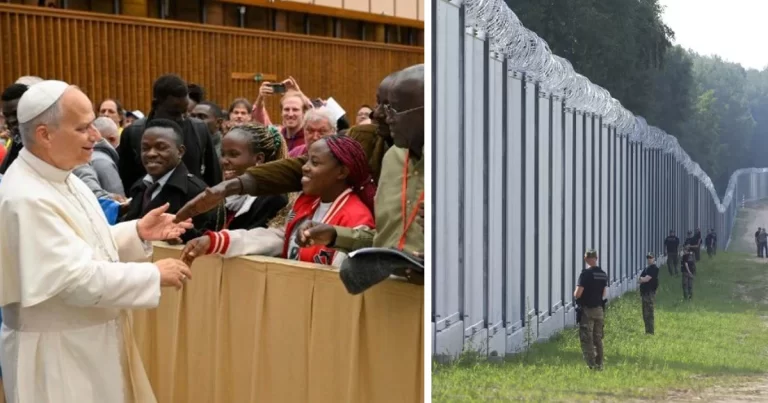
The Church’s balanced position upholds the dignity of migrants while also affirming the right to regulate migration flows and protect national borders.
The thinking of the Church is far more nuanced than the ideological frameworks of right and left.
Tensions surrounding the issue of migration are a daily matter, and the Church is often labeled by the political right as being “aligned with the left”.
But does this flattening toward one political side really exist?
Leo XIV: “The right to protect borders”
Yet on Tuesday, Leo XIV invoked “the right of every country to determine who, how and when people enter,” while siding with the U.S. bishops who oppose the “extremely disrespectful” treatment of migrants.
He used almost identical words at the end of October in his address to popular movements, stating: “States have the right and the duty to protect their borders, but this should be balanced by the moral obligation to provide refuge”
Pope Francis: “Prudence — better not to receive”
Many may believe this is something new, yet another innovation of Leo XIV. But that is not the case.
If anything, Pope Francis was even more direct when he said that “a people that can accept but does not have the possibility of integrating, is better not accepting”. And that “joined to the right of being able to emigrate” Francis explained, “as well as the right to not be constrained to emigratethe right not to have to migrate”.
Also because, as he added, “we are not able to open our doors in an irrational way.”
These and other statements by Francis can be found in our dedicated dossier (in Italian).
The clash between Trump and the American bishops
The election of the new leadership of the United States Conference of Catholic Bishops (USCCB) has highlighted the richness of Church thought beyond common clichés.
The newly elected president of the American bishops, the Archbishop of Oklahoma City, Paul Coakley, is considered a figure of “political conservatism,” and yet, while supporting the near-total ban on abortion in Oklahoma, he has repeatedly opposed the inhuman treatment of migrants carried out by the American government.
In fact, immediately after his election, he led the episcopal conference to renew the confrontation on immigration, expressing unanimously (216 votes in favor, 5 against and 3 abstentions) strong concern.
Thus, the issue is not right vs left, nor can it be reduced to a simple “welcome yes / welcome no.” The Church’s position is complex, balanced, and rooted in the dignity of the person, the legitimacy of the State, and social cohesion.
The Church and the Right to Regulate Migration Flows
This was explained very clearly by the Catholic philosopher Edward Feser, professor at Pasadena City College, in an article.
After highlighting the excesses of the Trump administration against migrants, which he says should be “rightly criticized”, Feser reaffirmed the principle of “abusus non tollit usum”. In other words, the abuse of a thing does not negate its proper use.
In fact, the enforcement of immigration laws is legitimate, and the fight against illegal immigration is also supported by the Catholic Catechism, which states that hospitality must be offered “to the extent possible” and that political authorities “may subject the exercise of the right to immigrate to various legal conditions, in particular to the duties of immigrants toward the country which receives them.”
In simple terms, the Church recognizes that a nation may impose conditions on immigration, that it is not obliged to welcome everyone who wishes to enter, and that those who are admitted must obey the law.
Even Saint John Paul II explained that “illegal immigration should be prevented,” and Benedict XVI added that “States have the right to regulate migration flows and to defend their own frontiers, always guaranteeing the respect due to the dignity of each and every human person”
The philosopher Edward Feser therefore observes that the Church addresses immigration as an important matter of public policy and does not reduce it merely to “a matter of individual rights and dignity,” even though these are important, “but also of duties toward the common good. From this perspective, the Catholic position on immigration cannot be simplified into a ‘for’ or ‘against’ stance.”
The Need for a Balanced Position
The bishops, the philosopher rightly concludes, “have the pastoral duty to acknowledge the concerns of both sides,” meaning both those who view welcoming migrants as a primary moral imperative and those who consider it more urgent to preserve the law, order, economic well-being, and cultural identity.
There is no side that is “more Catholic” than the other; both are represented in the Church’s social doctrine.
The task of the faithful, instead, is to “insist on maintaining the middle path,” reaffirming the Christian importance of welcoming the stranger while also adopting a politically prudent and balanced approach.
Pope Francis made this clear when he emphasized the need for a balanced position:
“Prudence on the part of public authorities does not mean enacting policies of exclusion vis-à-vis migrants, but it does entail evaluating, with wisdom and foresight, the extent to which their country is in a position, without prejudice to the common good of citizens, to offer a decent life to migrants, especially those truly in need of protection.”
Author






0 commenti a The Church Defends Migrants, But Also National Borders