
Anglican Church: A Woman Primate and the First Divisions
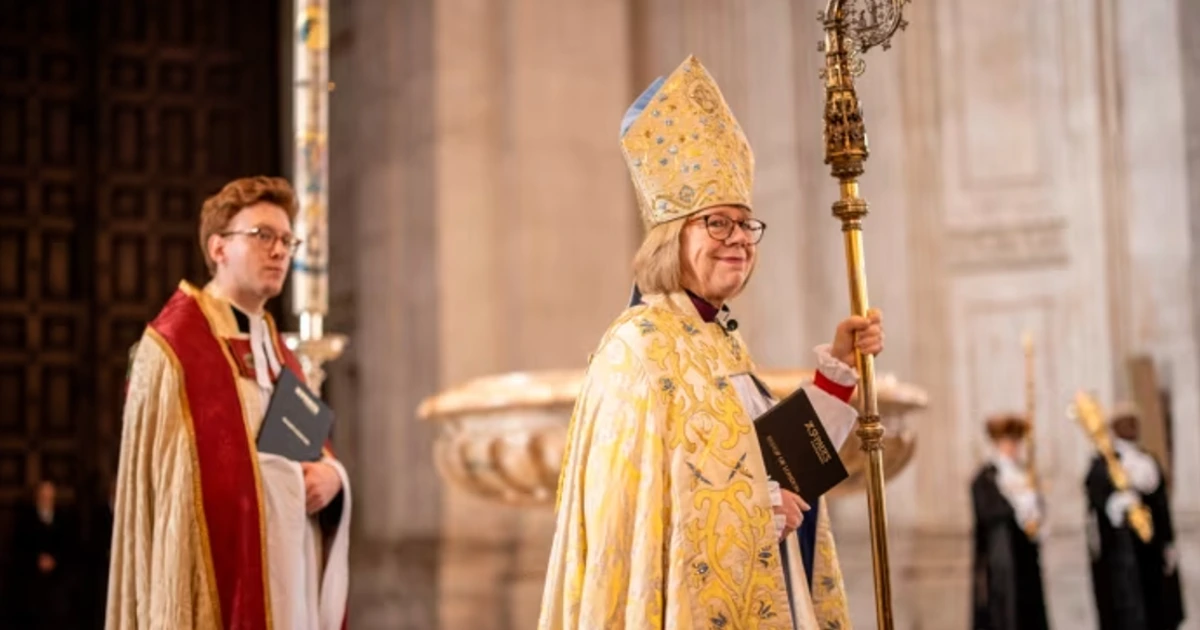
UCCR speaks with two Anglican associations about the appointment of a woman as head of the Anglican Church. The first reactions to an election that creates difficulties for the Anglican Communion
The election of Sarah Mullally as the new Archbishop of Canterbury is a historic turning point.
The first woman in about 500 years to be Primate of the Church of England, following a long consultative process.
We have repeatedly highlighted the curiosity of the fact that the leader of the Anglican Church had to receive final approval from the political prime minister (a secular socialist) and subsequently from King Charles III, nominal head of the Anglican Church.
This overlap between politics and religion is part of the imprint of Anglicanism, born in the sixteenth century from a decision by King Henry VIII, who broke with Rome after the papal refusal to annul his marriage to Catherine of Aragon.
Mullally’s appointment has already sparked a major debate and initial divisions. At 63, married and mother of two, her election is the culmination of a decades-long journey following the introduction in the Anglican Church of female ordination, first to the priesthood (1992) and later also to the episcopate (2014).
GAFCON Anglicans do not recognize the Primate
UCCR has been in contact with the Global Anglican Future Conference (GAFCON), one of the most influential bodies of Anglican bishops and leaders, which did not receive Mullally’s election very well. In fact, they have “received it with pain”.
The reasons, explained to us by Reverend Jodie McNeill, honorary canon of St Andrew’s Cathedral (Sydney), referring us to the relevant statement, are that the appointment “abandons Anglicans around the world, since the Church of England has chosen a leadership that will further divide an already divided Communion”.
The Archbishop of Canterbury indeed serves as Primate of all England but also as the spiritual and moral leader of the Anglican Communion worldwide, and the See of Canterbury is one of the four pillars of the Anglican Communion alongside the Lambeth Conference, the Primates’ Meeting, and the Anglican Consultative Council.
After this appointment, however, GAFCON can no longer “recognize the Archbishop of Canterbury as the Instrument of Communion or as first among equals” of the world Primates.
According to the Reverend, “the majority of the Anglican Communion still believes that the Bible requires an exclusively male episcopate”. Added to this is Sarah Mullally’s “progressive” stance, who “has repeatedly promoted non-biblical and revisionist teachings regarding marriage and sexual morality”.
GAFCON itself therefore considers itself ready to assume leadership of the Anglican Communion and from March 3 to 6, 2026 has convened all orthodox Anglican bishops worldwide in Abuja (Nigeria).
Anglo-Catholics remain faithful to tradition
Yesterday UCCR also spoke with Father Tom Middleton, director of Forward in Faith, an Anglo-Catholic association within the Church of England also present in Scotland, founded in 1992 precisely following the approval by the General Synod of the ordination of female priests.
Father Middleton explained to us that although “this appointment is the natural development of measures already introduced in the Church of England”, Forward in Faith recognizes Bishop Mullally as “the true and legitimate holder of such office”.
Their commitment remains, however, to “remain faithful to the teaching of the universal Church”, continuing “to offer sacramental guarantees in line with our understanding of historic apostolic succession”.
The underlying intention is to safeguard internal unity, even if “on these matters we look to the great Churches of the West, Rome, and of the East, the Orthodox. Only in this way do we think we can remain faithful to the universality of Christianity”.
Between tensions and the will for unity
On one side the concern for the Anglican drift and on the other the ambition to save the Anglican Communion while continuing to remain faithful to apostolic succession.
A position certainly not easy, made even more complex by the recent appointment of Mullally.
In the Catholic context, besides the formal congratulations to the new Anglican Primate, the intention is naturally to maintain dialogue between Churches even in the absence of common doctrinal visions on crucial matters.
In this regard, Cardinal Vincent Nichols, Catholic Primate of England and Wales, commented on Mullally’s appointment promising the prayer of the Catholic community, adding that “together we will respond to Jesus’ request: ‘That we may all be one’”.
Author







1 commenti a Anglican Church: A Woman Primate and the First Divisions
[…] As we had already anticipated, from March 3 to 6, 2026 an important conference took place in Abuja (Nigeria). […]