
Mosaic of Megiddo, the First “Physical Evidence” of Christianity

On display for the first time in Washington, the Megiddo mosaic, dating back to the 3rd century, is part of the earliest known place of worship of early Christianity, where Jesus was already venerated as God.
For the first time, it is now possible to visit the world’s oldest Christian place of worship.
This is the Megiddo mosaic, which dates back to the 3rd century and is now housed at the Museum of the Bible in Washington.
Unveiled to the world for the first time on September 15, 2024, it has already attracted thousands of visitors from across the globe. It will remain on display until July 2025.
What is the Megiddo Mosaic?
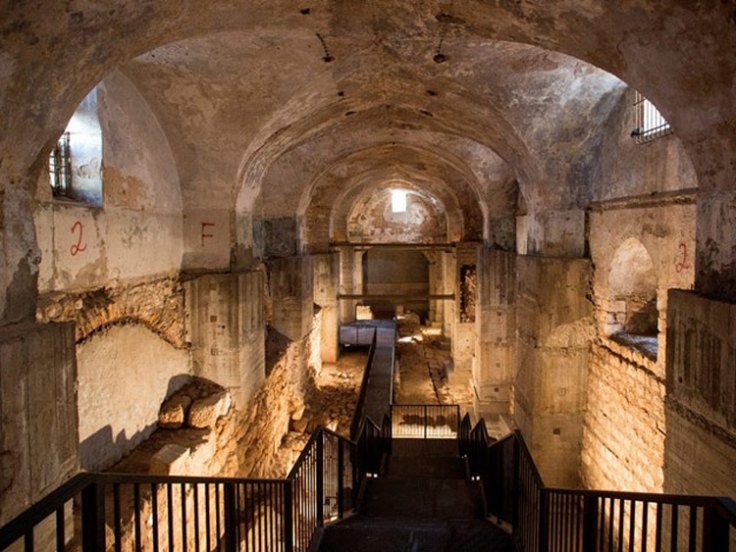
The Megiddo Mosaic was discovered during the construction of a prison in Megiddo in 2005, located in northern Israel in the Galilee region. This area, historically known as Legio, holds significant biblical and historical relevance (often associated with the Battle of “Armageddon,” mentioned in the Book of Revelation).
Regarded as the most important discovery since the Dead Sea Scrolls in Qumran (1946), the mosaic dates to around 230 AD, predating the legalization and broader acceptance of Christianity under Emperor Constantine.
It provides deeper insight into the spread of early Christianity in the Holy Land.
Scholars believe it was part of the floor of the oldest Christian place of worship, adorning one of the 50m² prayer rooms. It stands as a unique testament to a primitive ecclesial community before the more formal church structures developed in later centuries.

The first inscription of Megiddo Mosaic: the use of the term “brother”
The Megiddo mosaic, created by an artist named Brutius (whose name is preserved on the floor), features a depiction of a table/altar for the celebration of the Eucharist and the image of two fish, early symbols of Christianity.
However, there are other intriguing elements, including three inscriptions in Greek.
The first inscription is dedicated to a man named Gaianus, a Roman centurion who funded the mosaic floor at his own expense as an act of generosity. This serves as a rare example of unity between Romans and Christians.
Gaianus is referred to as “our brother”, affirming the use of the term “brother” in the early church as seen in the letters of the New Testament.
The Second Inscription: The Role of Women
The second inscription (pictured below) commemorates five women, calling them by name. These women likely played a significant role in the community.
They are Akeptous, wife of Gaianus, Primilla, Cyriaca, Dorothea, and Chreste.
Bobby Duke, the exhibition curator, believes these references emphasize «the crucial role of women in the early church». They may also have been financial supporters of this early “house church.”

The Third Inscription: Jesus as God
The third inscription includes the words: “God Jesus Christ”, specifying that the central table in the room is dedicated to Him.
This is a precious and ancient affirmation of faith in the divinity of Jesus, predating the major councils of the early church (for instance, Nicaea, held in 325 AD).
This statement is not presented as a grand revolutionary idea but as a simple (and almost self-evident) prepositional phrase, serving as the theological foundation of this early community’s faith.
It reveals a long-standing belief, thereby refuting Bart D. Ehrman‘s theory of a so-called late exaltation of Jesus as God.
In his controversial popular work, How Jesus Became God (HarperOne, 2014), the agnostic scholar attempts to challenge the evidence for what is known as “high Christology”, arguing that Christians gradually elevated Jesus to the status of a divine being equal to the God of Israel, formalizing this belief only at the Council of Nicaea (325 AD).
This is an old and recycled idea from early 20th-century historiography (originating with Wilhelm Bousset), widely discredited by the scholarly community thanks to researchers like Martin Hengel, Larry Hurtado, and Richard Bauckham. Ehrman’s book received an immediate and detailed response in the volume How God Became Jesus (Zondervan, 2014).
“There is neither Jew nor Greek, there is neither slave nor free, there is neither male nor female, for you are all one in Christ Jesus” (Gal. 3:28), wrote Saint Paul in the first half of the 1st century.
The Megiddo mosaic bears witness to a small Christian community living according to Paul’s ideal, where an artist, a Roman soldier, and a group of women created a room to allow the early local church to gather fraternally in the name of Jesus Christ, already then worshiped as God.









0 commenti a Mosaic of Megiddo, the First “Physical Evidence” of Christianity