
Who Was Muhammad? No Historical Certainty for Scholars
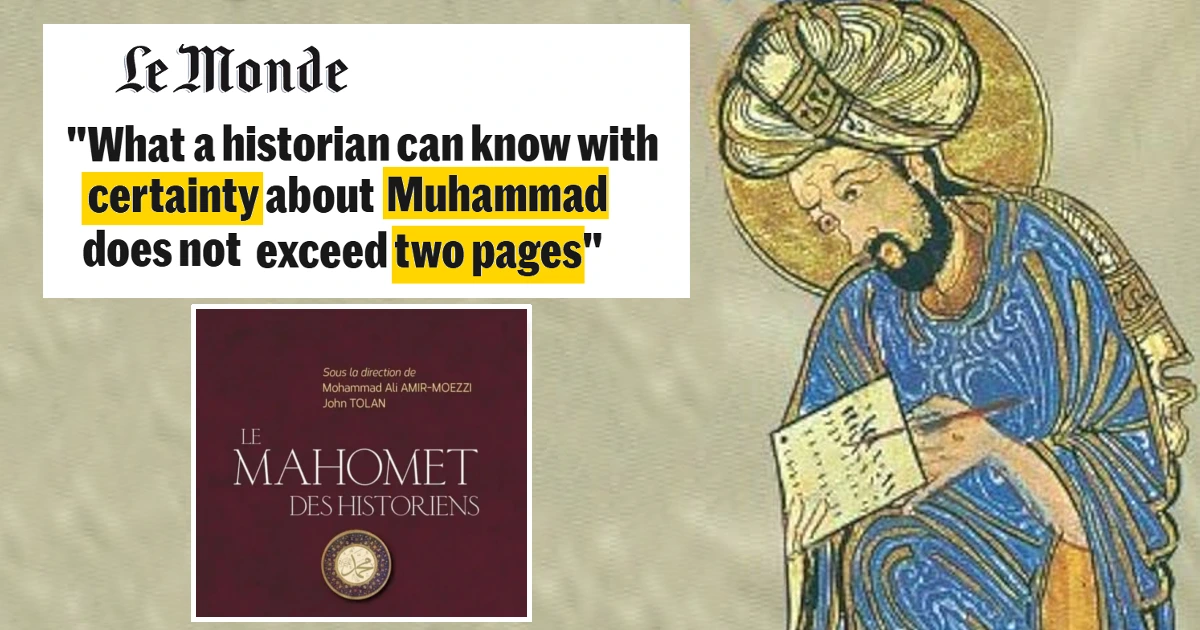
Muhammad, who was he? Scholars put the historical sources to the test, finding it almost impossible to provide a biography. What little is known is that he spread a biblical message.
Who was Muhammad? A new academic project reignites the historical debate on the founder of Islam.
Recently in France, “Le Mahomet des historiens“ (“Muhammad According to Historians”) (Les Éditions du Cerf 2025), a monumental two-volume work (over 2,000 pages) curated by Mohammad Ali Amir-Moezzi and John Tolan, with contributions from fifty international specialists, has been released.
The goal? To scientifically explore the figure of Muhammad, his message, his biography, and his cultural impact beyond myth and devotion, meticulously analyzing all sources—Islamic and non-Islamic, Arab, Christian, Persian, African, as well as mystical or literary texts.
Muhammad, no historical certainty
Despite the encyclopedic effort, the historians involved emphasize a crucial point: what can be considered certain about the historical life of Muhammad is extremely limited.
In an interview with Le Monde, the project’s main leader, Ali Amir-Moezzi, Emeritus Director at the École Pratique des Hautes Études (Paris) and one of the world’s leading Islamologists, even states that “what historians can assert with certainty about Muhammad perhaps does not exceed two pages”.
On the other hand, thirty years ago, in the journal “Arabica”, anthropologist Jacqueline Chabbi argued that “it is impossible, using critical methods, to write a historical biography of Muhammad because the sources about him are late, contradictory, full of approximations and errors, and theologically and politically biased”.
The first known biographical account of Muhammad, that of Ibn Isḥāq, reworked by Ibn Hishām, dates to over a century after his death.
The same authors of the recent work, the aforementioned Amir-Moezzi and John Tolan, Emeritus Professor at the University of Nantes, confirm in the interview that “if one manages to write a biography of Muhammad, it is because one does not adopt a critical approach to the texts. And if one wants to adopt a critical approach, the attempt becomes simply impossible”.

His message was biblical, not Islamic
In detail, according to scholars, it can be reconstructed with relative certainty only that Muhammad lived in western Arabia at the end of the 6th century. Everything else is shrouded in the fog of late and contradictory sources, including his birth and death dates, the number of his children and wives, etc.
Another established fact is that the founder of Islam, scholars explain, brought «a message situated within the Jewish and Christian monotheistic tradition», announcing the end of the world and inviting people to repent, to be pious, to give alms, and to be kind to one another in order to be spared from God’s wrath.
Amir-Moezzi also explains that the Quranic text «is presented as an extension of Moses’ Torah and Jesus’ Gospel (Sura 5, 46)», announcing apocalyptic themes that «are clearly Jewish and Christian». The only distinction is that, in the Quran, «God regularly speaks in the first person».
It is interesting how Amir-Moezzi specifies that this message is classified by historians as Biblical, while co-author John Tolan, Emeritus Professor at the University of Nantes, notes that the Islamic sacred text presents a population «widely familiar with the monotheistic universe», therefore biblical, so much so that the Quran constantly refers to stories from the Bible, «particularly those of the prophets from the Old and New Testaments, allusively, as if they were already known to everyone».
This aligns, among other things, with the thesis of two scholars discussed by UCCR recently, according to which the Quran specifically refers to the Syriac Peshitta, a text identical to the current Gospel.
The Quran does not specify at all that Muhammad, mentioned only four times, differs in any way from the Jewish and Christian prophets, nor that he intended to found a new religion.
The Quran spread thanks to Luther
At the end of the interview with “Le Monde”, Mohammad Ali Amir-Moezzi explains that Christian intellectuals in the Middle Ages, at least until the 16th century, considered Muhammad to be a false prophet, also because the Gospels had foretold the arrival of such figures. Even more so considering that the Quran incorporated biblical elements.
Everything changed in 1543 when the Quran was translated into Latin with a preface by Martin Luther. Since then, the scholar explains, «Protestant authors found arguments against the Catholics in the Muslim text» and thus, «although the perception of Islam remained negative, it was perhaps a lesser evil compared to Catholicism from a Protestant perspective».
With the Enlightenment, a positive image of Muhammad developed, «perceived as a great spiritual figure and poet, particularly by Goethe and Victor Hugo, with the idea that Muslims had preserved a spirituality that Europeans had lost with modernity. For his part, Napoleon considered him a great lawgiver».
In 1979, with the Iranian revolution, political Islam effectively emerged, and since then the Muslim religion has been seen as a threat.
The Difference with Christian Sources
This happens when, for once, the historical-critical method is not applied to Christian sources but, in this case, to Islamic ones.
For centuries, Christianity has withstood almost unscathed the rigorous analysis of sources, and in fact, today we know that the key data about the historical Jesus were known “almost certainly in Roman Palestine of the 30s of the 1st century”1B. Ehrman, Did Jesus Exist? HarperCollins Publishers 2012, pp. 132-133, thus contemporaneously with his crucifixion.
In short, the same methodological rigor that allowed Christianity to be “put to the test,” when applied to Islam, reveals a fundamental problem: the certain sources are too few, and much of what is believed about Muhammad remains, for historians, a reconstruction that can hardly be called historical.
Author







0 commenti a Who Was Muhammad? No Historical Certainty for Scholars