
Why the Vatican Was Bombed on This Day
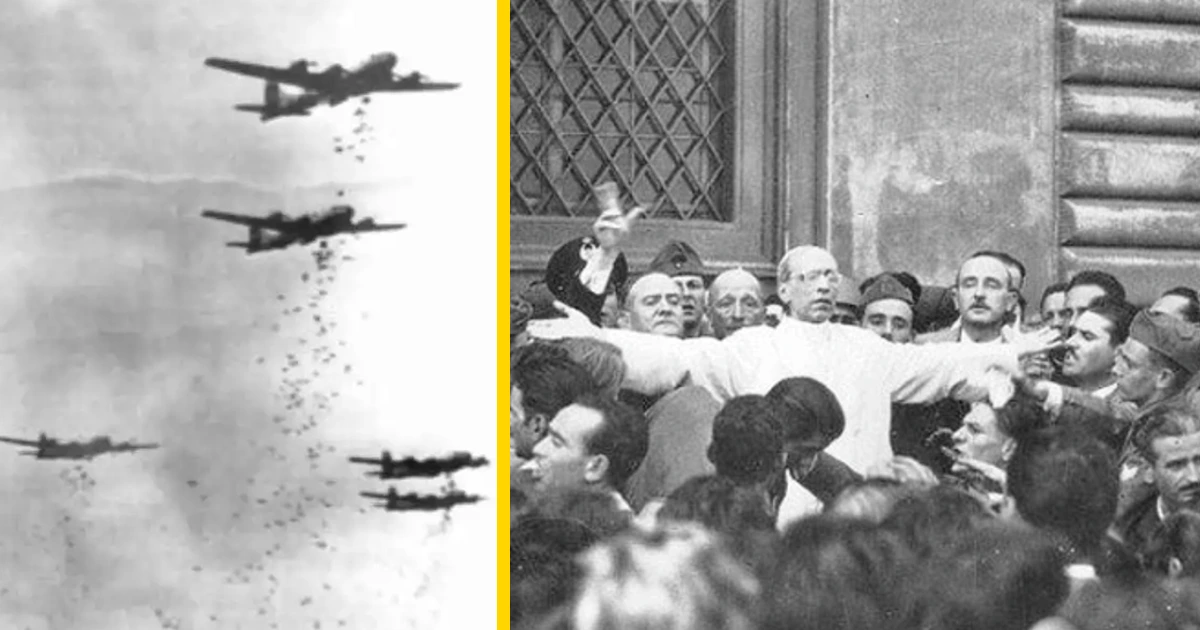
The motives and those responsible for the bombing of the Vatican that took place on November 5, 1943, exactly 82 years ago.
On the evening of November 5, 1943, at 8:10 p.m., an aircraft entered the airspace of Vatican City.
Five bombs were dropped, and four exploded within the pontifical borders, while one remained unexploded.
The detonations hit the Vatican Mosaic Laboratory, the Governor’s Palace, the nearby train station, and the square in front of St. Peter’s Basilica, causing significant material damage but – by a true miracle – no casualties.
Why Was the Vatican Bombed?
Even today there remains an aura of uncertainty regarding responsibility for the attack.
Different versions attributed the action to Fascist aviators of the Italian Social Republic, or to an out-of-control Allied mission, or even to a single American pilot.
The most reliable version, however, was reconstructed in the book by Augusto Ferrara, “1943. Bombs on the Vatican” (LEV 2006), according to which the target was Vatican Radio, which broadcast messages for prisoners of war, representing a “voice” unwelcome in a wartime context.
Ferrara collected period documents, about thirty unpublished photographs tracing the aircraft’s route, along with philatelic and postal documentation from that time, and maintains that the plane took off from the Viterbo (VT) airport and was a Savoia-Marchetti SM 79 “Sparviero” model piloted by a Fascist officer under the command of Roberto Farinacci.
The reconstruction does not claim to provide a definite name for the perpetrator: there are also versions that attribute the attack to an error by the United States Army Air Forces during an Allied mission. Ferrara himself acknowledges the uncertainty about those responsible but favors the internal Italian lead.
The Vatican was bombed a second time, on March 1, 1944, with six bombs falling just outside the borders, near Porta dei Cavalleggeri. In this case, the RAF, the British Air Force, admitted the mistake.
The Pope’s Reaction
In the context of the world conflict, in any case, the entire city of Rome had been subjected for months to repeated bombings. From July 1943 until its liberation in June 1944, there were about 51 air raids on the city.
This made the Vatican State – neutral and protected by international prerogatives – a place considered safe by many civilians and refugees. And it was precisely this condition that made the attack even more symbolic.
At that historical moment, Vatican City hosted refugees, civilians, and Jews and, as mentioned, broadcast radio transmissions considered strategic.
Pius XII’s response became iconic: together with Monsignor Giovanni Battista Montini (the future Paul VI), he went down into the streets of Rome to share in the people’s suffering.
Pacelli repeated the same gesture on August 13, 1943, during a second bombing of the Italian capital.
Author



0 commenti a Why the Vatican Was Bombed on This Day