
The Christian Middle Ages, Cradle of the West: History Lesson
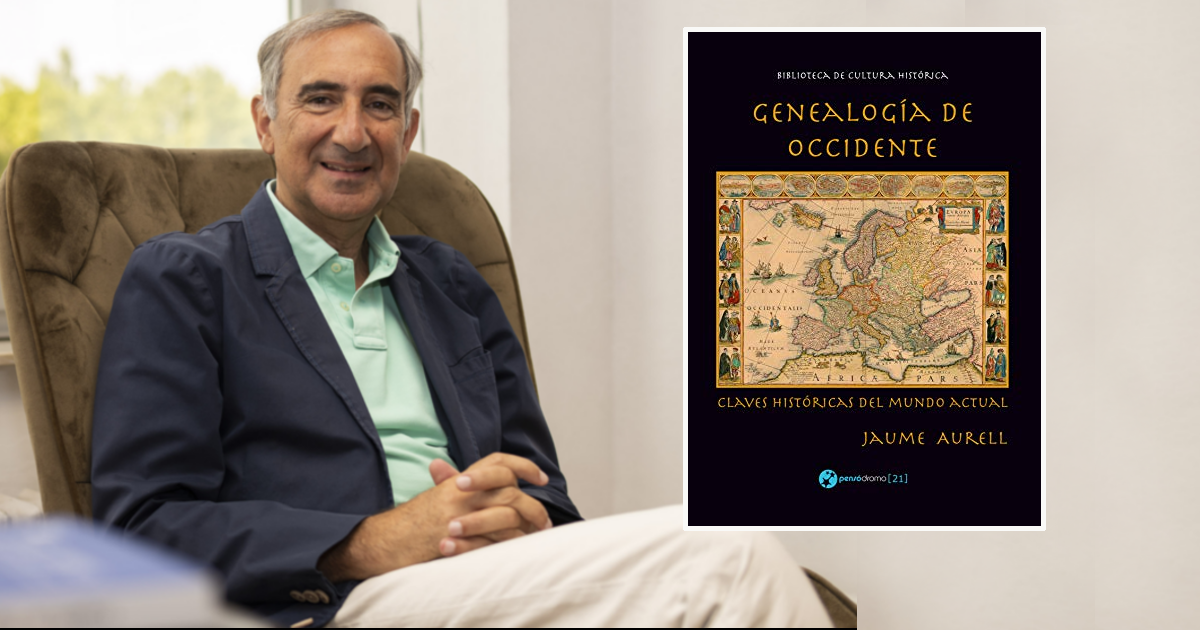
Summary of the speech by the eminent historian Jaume Aurell Cardona (University of Navarra) on the reasons why the Middle Ages shaped the West and influence our life today.
The alleged darkness of the Middle Ages illuminated by a famous lecture by Jaume Aurell Cardona.
He is a prominent Spanish historian, professor of Medieval History at the University of Navarra, who recently spoke in a panel titled “Why is what is truly specific to the West found in the Middle Ages?”.
Here we summarize the key points of his long speech, in which he details how modern Western society depends on the Middle Ages, from the first forms of representative government to universities, through the end of slavery, the origins of science and capitalism, up to the cultural synthesis between religion and previous civilizations.
Professor Cardona’s thought is presented in his bestseller “Genealogía de Occidente“ (Pensódromo 21 2019), in which he analyzes the fundamental stages through which the West was forged.
The term “medieval” in a derogatory sense
The first point addressed by the Spanish medievalist is the use of the adjective “medieval”, explaining that historians are increasingly agreeing in perceiving “barbaric that other eras defined the Middle Ages as ‘barbaric’”.
He is not sure if he would go live in the Middle Ages because “morning hot showers are convenient for almost everyone”. But, irony aside, Cardona continues, “if you really push me, the only era in which I would not have wanted to be born is between 1920 and 1950, with Stalin, Hitler, or Pol Pot. Unbelievable figures to encounter in the Middle Ages”.
Even the Middle Ages had brutal men, like Frederick II or John Lackland, but he adds, “even they were redeemable, they attended the Church to ask forgiveness for their sins. There was a context that helped prevent descending into the total barbarity that we witnessed in many cases in the modern age”.
The first step to popular revaluation of the Middle Ages, he explains, “is to start not using the adjective ‘medieval’ in a derogatory sense”. A distortion that originated with the Enlightenment thinkers, who “to build their identity as the ‘Age of Enlightenment,’ chose the medieval era as the enemy, ‘the dark age.’ Much of the Middle Ages’ bad reputation comes from there”.
After this introduction, Jaume Aurell Cardona gets to the heart of his speech analyzing the key points for which the Middle Ages are the cradle of the West.
The Middle Ages and the overcoming of slavery
In the Middle Ages occurs the overcoming of slavery, what the historian calls “the great socioeconomic system of antiquity”.
In medieval centuries the concept of feudalism was invented, which is certainly not a virtuous model for us today but “from the 10th, 11th, 12th centuries it replaced slavery, and people thanked God for this”.
The reason, explains the Spanish historian, “is that for the first time the relationship ‘between inferior and superior’ involved rights and duties on both sides. The slave, with respect to the master, had no rights: only the lord had rights over him. Instead, between vassal and lord there existed a complex legal bond, in which the lord also had duties toward the vassal”.
For those who wish to delve deeper, we suggest our historical dossier (in Italian) on the end of slavery in medieval Christian society.
How the Middle Ages invented the modern state
The second point addressed by Aurell Cardona is the construction of the State.
The Middle Ages indeed achieved something absolutely unique: a synthesis between Christianity and the three great previous cultures: Jerusalem, Athens, and Rome. Plus a fourth, often forgotten but fundamental: the Germanic world.
It is precisely from the latter that the monarchy was adopted, not from Rome. Indeed, the historian states, “the Roman monarchy has nothing to do with the monarchy we inherited in Europe from the Germanic world. There it was more about city-states than a monarchy in the proper sense”.
Again: was the monarchy despotic and authoritarian? Certainly not a model for today. But compared to the feudal lord, the “chief” was distant, and medieval peoples saw “the king as a liberation”. Moreover, in the cities that were forming, fiscal autonomy developed.
Thus “what we know as the modern state”, explains Aurell Cardona, “of which thinkers like Hobbes and Locke would reflect on in the modern age, actually began to form between the 11th and 15th centuries”.
The first parliament in the world was born in the Astur-Leonese kingdom in 1188, in the heart of the Middle Ages, that is, “the first time citizens entered a parliament, the first time rights were proclaimed as embryonic as those present today in our constitutions, such as the inviolability of the home, the presumption of innocence, etc.”.
The birth of capitalism
A third argument of the Spanish historian is capitalism.
It also arose in the Middle Ages, for better or worse. The positive aspects, at least in that era, were the beginning of wealth generation “among people who previously had almost nothing and depended only on agricultural rents”.
Instead, in the cities of the 11th-14th centuries, especially in Italy but also in Northern Europe, capitalism began to generate “much better conditions than before”.
The Middle Ages between science and universities
The fourth point is the origin of modern science.
A topic linked to Scholasticism and the birth of universities, inventions exclusive to the Franciscans and Dominicans of the 11th century.
“It is impressive that the model designed by those geniuses remains substantially the same even today”, explains the Spanish medievalist. “All university professors recognize it: when we enter a university, whether in Rio de Janeiro, Johannesburg, Seoul, Tokyo, or Beijing, we move within the same institutional framework born in the Middle Ages”.
On this topic as well, we invite you to consult our historical dossier (in Italian) on the origin of science in the Middle Ages.
Separation between politics and religion
The last point addressed by Jaume Aurell Cardona is secularism.
A topic “taken” by the Enlightenment, during which the distinction between political and religious, civil and ecclesiastical, temporal and spiritual developed radically.
“This, however, was not new at all”, explains the historian. “Already in the Middle Ages, in Spain, kings had developed this distinction through the ceremony of self-coronation”.
This was the moment when the bishop placed the crown on the king’s head, who would tell the religious authority: “You may perform the anointing, which is the sacred act, but you do not touch the crown, which is the symbol of temporal power and belongs to me.” With this gesture the political was clearly distinguished from the religious already between the 11th and 15th centuries.
When the Enlightenment thinkers arrived to establish this separation, explains Aurell Cardona, “they were probably unaware that already in the so-called clerical Spain, the political was being wisely distinguished from the religious”.
As anticipated, the article does not claim to be exhaustive and should be read as an extreme summary of a long speech and, above all, of a long book of historical reconstruction.
But it still offers a clear overview of the reasons why the Middle Ages shaped the West and continue to profoundly influence our society.
Author





0 commenti a The Christian Middle Ages, Cradle of the West: History Lesson