
Turkey, 1,300-Year-Old Eucharistic Breads Discovered
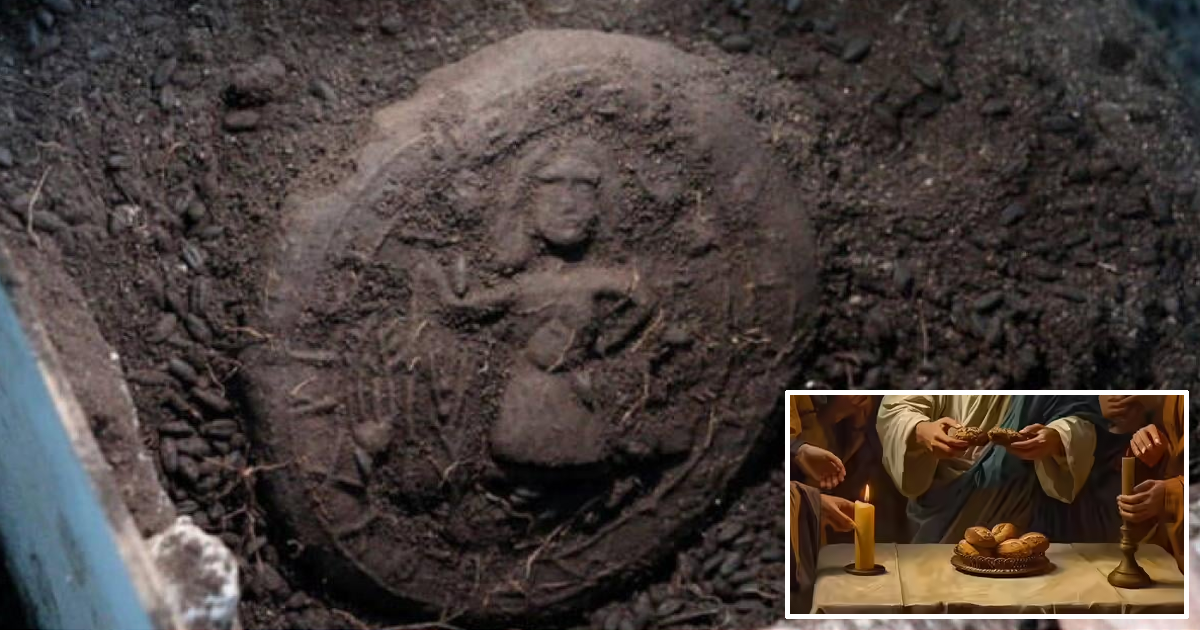
An exceptionally rare discovery in Anatolia (Turkey): five loaves intended for the Eucharist dating back to the 7th–8th centuries, one of which depicts Jesus as the Sower.
Five loaves for the Eucharist dating to the 7th–8th century.
This is what was found in Anatolia at the Topraktepe site, the ancient Irenopolis.
The charred loaves date to the Byzantine period; one in particular bears an engraving depicting Jesus as a sower, accompanied by the Greek inscription: «With gratitude to blessed Jesus».
Some even suggest that the discovery may have solved the mystery of the Sator Square. We will see below.
The Five Eucharistic Loaves of Anatolia
A very original and extremely rare discovery, especially for the image of the Lord as a farmer, different from the well-known Christ Pantocrator. A motif linked to agriculture that could indicate an intention to address the local community where faith coexisted with working the land.
It could also reflect the parable of the sower cited in the Gospels, a powerful allegory of faith as a seed that takes root in the human heart and bears spiritual fruits.
The other Eucharistic breads bear imprints of a Maltese cross, reinforcing the hypothesis that they were intended for the liturgy and the Eucharist.
The circular loaves survived 1,300 years thanks to carbonization, which preserved surface details, combined with burial in low-oxygen conditions and stable temperatures. The next objective will be tomographic examinations to identify the cereals and baking techniques useful for understanding the local diet.
Turkey, Cradle of Early Christianity
The presence of a production center of quality Eucharistic breads with such iconography confirms the existence in Irenopolis of an active Christian community, endowed with resources and a distinct theological identity.
It should be noted that present-day Turkey hosted the first Christian communities, starting from the travels of Saint Paul and from the Council of Nicaea which shaped the Creed still recited today. Shortly it will be the destination of Pope Leo XIV’s first apostolic journey.
Acts 11:26 also reads that in Antioch (present-day Antakya, in Hatay province) “the disciples were called Christians for the first time” (Acts 11:26). Turkey was therefore undoubtedly one of the earliest cradles of Christianity.

A Eucharistic Liturgy Not Unlike Our Own
Another point we would like to emphasize about the discovery concerns the centrality of the Eucharist which, as the Catechism of the Catholic Church teaches, has at its heart «bread and wine, signs of the goodness of creation, which become the Body and Blood of Christ» (CCC 1333).
This find testifies that, already in the 7th–8th centuries, Christian communities celebrated the Eucharist in a manner similar to how we still celebrate it today, at least within Catholicism.
We discussed this just yesterday telling the conversion to Catholicism of Carrie Prejean Boller after she realized, studying the early church, that “everything was centered on the Eucharist” and that it was not a sporadic or merely symbolic rite.
Solved: The Sator Square Mystery?
A third interesting aspect is highlighted on StileArte by observing that on the back of one of the charred loaves, among the emerging motifs, appears a multi-square design with traces of radial crosses.
It is suggested that this motif could be connected to the famous Sator Square, the Latin palindromic inscription SATOR AREPO TENET OPERA ROTAS found in various archaeological contexts related to early Christianity.
According to the authors the association would not be accidental: “Sator” means “sower”, which ties directly to the image of the agricultural Christ impressed on one of the loaves. Recalling the inscription of the Sator Square, it is hypothesized that “Arepo” was a fictional name necessary for the palindrome, while “tenet opera rotas” would refer to the action of guiding the plow’s wheels, in an allegory that connects earthly labor and divine action.
Could this finding therefore have solved the mystery of the Sator Square?

It remains fascinating to think that after more than a thousand years, the Eucharistic bread continues to speak of the same reality: the presence of Christ at the center of community life.
A concrete sign that the ancient liturgy was not distant from ours, but part of a living tradition that unites faith, memory and everyday life.







0 commenti a Turkey, 1,300-Year-Old Eucharistic Breads Discovered