
The FSSPX Talks with UCCR: What Separates It from the Church?
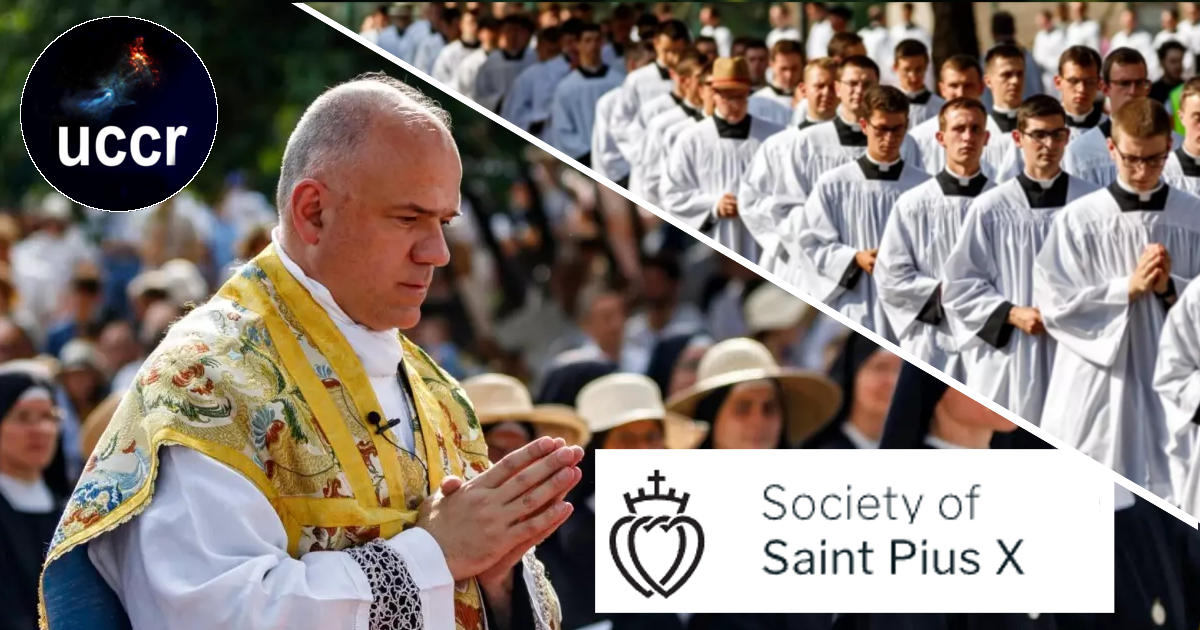
Why is the Society of Saint Pius X (FSSPX or SSPX) still separated from the Church? UCCR speaks with Fr. Daniele Di Sorco about the basis of the FSSPX’s positions, a fraternal dialogue.
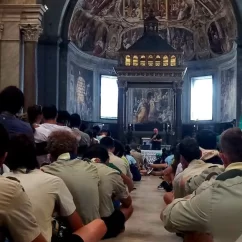
On August 20 the Society of Saint Pius X also took part in the 2025 Jubilee with a pilgrimage.
Almost no one talked about it but more than 7,000 members from around the world showed up in Rome, including 680 priests.
We genuinely appreciated this gesture, which is by no means a given since many now consider the FSSPX to be in an irreparable state of separation from the Catholic Church.
FSSPX and the rupture with the Church
Founded by Archbishop Marcel Lefebvre in the 1970s, the Society of Saint Pius X has always had a complex relationship with Rome because of Lefebvre’s rejection of the reforms of the Second Vatican Council.
The rupture culminated in his excommunication in 1988, when he consecrated four bishops without papal approval.
In 2009 Benedict XVI lifted the excommunications, expressing the hope for full communion, while nevertheless maintaining the irregular canonical situation of the FSSPX, which still lacks canonical recognition until the full acceptance of Vatican II and the teaching of the post-conciliar popes occurs.
After years of dialogues and tensions, under the pontificate of Pope Francis further steps of pastoral openness were taken: in 2015, FSSPX priests were authorized to validly hear confessions during the Jubilee of Mercy and, in subsequent years, the celebration of marriages under diocesan supervision was facilitated.
The dialogue between UCCR and FSSPX
For several days UCCR engaged in a fraternal dialogue with the FSSPX, in the person of Fr. Daniele Di Sorco, delegate for press relations. To him we expressed our appreciation for their presence at the Jubilee.
Besides reminding us of the FSSPX’s participation in the 2000 Jubilee, he also cited Lefebvre’s convicted adherence “with all his heart and with all his soul” to “Catholic Rome guardian of the Catholic faith and of the traditions necessary for the preservation of that same faith, to eternal Rome, teacher of wisdom and truth”.
Members of the Society of Saint Pius X, Fr. Di Sorco tells us, “are fully Catholic, and for this reason they are eager to show their attachment to the Roman See, also through participation in the jubilee”. Also because the FSSPX sees “in Leo XIII and in his immediate predecessors the legitimate successors of the Apostle Peter and fully recognizes in them the pontifical authority”.
From this point on, however, the “buts” and “howevers” arise.
The FSSPX representative tells us that the Fraternity “cannot accept those innovations which, from the Second Vatican Council onwards, oppose what the Magisterium of the Church has already taught definitively. It is solely for this reason that our Institute was in the past subjected to canonical sanctions which we have always considered unjust and therefore invalid”.
Thus, Fr. Daniele adds, “more than a legitimization of our reality, the Fraternity hopes and prays that the authorities of the Church return to profess the Catholic faith in its entirety”.
This is a concept the FSSPX representative reiterates to us several times: the stumbling block to full communion is the liturgy according to the ordinary Roman rite and the doctrines of the Second Vatican Council and subsequent Popes “which oppose what the Church has always taught”.
Therefore, through contacts with ecclesial authorities, the Fraternity does not intend “to obtain the ‘normalization’ of its canonical situation, but to contribute to resolving the crisis in the Church through a return to traditional Catholic doctrine”.
FSSPX: adherence to the Church but it must correct itself
We did not hide from Fr. Di Sorco that we read a contradiction in these positions.
On the one hand a formal adherence to the authority of the Pope and the Church of Rome is expressed, on the other the conviction that it is not the Fraternity that must change, but the universal Church that must “return” to traditional faith.
In other words, the FSSPX recognizes Rome as guardian of the Catholic faith and shows visible attachment to the Pope, to the Apostolic See and even to the Church’s official events, like the Jubilee. On the other hand, it refuses to consider valid the canonical sanctions suffered and does not accept as binding the decisions of the councils and post-conciliar pontiffs, which it judges to be in rupture with Tradition.
In this way, while professing unity with the Church, the Fraternity seems to place itself de facto on the same level as it, claiming the faculty to judge which acts of the Magisterium are to be accepted and which are to be rejected. It is no longer the Church that asks for a return to obedience, but the Fraternity that reverses the perspective, asking the Church to “correct” itself.
Does today’s Magisterium contradict the past?
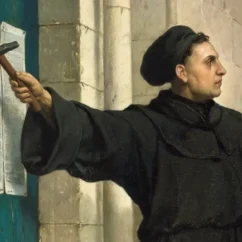
To such objections, the FSSPX representative responded by agreeing with them and seeing in them precisely the error of Luther and the Reformation.
He then clarified that the Fraternity’s position is different from the Protestant one: the refusal of certain doctrines of the Council and the post-conciliar period is not due to a conflict with their interpretation of Scripture or Tradition, but “because they are in contradiction with what the ecclesial Magisterium has already taught definitively”.
Fr. Daniele then listed a whole series of (alleged) contradictions committed by Pope Francis, Benedict XVI and John Paul II, concluding that “one must follow what the Church has always constantly taught and reject those doctrines that oppose it, even if they are proposed by the supreme authority of the Church”.
This approach is also applied to the sanctions received by the FSSPX. How is it possible to consider them “unjust” and “illicit” if they were imposed by the Church whose authority one fully recognizes?
Fr. Di Sorco’s answer is that “one thing is unjust not because I perceive it as such, but because it goes against a law”. Namely, he clarifies, “the Roman authorities threaten the Society of Saint Pius X with sanctions if it does not accept adherence to doctrines that are in opposition to what the Church has already definitively taught, that is, against divine law. One can easily understand what value such sanctions have”.
Does the FSSPX have the authority to interpret the Magisterium?
The clarifications from the FSSPX representative are understandable, however the knot remains completely unresolved.
The Fraternity rightly wants to distinguish itself from Protestantism, emphasizing that it does not base its resistance on a private interpretation of Scripture, but on the idea that the conciliar and post-conciliar Magisterium has objectively contradicted previous teachings already definitive.
However, the point remains: who has the authority to establish what objectively belongs to the deposit of faith in an irreformable way and what is instead developable or reformable?
In the Catholic Church, such authority is not entrusted to the individual believer nor to a priestly fraternity, but to the Magisterium itself, exercised in communion with the Pope. Reversing this logic means, once again, placing oneself on an equal footing of judgment with the universal Church, not subordinate to it.
Without wanting to force the connection, the reformers of the sixteenth century made exactly the same move, claiming to obey the “true Church” and accusing Rome of having gone astray. The Fraternity rightly rejects this parallel, but the ecclesiological dynamic appears very similar.
Thus, declaring the canonical sanctions “invalid”, while formally recognizing the authority of those who imposed them, amounts in practice to denying the effectiveness of the Church’s governance. One cannot say: “I recognize the Pope as supreme pastor” and at the same time add “but his decisions are null if judged contrary to what I consider Tradition”.
In this sense, neither we, nor the individual faithful, nor a single priest, nor the Society of Saint Pius X is appointed to determine the perimeter of orthodoxy, nor has the authority to identify errors or correct the Church itself.
Adherence to the Church of Rome, we wrote to Fr. Di Sorco, implies accepting that the ultimate criterion of truth does not reside in one’s own vision/interpretation of the Magisterium, but in that of the successor of Peter in unity with the college of bishops, to whom Christ entrusted the task of faithfully guarding, interpreting and transmitting Revelation.
It is precisely here that the real issue is played out: if everyone claimed the right to reject councils, papal documents or canonical sanctions in the name of a contradiction “with what the Church has always taught”, ecclesial communion would dissolve into self-referential fragments.
The risk of subjectivity
Fr. Di Sorco does not share this position, however, arguing that “the Magisterium speaks directly to our intellect. That is why a possible contradiction between two acts that both present themselves as Magisterium can quite legitimately be made by our intellect, without falling into the accusation of private examination”.
Certainly the involvement of the individual is fundamental otherwise, as the FSSPX representative rightly writes to us, “the Catholic faith would be reduced to a blind and unreasonable adherence to authority”.
However, that the Magisterium is “the proximate norm” does not mean that every faithful can evaluate in isolation the validity of a magisterial act according to his own intellect. Otherwise the door would open to private judgment and individualistic subjectivity, exactly what the Church “always” has sought to avoid.
One’s own judgment must always be placed in a context of communion and ecclesial continuity, connected to the living Tradition and the guidance of legitimately constituted pastors. Otherwise, every document, even conciliar or papal, risks becoming a mere debatable text, subject to private judgment, and the Catholic faith would lose that objective and binding character that makes it universal.
UCCR and FSSPX: a fraternal exchange
The exchange between UCCR and FSSPX was frank, animated by fraternal charity, a willingness for sincere dialogue and a desire for mutual understanding.
For the reasons set out above we continue, however, to believe that the Society of Saint Pius X is in error and, by placing itself on the same level as the Church and overestimating the authority of its own interpretation regarding the coherence of the current magisterium with the pre-conciliar one, risks following the same path as the Lutheran reformers.
History teaches that every attempt to “save the Church from the Church” has led to new divisions. Even when motivated by the best intentions.
Their participation in the 2025 Jubilee is an important step; we entrust to the Lord the possibility of a future full communion with the successor of Peter.
Author






1 commenti a The FSSPX Talks with UCCR: What Separates It from the Church?
La posizione della Fraternità Sacerdotale San Pio X (FSSPX) è molto equilibrata, da una parte riconosce l’autorità di Pietro, dall’altra continua a rimanere cattolica. Nessuna autorità, neppure la più alta può impedirci di rimanere cattolici, oppure può obbligarci a diminuire la nostra fede. Il Vaticano II ha diffuso errori gravissimi, evidentemente incompatibili con il cattolicesimo, uno per tutti il documento Dignitatis Humanae, che abbassa l’unica vera religione al livello delle false religioni e va direttamente contro al primo comandamento. Non è possibile accettare tali errori, per amore di Pietro e della Chiesa la FSSPX resiste e grazie ad essa è stata preservata la fede cattolica di sempre e l’unico rito che la esprime. Che Iddio renda merito a mos. Lefebvre ed alla FSSPX.