
Bethsaida, Archaeology Finds the City of the Apostle Peter

Where is Bethsaida? A wildfire allows us to confirm the discovery of the hometown of Peter, Andrew and Philip, identified with present-day el-Araj. It corresponds to what Flavius Josephus wrote.
A fire near the Sea of Galilee has rekindled attention on the city of Bethsaida, mentioned in the Bible.
We are in Israel, north of the Sea of Galilee and specifically at el-Araj, a locality long identified as ancient Bethsaida, the village from which, according to the Gospel of John, the apostles Peter, Andrew and Philip came.
Bethsaida, previous findings
For years archaeologist Mordechai Aviam (Kinneret College) has been directing excavations in this area and in 2019 he uncovered the first remains of a 5th-century Byzantine church.
Last year, instead, he brought to light magnificent mosaics and Greek inscriptions, one of which explicitly asks for the intercession of Saint Peter, designated as “Head and Guide of the Heavenly Messengers” and “Keeper of the Keys”, titles traditionally associated with Saint Peter.
The builders of the church had evidently recognized Peter’s house (and Andrew’s) described in the New Testament, just as happened at another important Galilean site, Capernaum. Peter, in fact, was born in Bethsaida but moved to Capernaum, the town of his wife.

Bethsaida, recent discoveries
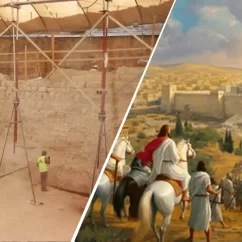
We come then to last month, August 2025, when a wildfire that developed in the area further revealed ancient remains, confirming the existence of an urban reality.
Remains of private houses, traces of public buildings, Corinthian and Doric capitals and imposing architectural elements have emerged clearly, outlining a scenario far more complex than a simple fishing village.
Prof. Aviam pointed out in an interview the correspondence between the architectural features of the site and the description provided by Flavius Josephus of the city of Julias, Bethsaida’s transformation under Philip, the tetrarch of Judea.
The Jewish historian indeed speaks of Bethsaida as a dignified city in Antiquities of the Jews, emphasizing «the number of inhabitants it contained» and its «other greatness». Evidently, the archaeologist comments, «in light of what Flavius Josephus states, Bethsaida could not have been a small village».
«The fire helped us greatly to understand the site», he explained, and the remains can be dated to the Roman period.
The flames destroyed his team’s equipment, but they also cleared the dense vegetation that had hidden large parts of the site. Thus the thesis that what was found is indeed Bethsaida has been strengthened.
Where is Bethsaida located?
For the sake of truth it must be said that el-Araj is not the only town candidate to be the site of the hometown of the first apostles.
About two kilometers away is the site of e-Tell, the first to be identified as Bethsaida since 1987. There is also a third possibility involving al-Mesydiah, but its identification is supported by few proofs.
El-Araj, on the other hand, shows evidence of occupation from the Hellenistic and Hasmonean period (2nd century BC) until the end of the Roman period (3rd century AD), when the village was probably abandoned due to rising lake levels.
Traces of an ancient Jewish settlement include various Hasmonean coins found, stone vessels (which Jews used for ritual purification) and a very limited number of pig bones.
According to the New Testament, Bethsaida was visited several times by Jesus of Nazareth himself.
Here he performed the miracle of healing a blind man (Mark 8:22–26) and the multiplication of the loaves and fishes (Luke 9:10–17). The city is also reproached by the Nazarene because it did not repent despite having witnessed numerous miracles (Matthew 11:21).
The team plans to return to el-Araj around late October, UCCR will keep readers updated on any developments.
Author








0 commenti a Bethsaida, Archaeology Finds the City of the Apostle Peter